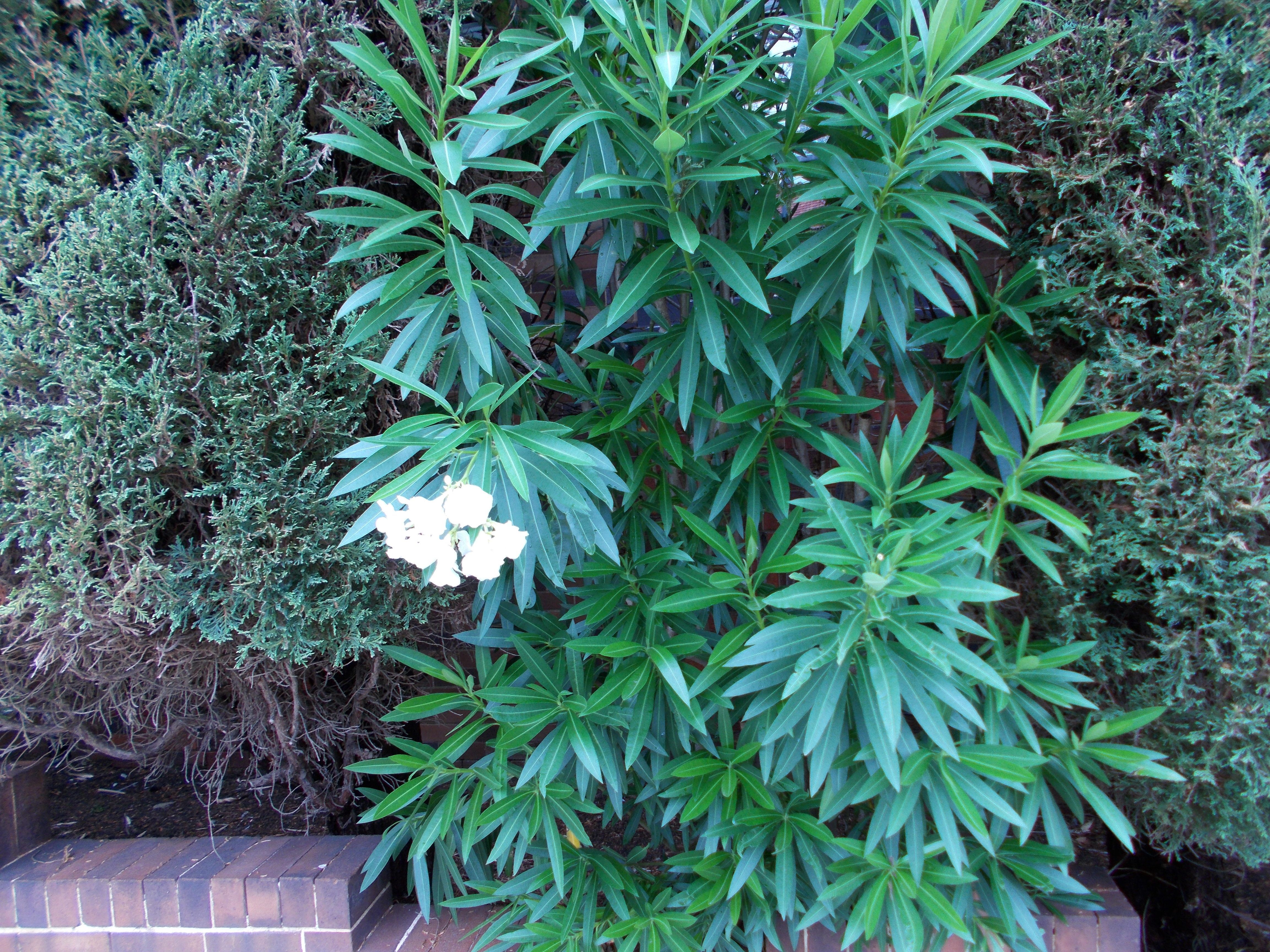
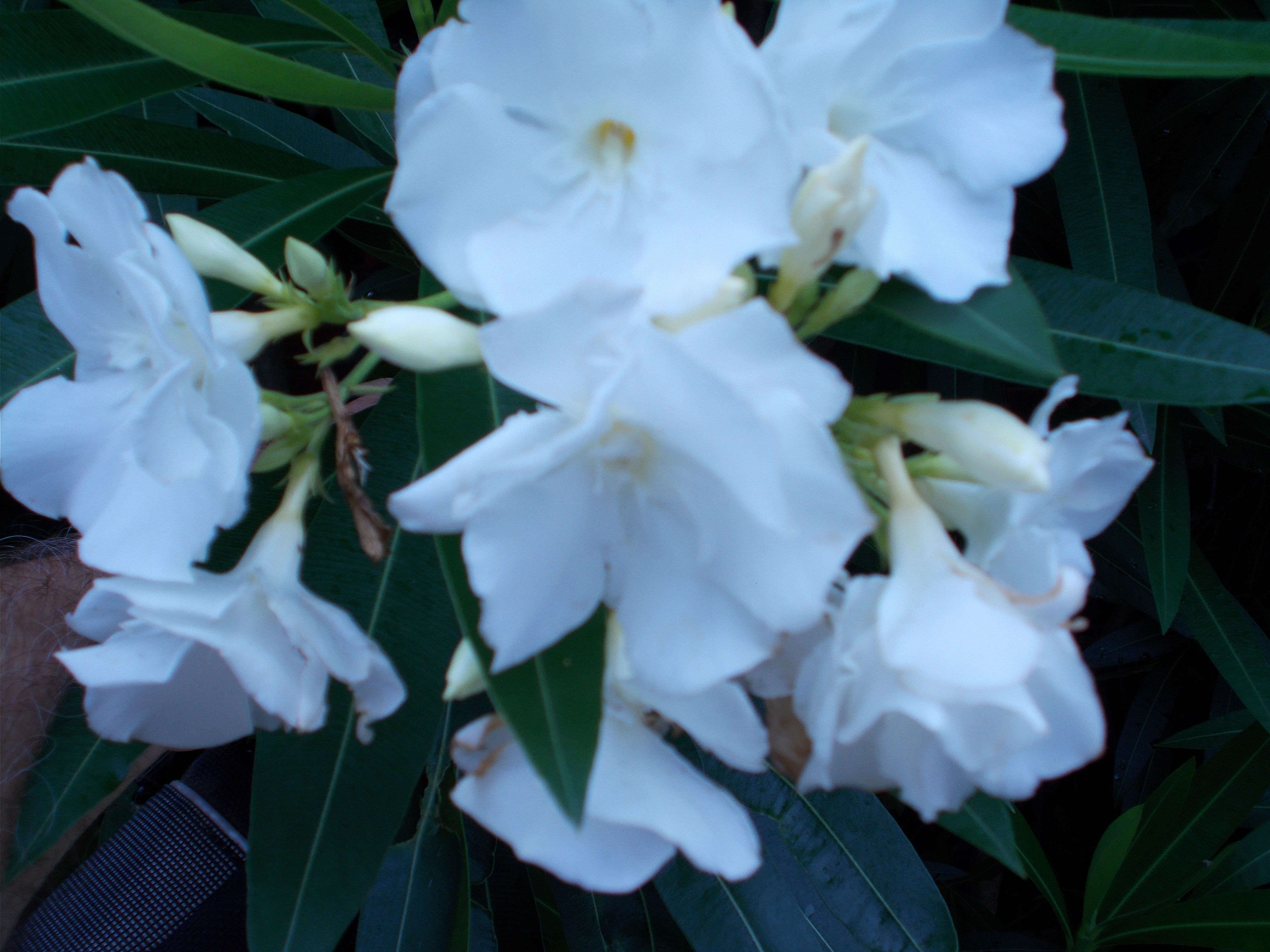
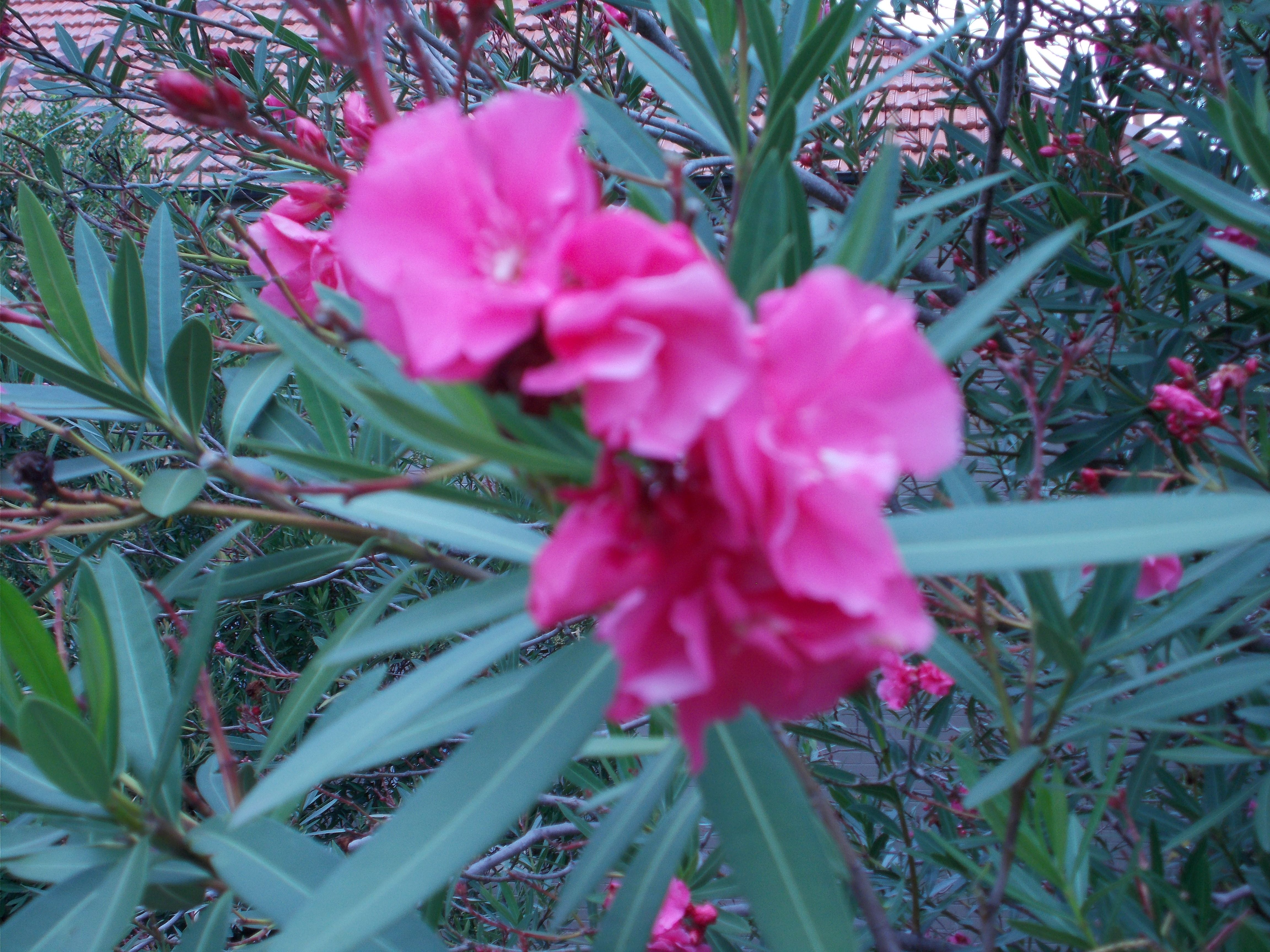
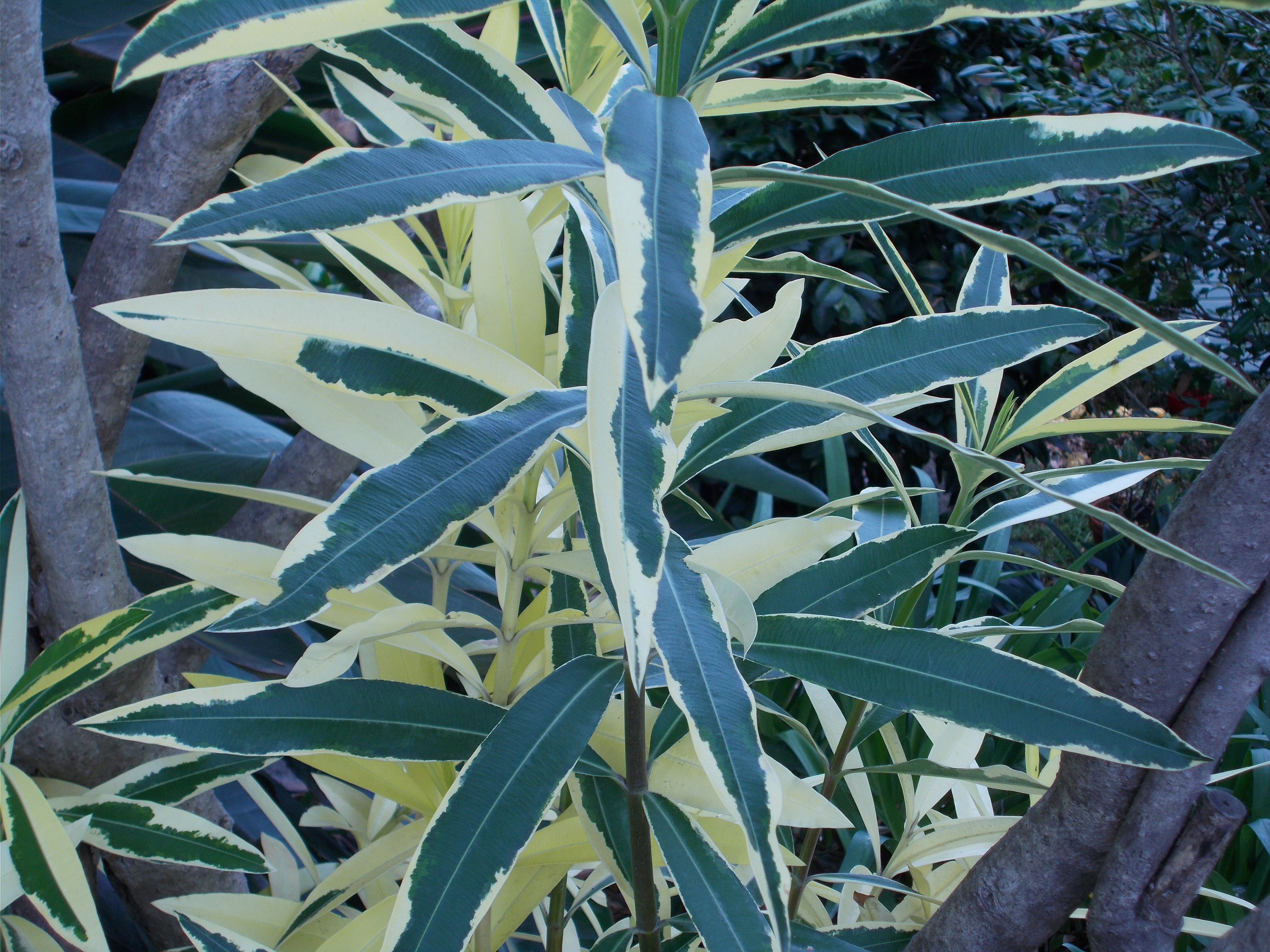
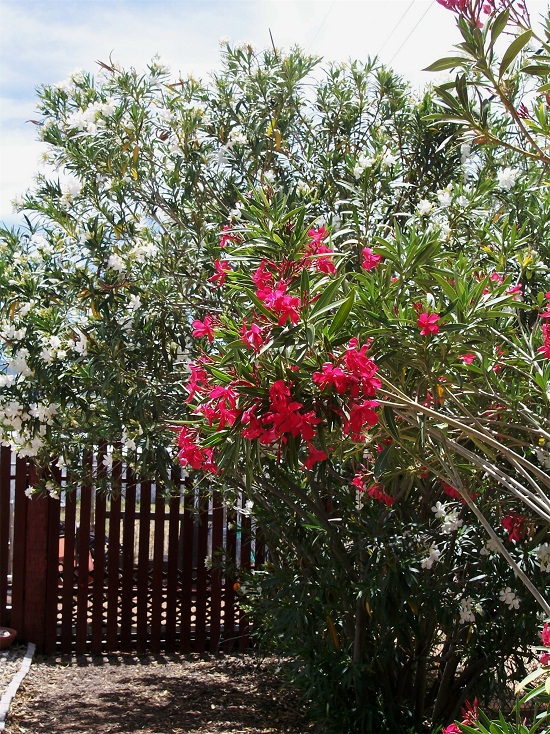
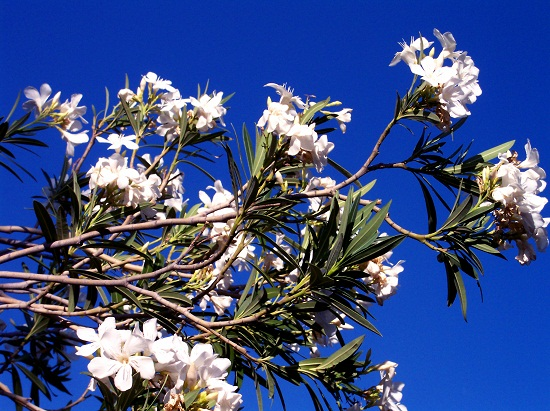
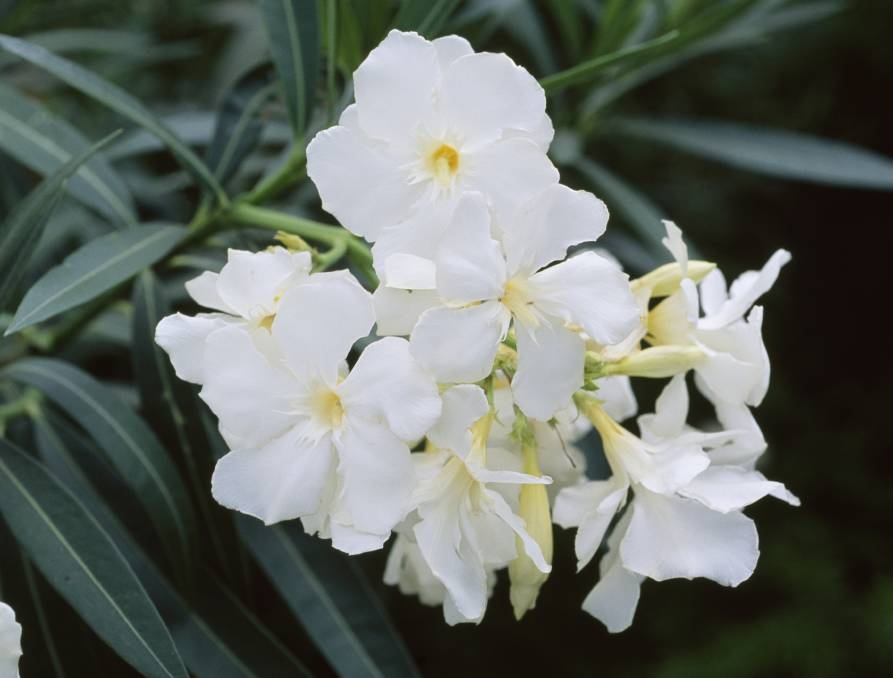
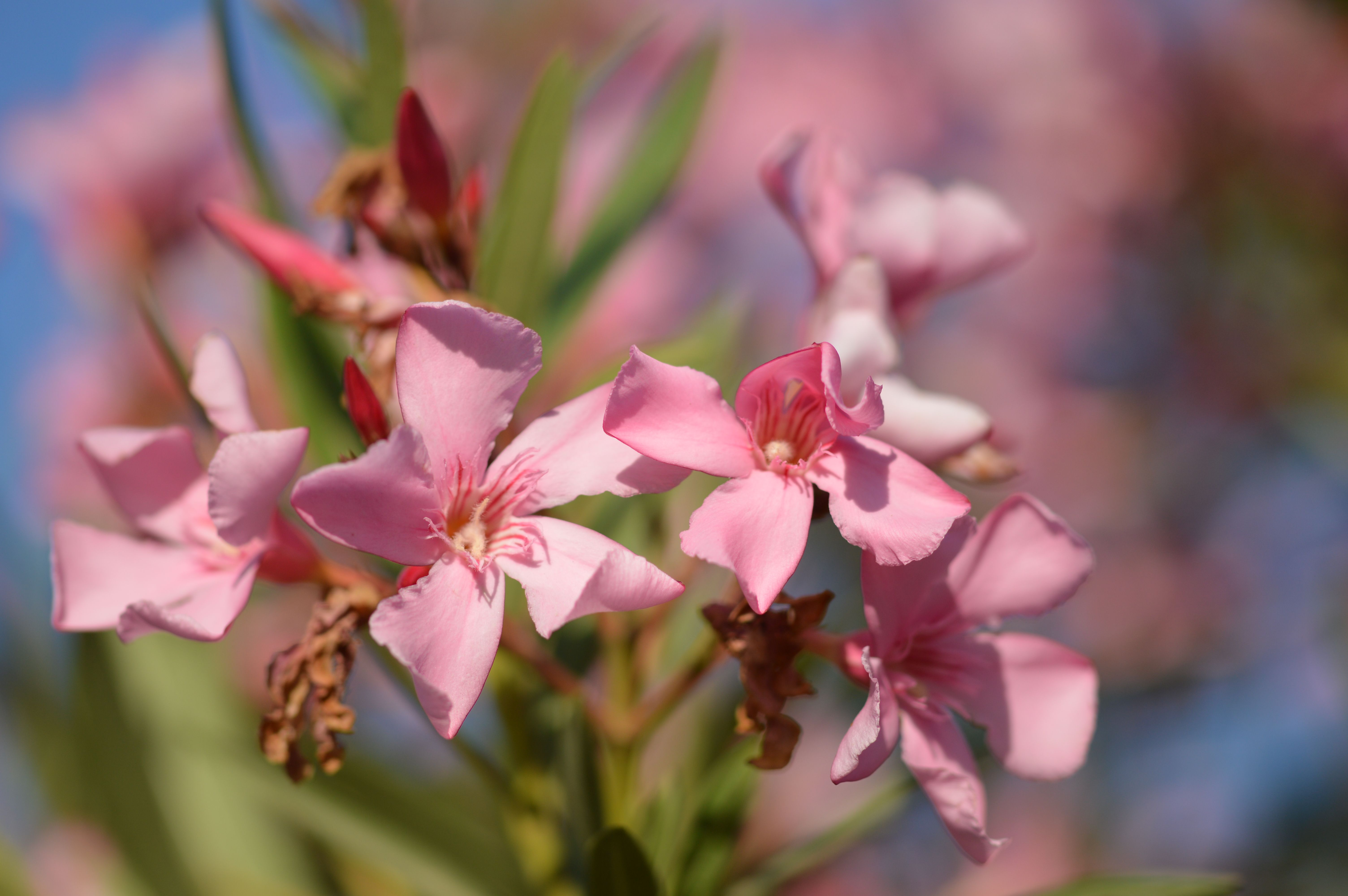
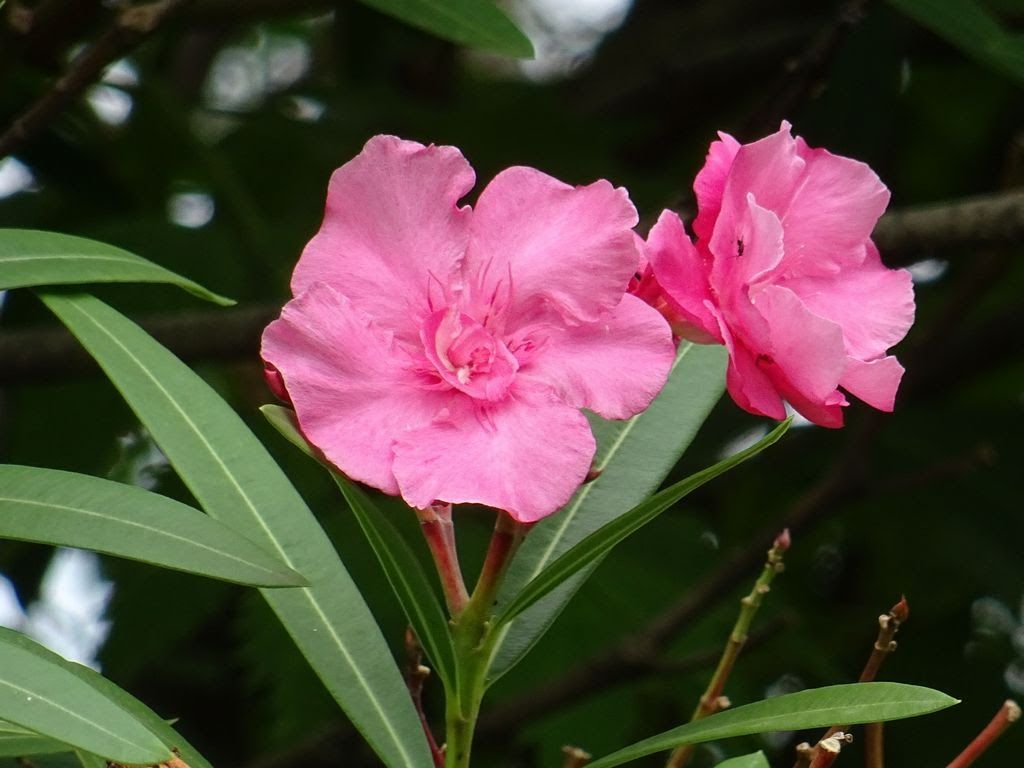
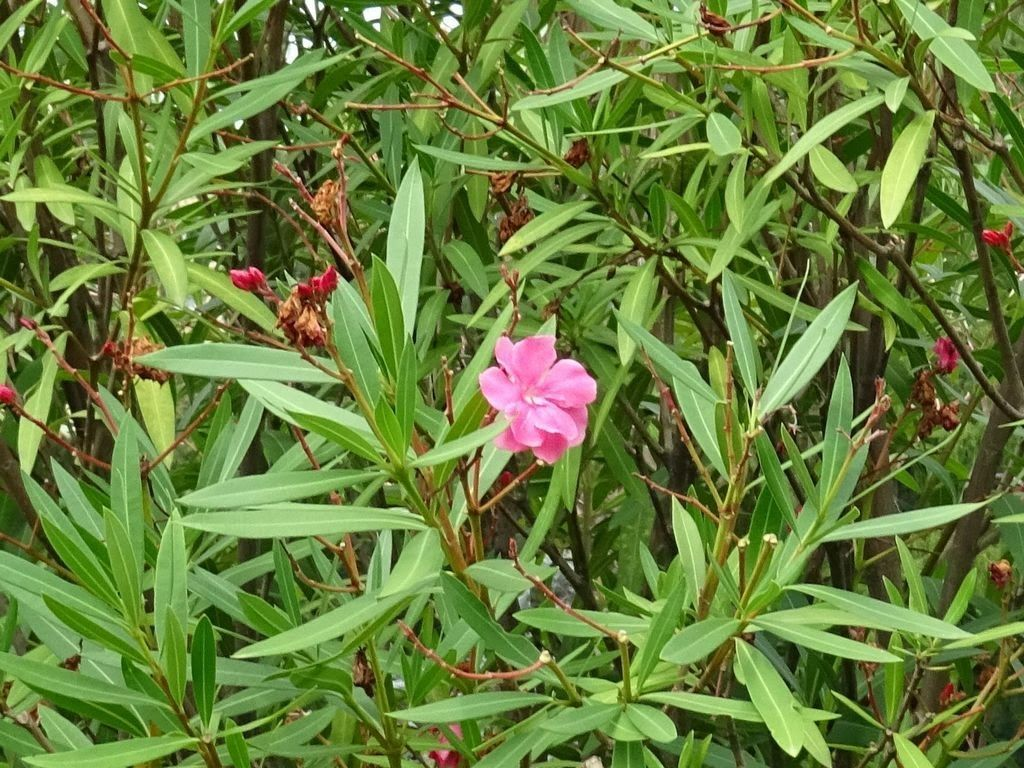
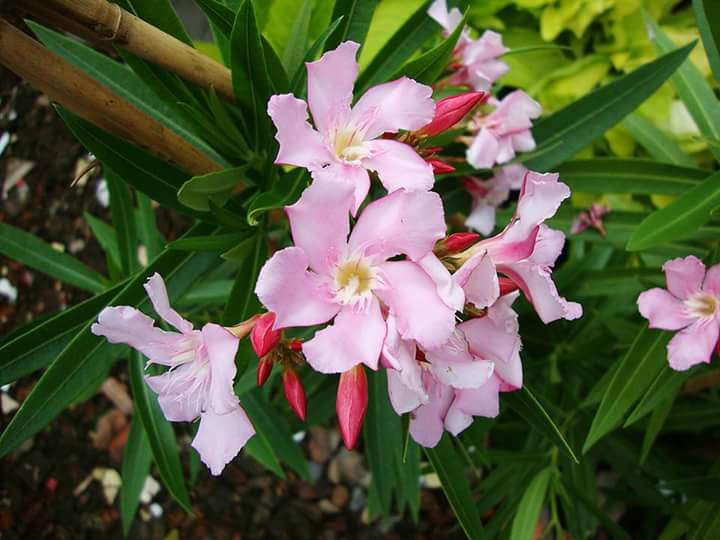
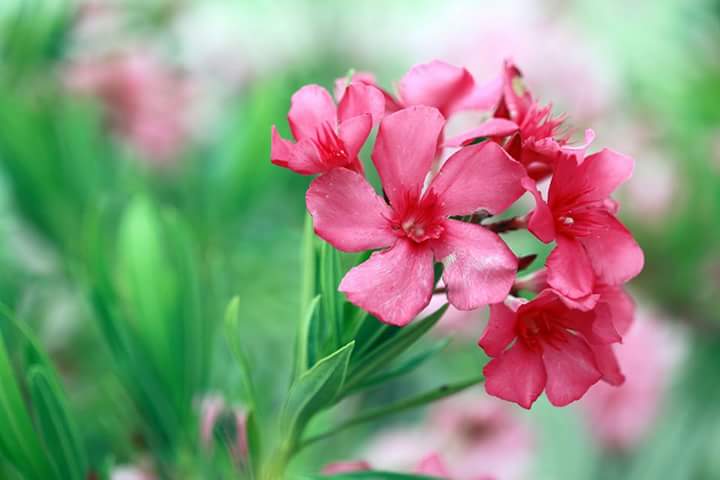
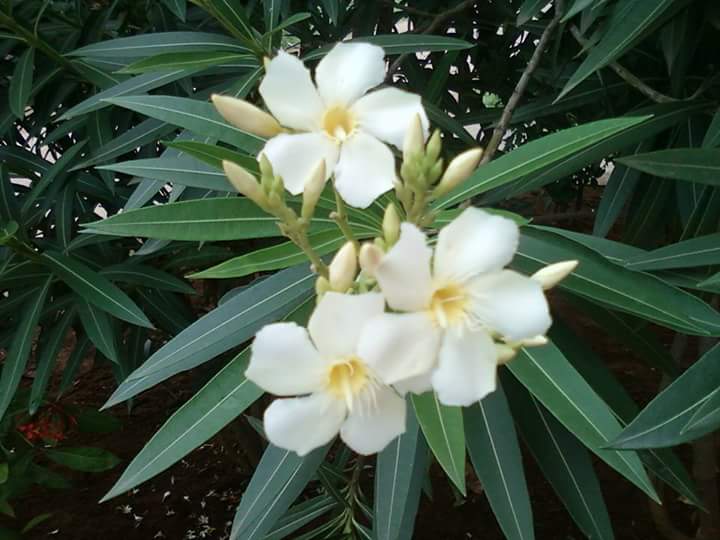
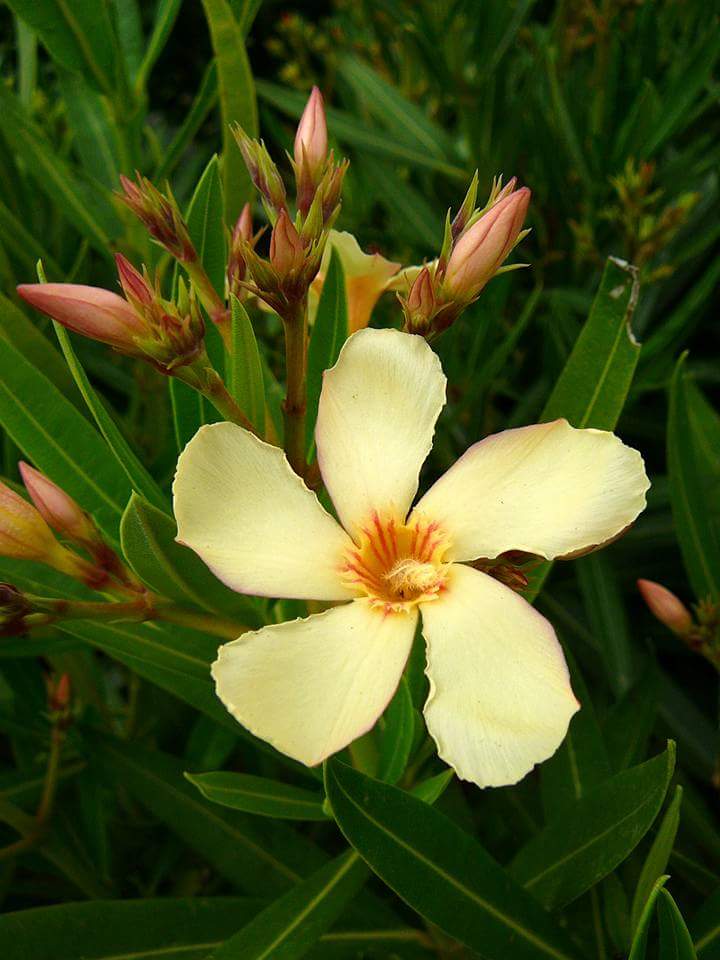
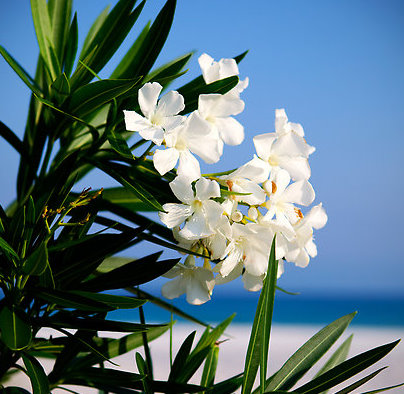
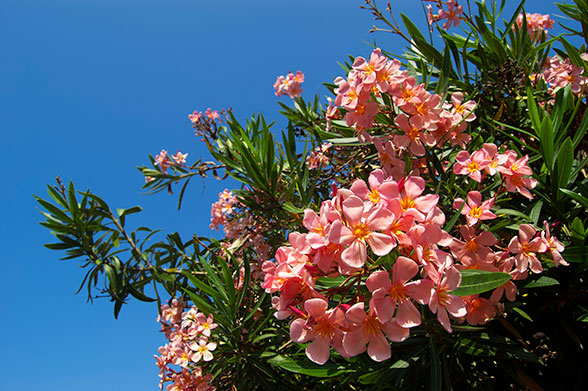
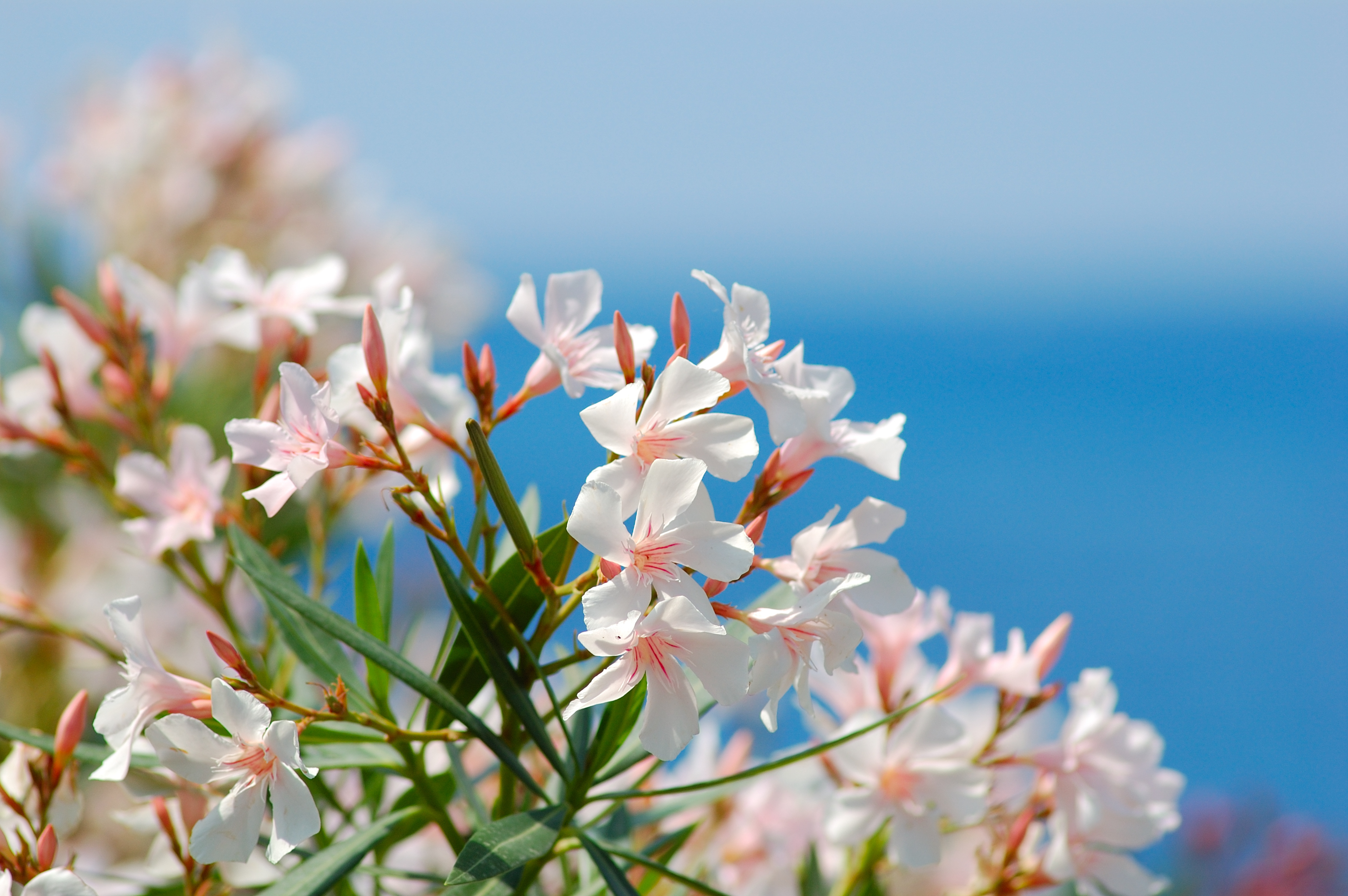
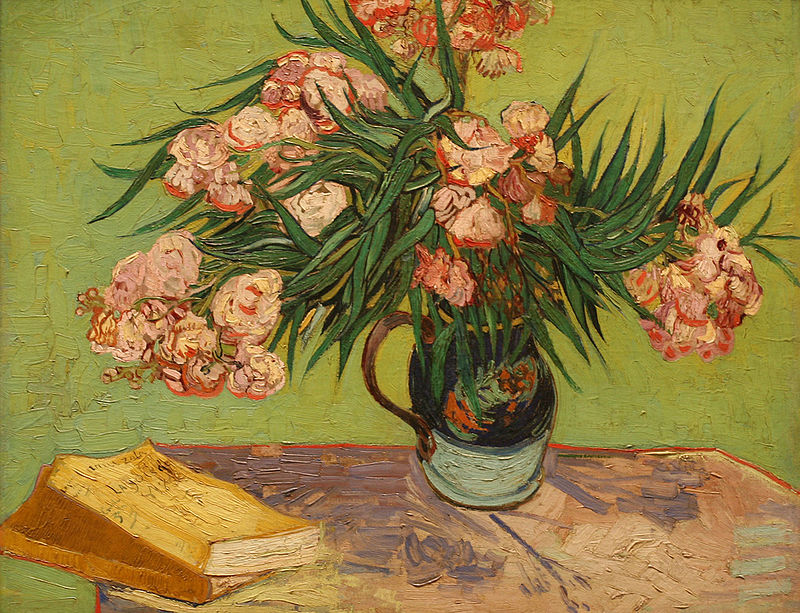
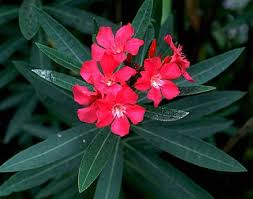
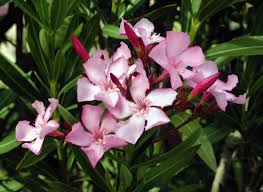
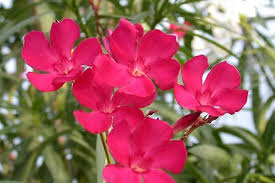
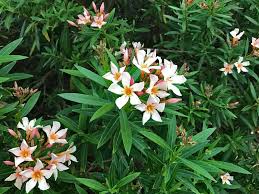
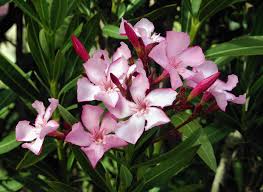
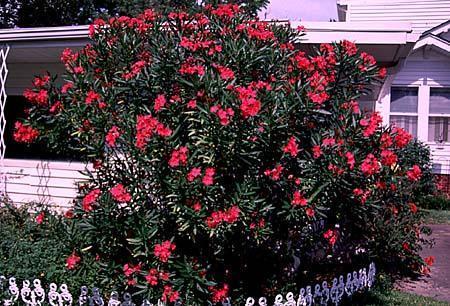
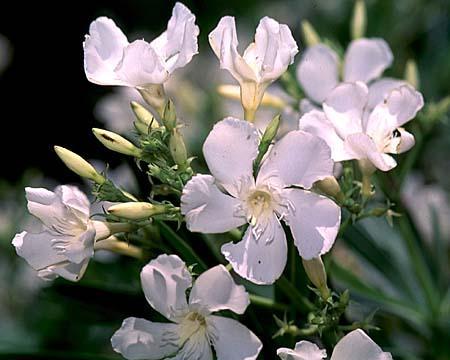
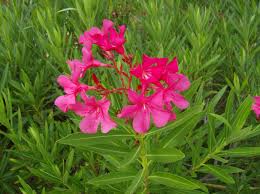
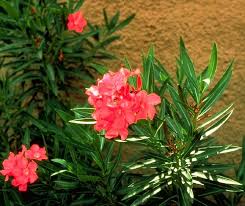
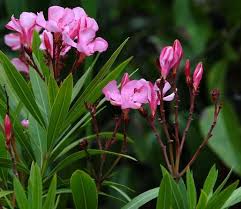
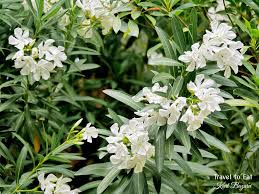
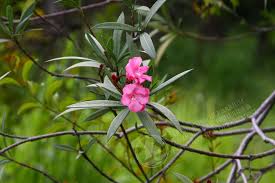
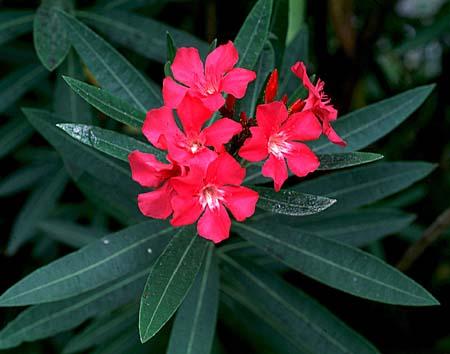
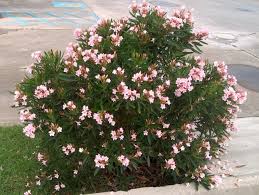
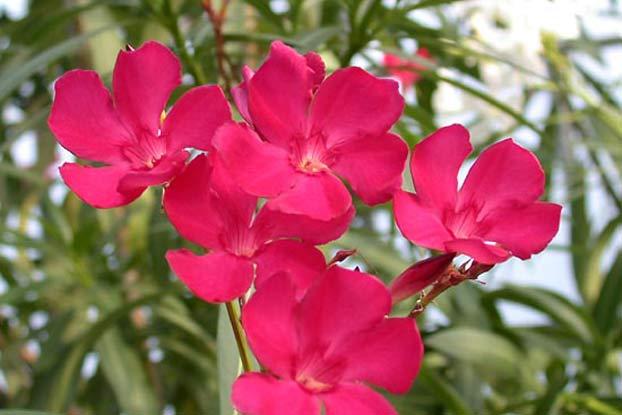
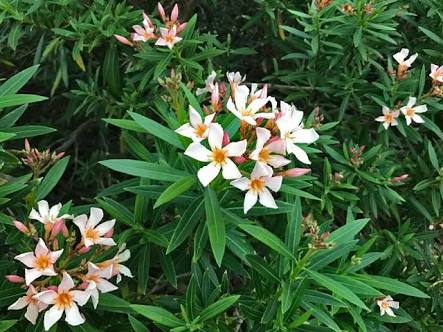
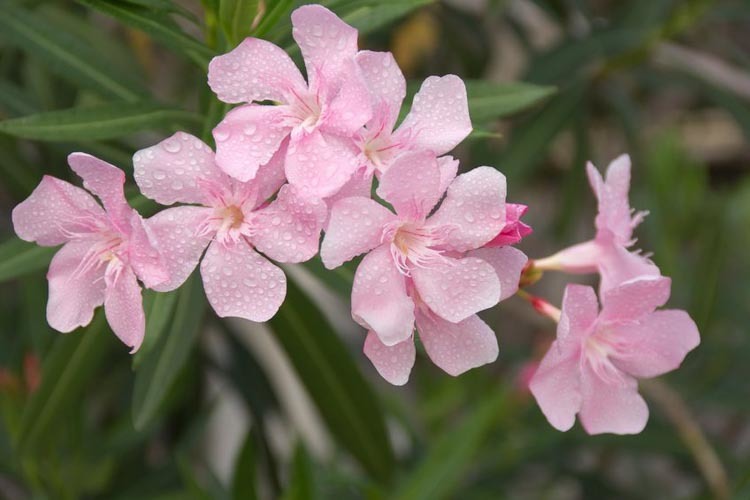
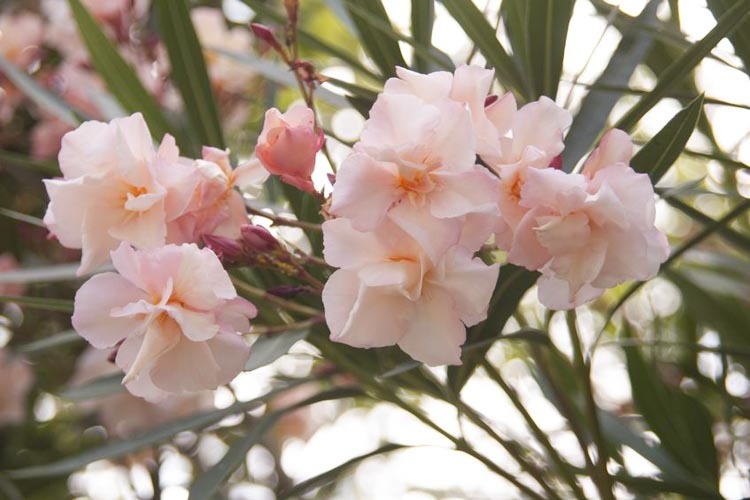
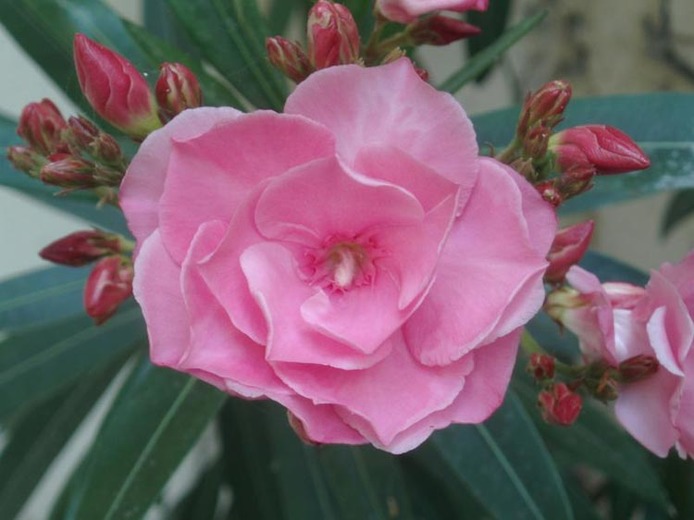
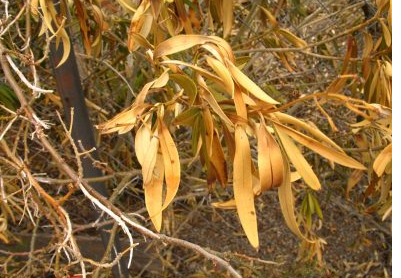
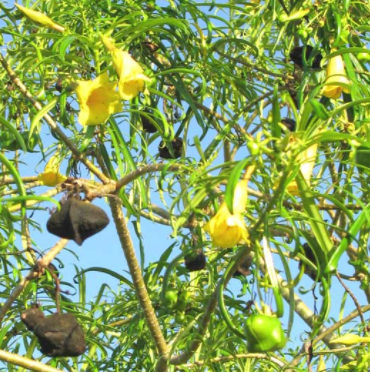
Nerium oleander (Oleander) is a large evergreen shrub or small tree suitable for warm and temperate climates. It has a good variety of flower colours, and has long shiny dark green leaves. The variegated variety has bi-colour leaves of green and yellow. Oleanders flower for most of the year, and are happiest in a full sun position. They will also tolerate coastal conditions. Once established they are very hardy. Care must be taken when handling all parts of this plant as it is toxic. Oleanders grow well in Sydney, where these photos were taken.[IMAGE: https://steemitimages.com/DQmVwbzn9qhgCRNeE1TfvovtCZECSjDE5kXznHaWzEGG9cu/NEW%203%20030.JPG] [IMAGE: https://steemitimages.com/DQmcHu78WHfiRRuc7QMgyPgxFAstebSg7bYKhisppjJyaSM/NEW%203%20031.JPG][IMAGE: https://steemitimages.com/DQmUVv52zTWBgBAe249LdiGDzzWrJQ7sAokXVioYHWqEpbG/NEW%203%20087.JPG][IMAGE: https://steemitimages.com/DQmXPLif5dQoc816hSsPmZJcC7X86MGHXoePs686nqDBdAz/NEW%203%20073.JPG]
Oleander - Beautiful but Deadly.
Replies
nice photos and very cool garden
This is really beautiful, After women, flowers are the most lovely thing God has given the world.
Magoo-2 found a series of multi accounts of a same owner is following your articles to cheat your generous rewards.
Magoo-2 found these accounts are suspicious & can be multi accounts of a single owner. Conclusion is based on last 30 days transactions:
@mumin007
@naqshab02
@muhasib
@sheikhiqra
@hariszahoor
@zahidmalik
@chaddiman
magoo-2
Check our latest multi comment spam update report
Bi colored leaf.... Now how often do u see that...😎😎😎
Wow thats beautiful and pretty, one of the major pretty things that made this world look beautiful. ;-)
a deadliest plant, proper care should be taken while cutting it, gloves should be used and should cut the lower short stems first then cut it halfway down...
Magoo-2 found a series of multi accounts of a same owner is following your articles to cheat your generous rewards.
Magoo-2 found these accounts are suspicious & can be multi accounts of a single owner. Conclusion is based on last 30 days transactions:
@mumin007
@naqshab02
@muhasib
@sheikhiqra
@hariszahoor
@zahidmalik
@chaddiman
magoo-2
Check our latest multi comment spam update report
Its amazing how u see a flower has more than one colour that blends and looks very attractive.
Its thrilling how they beautify, while some medicinal and some are healers to peoples hearts and some deadly. Hahaha. Wow.. I just can't love them enough..
And really,
[IMAGE: https://steemitimages.com/DQmRLw2P4yyn78ecMYtmsDDv8tdsBrYux9RS9r3KqpCYK15/flowers-quotes-1.jpg]

Magoo-2 found a series of multi accounts of a same owner is following your articles to cheat your generous rewards.
Magoo-2 found these accounts are suspicious & can be multi accounts of a single owner. Conclusion is based on last 30 days transactions:
@ritue
@pariza
@suchi
@maicle
@quinnpeterson
@ziaurrahma
@steemitsabbir1
@utpolbiswas
@davitone
@steemitsabbir1
magoo-2
Check our latest multi comment spam update report
[IMAGE: https://gateway.ipfs.io/ipfs/QmTXhkj1PtR6RzNZiG1FaYcxv9coFdYcAGLRQdp3hferKc]
Oleander plants (Nerium oleander) are among the most versatile of shrubs, with dozens of uses in southern and coastal landscapes. They tolerate a wide range of conditions, including difficult soil, salt spray, high pH, severe pruning, reflected heat from pavements and walls, and drought. But the one thing they can’t withstand is winter temperatures below 20 degrees Fahrenheit. However, in cooler climates, you can grow an oleander plant in a container and bring it indoors when temperatures drop.
-
How to Care for Oleander
https://gateway.ipfs.io/ipfs/Qma6Bfnoyo37AaRUhwBJ56LbPpDVgnxmPtCMxrRvEtVP1T
Oleander care is easy and this makes the shrub popular with highway departments. You’ll often see masses of oleander shrubs planted in highway beautification projects where they provide an outstanding display of long-lasting flowers with very little maintenance. Even in the garden, oleander shrubs require minimal care. Although the shrubs are drought-tolerant, they look their best when they are watered during dry spells. However, take care not to over water them. Yellowing leaves indicate that the plant is getting too much water. If the soil is poor, feed the plant lightly with a balanced fertilizer during its first spring. Once established, oleander shrubs don’t require routine fertilization. Pinching out the tips of young stems reduces legginess and encourages the shrub to branch out. Pruning oleanders can also be performed. Prune to remove damaged or diseased limbs any time and prune to shape the shrub in late fall.
Images of Oleander:
[IMAGE: https://gateway.ipfs.io/ipfs/Qmaffw7uusxaMCSGCYdXBhXRx2g4k8TDUk8ar9893PSGN5]
[IMAGE: https://gateway.ipfs.io/ipfs/QmWTNVrhFji3GkXNkDQyZTeHdHYFmNFdR3vtb2BR2gTAQ6]
[IMAGE: https://gateway.ipfs.io/ipfs/QmNTrbZyPKyYNtmTutVEu7AhbG11Rh6F23iQXDVTvffZKk]
We do have that in our garden.
But the flowers havnt come out yet ,it looks beautiful when the pink flower shows up ,spring time is best ..
[IMAGE: https://gateway.ipfs.io/ipfs/QmV2GmbFeNu7EMt5MBZBsaPycUCkQ9fwsbrGEAjABXLpJp]
you are the best in exploring these trees,you are amazing sir.great job sir once again.
@ctrl-alt-nwo, That's very beautiful leaves & flowers indeed plant introduction. I add some via web site.
Most oleander cultivars reach a height of 8 to 12 feet and spread to cover an area of about 10 feet when fully grown. Each year, a plant generally adds 1 to 2 feet to its height, although dwarf cultivars add proportionally less, depending on their mature size.
[IMAGE: https://gateway.ipfs.io/ipfs/QmXuceiFPksG9QssE99vZ1kVsx8pxVF28iWKoNhQnmhc7r]
Native to the Mediterranean region and parts of Southeast Asia, oleanders are evergreen shrubs with leathery, sword-shaped leaves and showy flowers that appear during summer in many colors, depending on the cultivar. Giving an oleander some basic care can ensure it grows at a steady rate and eventually reaches its mature size.
An oleander grows best in a spot that gets bright sun for most of the day, although it can tolerate partial shade for a few hours each day. In areas with hot, intense summer sun, the best location is one that gets full sun until early afternoon and then gets light, filtered shade during the hottest afternoon hours. An oleander plant can be damaged by cold spells, doing poorly if the temperature falls below freezing for an extended time.
[IMAGE: https://gateway.ipfs.io/ipfs/QmYCzoBSAs9LzQadBtoaT1J6XXTPdu5wXX7nZBtmUhZHB5]
Although an established oleander requires little or no fertilizing, feeding a young plant can maximize its growth rate and help it mature quickly. Feeding is best done in early spring, when new growth first appears, and again in early fall, to help the plant store nutrients for the next season.
[IMAGE: https://gateway.ipfs.io/ipfs/Qmd6JYwdp3ByC7dWaX3s2po1F51C8nokhWJtbcSVQHqHj9]
Source: http://homeguides.sfgate.com/growth-rate-oleander-plants-75907.html
Oleander (Nerium oleander) is a plant of the genus Zakkumgiller. It is also known as the flower of hell that grows in warm regions and loves warmth. along the coastline of the Mediterranean region, while Turkey is grown in West and South.
§§§§§§§§§§§§§§§§§§§§§§§§§§§§§§§§§§§§§§§§§§§§§§§§§§§§§§§§§§§§§§§
http://www.nkfu.com/wp-content/uploads/2013/02/zakkum-14.jpg
§§§§§§§§§§§§§§§§§§§§§§§§§§§§§§§§§§§§§§§§§§§§§§§§§§§§§§§§§§§§§§§
Its length can usually be 2-3 meters, sometimes up to 5 meters. It is a common tree with no leaves in winter. It grows naturally in parks and gardens, as ornamental plants. There are beautiful flowers in red or pink color.
§§§§§§§§§§§§§§§§§§§§§§§§§§§§§§§§§§§§§§§§§§§§§§§§§§§§§§§§§§§§§§§
[IMAGE: https://steemitimages.com/DQmZ2vXKXUQpWaQ628Cva1s4brgZx1C2TVAQFmGm4f9yZ2B/image.png]
§§§§§§§§§§§§§§§§§§§§§§§§§§§§§§§§§§§§§§§§§§§§§§§§§§§§§§§§§§§§§§§
Oleander is a poisonous plant. Leaves contain resin, glucose, tannin, vitamin C and a glycoside called oleandrin. Its shells contain volatile and fixed oils, a resinous compound and glycosides. Seeds also contain many glycosides. It is very toxic and should be kept away from children's leaves. Even when 1 gram of leaf is defeated, it can lead to significant poisoning.
§§§§§§§§§§§§§§§§§§§§§§§§§§§§§§§§§§§§§§§§§§§§§§§§§§§§§§§§§§§§§§§
[IMAGE: https://steemitimages.com/DQmdZEAW34ZB5VPE3MhnJQ4jvdHGEWfVm4v48WBAio7BGDj/image.png]
§§§§§§§§§§§§§§§§§§§§§§§§§§§§§§§§§§§§§§§§§§§§§§§§§§§§§§§§§§§§§§§
[IMAGE: https://steemitimages.com/DQmQG95N7fFxJsiQ7tVu5QQddgrCSUYwJ4hERwoysZTBDxg/image.png]
§§§§§§§§§§§§§§§§§§§§§§§§§§§§§§§§§§§§§§§§§§§§§§§§§§§§§§§§§§§§§§§

[IMAGE: https://steemitimages.com/DQmdLLtD2Du9oS19ptmgnuSuUEP1js9PGH6REWq6zmoCGWd/rawImage.jpg]
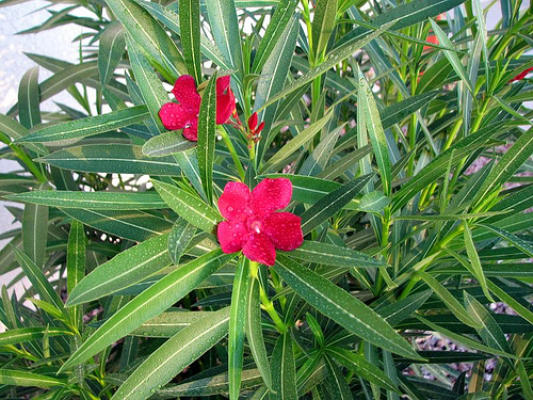
Oleander is an ornamental shrub with attractive characteristics from flower to stems. The plant is an erect evergreen shrub with lovely flower clusters of pink flowers. Each flower has 5 spreading petals.The flower clusters are supported by the plant’s slender stems. Lance-shaped with leathery texture and pointed tips refer to the plant’s leaves.
[IMAGE: https://steemitimages.com/DQmRTQpEp4pTEjyWKSRFf2bnijYt7xrkthaHjENagWZP5Qr/nerium-oleander-n4.jpg]
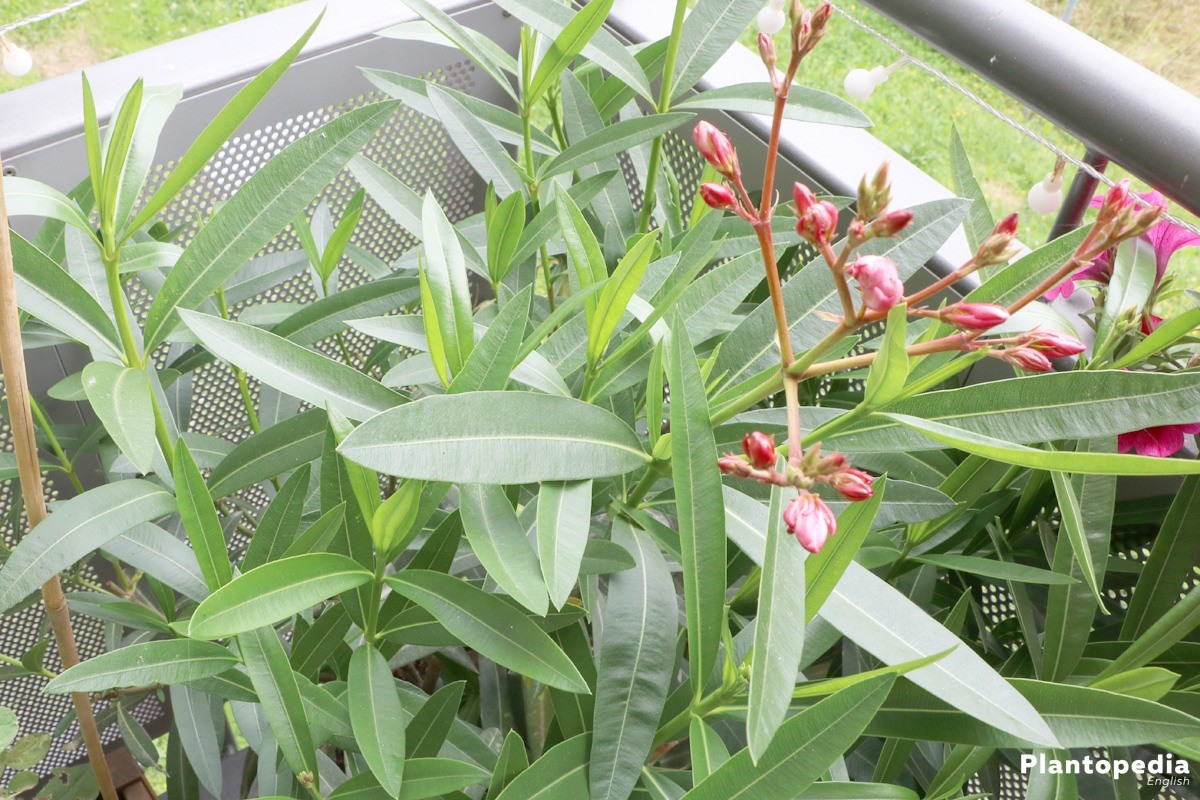
If the flowers come in clusters, the leaves come in groups of 2 or 3 along the branch.
Oleanders are so well known to both northern and southern gardeners, they need little introduction or description.They are grown everywhere in the South, and at one time ranked with hydrangeas as northern house plants. For some obscure reasons, oleanders faded from popularity some years ago, but they are now making quite a comeback. Give these plants well-drained soil, full light, and plenty of fresh air.
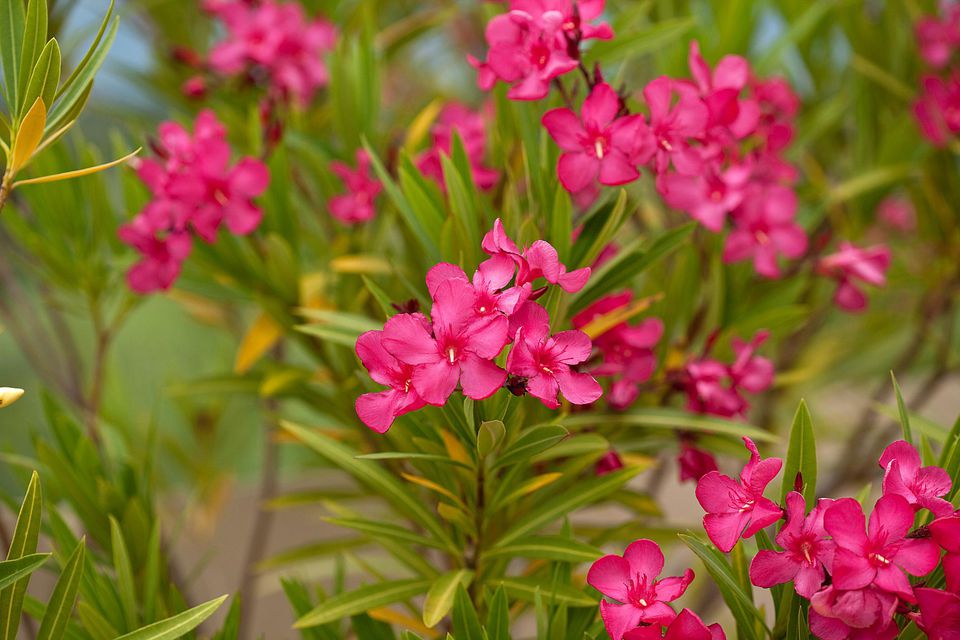
Lot of various Olenders plants has around the world. Thanks.
The oleander tree is bushy one and reaches up to 10-12 ft in height. It has small stem with multiple branches and each branch has three pair of 6-8 inch long leaves. Those leaves are completely green, smooth, shiny even rough. Oleander flowers are found in different shades like pale pink, dark pink, red, white and yellow even. The trees are grown in temples, gardens, parks and also used as the ornamental plant. It bears flowers throughout the year; while the yellow oleander gives the illusion of having spring and rainy season at the same time.
[IMAGE: https://steemitimages.com/DQmUQR7RXFQcGSBTB8SkvES7f3zxc9L6x1aXHjDMPv659kv/oleander.jpg]
10 Health benefits of Oleander-
1. For Heart pain-
2. As a toothbrush-
3. For Headache-
4. For Piles-
5. As a face pack-
6. For Joint pain-
7. For snake bite
8. For eczema
9. For Contagious diseases-
10. For Itching-
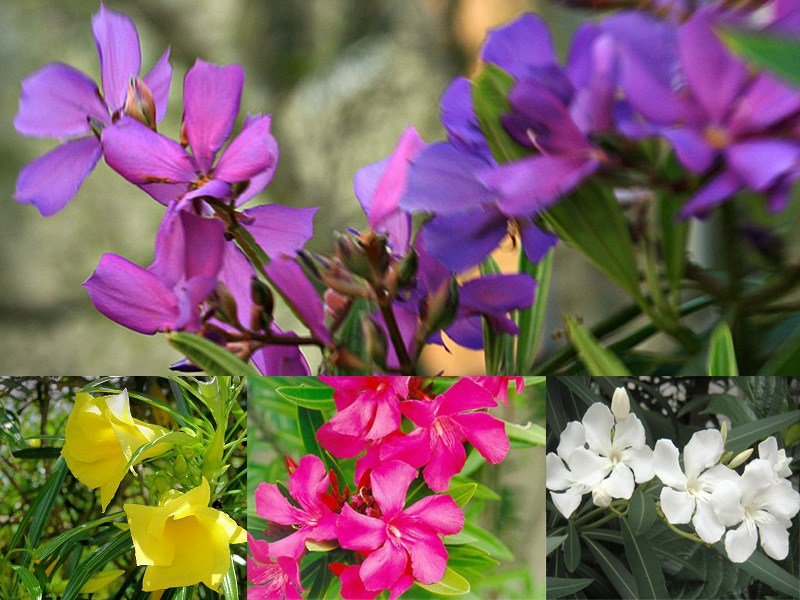
Yes, I heard about this plant. It's beautiful though, but I would not risk growing it. All parts of the plant are poisonous, which is associated with the content in them of oleandrin, cornerine and other cardiac glycosides. Oleander juice, ingested, causes severe colic in humans and animals, vomiting and diarrhea, and then leads to serious problems in the activity of the heart and central nervous system. The cardiac glycosides contained in it can cause cardiac arrest. In connection with the poisonousness of the plant, it is not recommended to place it in children's institutions.Thanks for the useful information .
http://www.terraforma.ae/shop/wp-content/uploads/2014/05/SHNO_2.jpg
http://www.terraforma.ae/shop/product/nerium-oleander-oleander/
Botanical Information: From Zakkumgiller family; It is a plant that grows up to 5 meters in height. It does not shed its leaves in winter months. It's often branched. The flowers are pink. Fruit is in the form of capsules, poisonous. It should not be used in home remedies.
[IMAGE: https://steemitimages.com/DQmWmYP4FHvweA3z6xVEtwwCBy1GoDw2NFU9Zgkx6yohwAS/image.png]
Cultivated Places: It grows in our dominant lands of Mediterranean climate.
Known Composition: The leaves have resin, tannin, glucose, vitamin C and a glycoside called oleandrin. Shells and seeds also have effective ingredients.
Benefits:
If used externally, the muscle will relieve the pain. Scorpion and bee sting is useful. If it is used in low doses, it strengthens the heart, it excretes urine in abundant quantities. Empty the water that accumulates in the body.
[IMAGE: https://steemitimages.com/DQmZ2sytS56tMMyrYEfV2aC9rzUap5TDDQZK7ctmLfa6MMd/image.png]
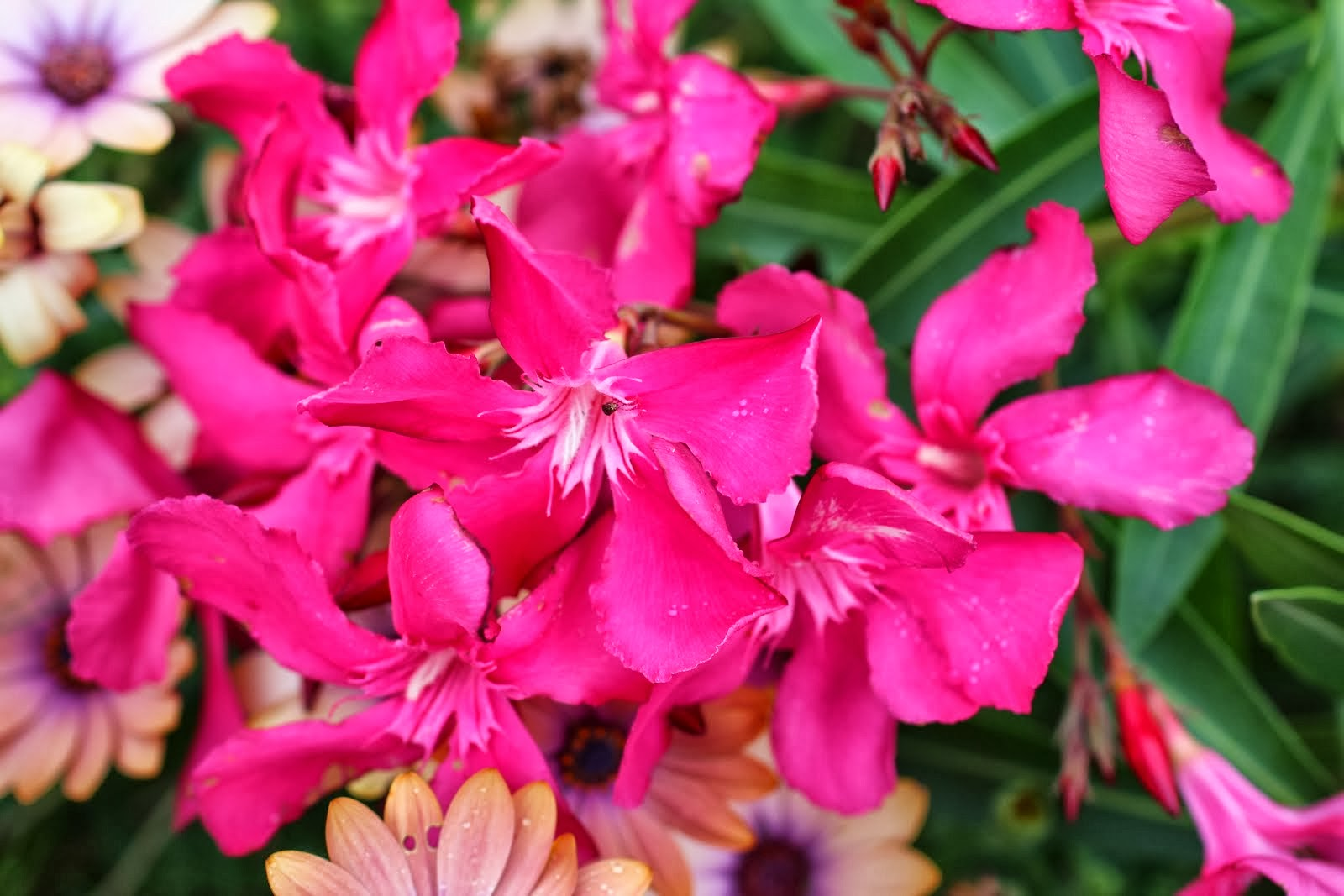
WARNING: It is poisonous and should be used with caution.
[IMAGE: https://steemitimages.com/DQmcBQDN45yAnJxyFzrmwHAUDxFWmE87SkujfwBHRc7EaGD/image.png]
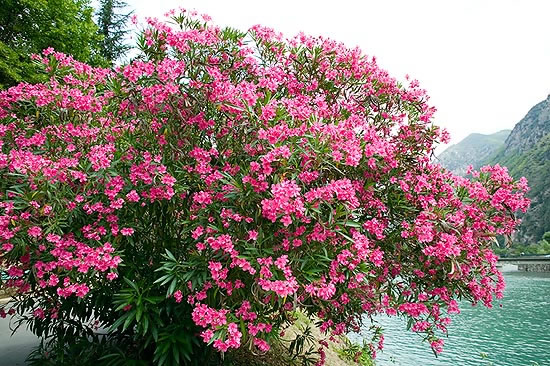
Oh.... Theyre beautiful to behold...
Oleanders have long, narrow, dark green leaves that are typically four to six inches long and less than an inch wide. The showy flowers are either single or double and range from white through yellow, peach, salmon and pink to deep burgundy red. They flower from summer to fall. Oleanders are drought tolerant and will even tolerate salty spray, making them useful for planting near the ocean. They are hardy in USDA zones 8 through 10, although they occasionally get frost bit in zone 8 and die back to the roots. They come back the next spring, however.
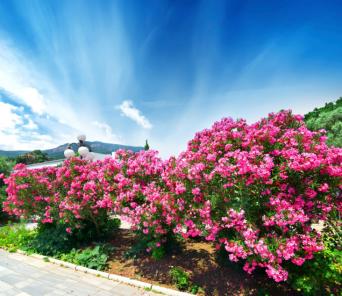
Given how poisonous oleanders are, you may be wondering why anyone would plant them. They are drought and sea salt tolerant so are often planted along highways in beautification projects.They grow quickly, one to two feet a year, and can quickly become a thick hedge or a small tree. Most oleanders grow to be between eight and 12 feet tall and just as wide. Dwarf varieties stay three to five feet tall and just as wide. Occasionally, a protected tree may reach 20 feet. Their showy blossoms make them an ideal accent piece in the garden
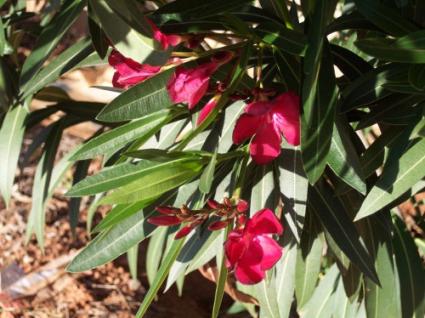
Known in ancient texts as “the desert rose,” historical references show that 15th century B.C. Mesopotamians trusted in the healing benefits of oleander extracts. From a remedy for hangovers to a herb studied for cancer, the Babylonians, Romans, Arabs and ancient Greeks alike used this herbal extract for a variety of health concerns.
Oleander, also known as laurier rose, dogbane and rosebay, is native to the Western Himalayas. It is an incredibly hardy, adaptable plant which grows thick and green in mountainous climates.
Quickly growing, this plant bears clusters of lovely pinkish-white and red flowers in the spring time. Traditionally, oleander leaf has been used to treat a number of health conditions. If you live in the southern United States, chances are you or your neighbors may have some growing in the yard.[IMAGE: https://steemitimages.com/DQme5wmRdQxCXTgu6xrVrKvbDKei8su4K8S5fHMuWV8hj2k/oleander_bush.jpg]
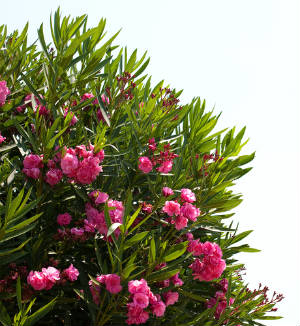
I am medicenal professional i investigate that oleander is a shrub thats used for medicenal perposes.
I also like it due to its beauty of flowers &leaves.
The Origins of Oleander
Known in ancient texts as “the desert rose,” historical references show that 15th century B.C. Mesopotamians trusted in the healing benefits of oleander extracts. From a remedy for hangovers to a herb studied for cancer, the Babylonians, Romans, Arabs and ancient Greeks alike used this herbal extract for a variety of health concerns.
Oleander, also known as laurier rose, dogbane and rosebay, is native to the Western Himalayas. It is an incredibly hardy, adaptable plant which grows thick and green in mountainous climates.
Quickly growing, this plant bears clusters of lovely pinkish-white and red flowers in the spring time. Traditionally, oleander leaf has been used to treat a number of health conditions. If you live in the southern United States, chances are you or your neighbors may have some growing in the yard.
Modern studies show that while no single chemical component of the extract can be stated as the sole source of its health benefits, the powerful activity of the plant comes from a highly complex amalgamation of components held within the combined form of the extract. These components work synergistically to boost and stimulate the human immune system, offering support for a wide variety of health concerns.
Oleander can be found throughout the world in tropical and subtropical locations. It's originally from Asia, but has become a popular landscape plant in warm climates of North America. The reason for its popularity is the beautiful clusters of flowers that grow at the end of each branch. It's also hardy and drought tolerant.
https://s3-us-west-2.amazonaws.com/media-tentree-com/wp-content/uploads/2017/03/idNjZlMDJjMzlhNGJk-e5ed9d6ae84356a2e7113765141c54a1.jpg
If eaten, the poisonous effects of this plant can be felt almost immediately. It targets the gastrointestinal and cardiac systems with symptoms of blurred vision, irregular heartbeat, nausea, vomiting, drooling, and bloody diarrhea. Every single part of this plant is poisonous. There have even been cases of people being poisoned by inhaling the smoke from burning oleander.
[IMAGE: https://steemitimages.com/DQmPUW3bz8FbNCg9RWpCc42enLoptmEz8pxeVbdq8uAdgrh/image.png]
nice post
magoo-2 found a series of multi accounts of a same owner is following your articles to cheat your generous rewards.
magoo-2 found these accounts are suspicious & can be multi accounts of a single owner. Conclusion is based on last 30 days transactions:
@moniristi, @shishiristi
magoo-2
Check our latest multi comment spam update report
Oleander: Beautiful but Deadly to Pets
Nerium oleander is a popular ornamental garden plant due to its beauty and tolerance of poor soil and drought, but unfortunately it’s very toxic to many species of animals.
Dogs, cats, goats, cattle, sheep, camelids, budgerigaries, rabbits and horses are all species that have been affected by oleander. Studies indicate mice, rats and chickens may be more resistant to the cardiac effects of Oleander; however, at higher doses neurological signs may be seen in these animals.
Mechanism of Action
Oleander contains cardiac glycosides, which inhibit the sodium/potassium ATPase pump, causing hyperkalemia and also increased intracellular calcium leading to early depolarization, cardiac irritability and arrhythmias.
Last but not least, glycosides decrease sympathetic tone and increase vagal tone, resulting in bradycardia and heart block.
Clinical signs may include:
Gastrointestinal (vomiting, diarrhea)
Arrhythmias (bradycardia, tachycardia, ventricular tachycardia, premature ventricular contractions, AV block)
Blood pressure changes (hypotension or hypertension)
Neurological signs (lethargy, depression, ataxia, tremors, seizures)
Dehydration
Shock
Laboratory Findings
Hyperkalemia is the most common; however, hypoglycemia has been reported as a direct result of the toxins.
Due to potential severity of signs, other changes such as hemoconcentration, prerenal azotemia and electrolyte abnormalities may be seen secondary to the gastrointestinal effects and/or poor perfusion.
Treating the Asymptomatic Pet
If the pet has presented without symptoms and is a recent exposure (generally three hours or less post exposure), emesis may be considered. Activated charcoal also should be considered, with repeated doses considered in large exposures.
Monitor the patient in hospital for a minimum of 12 hours. If signs develop, they may last up to three days. Encouraging passage of plant material, particularly in large exposures, is advised. Obtaining baseline electrolytes, glucose, and biochemistry profile is ideal.
Treating the Symptomatic Pet
Manage vomiting with an antiemetic if needed.
Administer IV fluids with a balanced electrolyte solution (avoid calcium containing fluids) for rehydration and cardiovascular support.
Evaluate and address cardiovascular signs—typically hypotension is secondary to arrhythmias. Atropine is appropriate for bradycardia or AV block, lidocaine for tachyarrhythmias.
Benzodiazepines may be used for seizures.
Hyperkalemia may need to be addressed with sodium bicarbonate or insulin/dextrose therapy.
https://s-media-cache-ak0.pinimg.com/originals/bb/d0/56/bbd056983b7347662ead730cb0778b49.jpg
White Oleander a beautiful but deadly flowers
https://www.haus-garten-magazin.de/wp-content/uploads/2018/02/oleander.jpg
Nerium oleander is a popular ornamental garden plant due to its beauty and tolerance of poor soil and drought, but unfortunately it’s very toxic to many species of animals.
https://s3-us-west-2.amazonaws.com/media-tentree-com/wp-content/uploads/2017/03/idNjZlMDJjMzlhNGJk-e5ed9d6ae84356a2e7113765141c54a1.jpg
Dogs, cats, goats, cattle, sheep, camelids, budgerigaries, rabbits and horses are all species that have been affected by oleander. Studies indicate mice, rats and chickens may be more resistant to the cardiac effects of Oleander; however, at higher doses neurological signs may be seen in these animals.
Mechanism of Action
Oleander contains cardiac glycosides, which inhibit the sodium/potassium ATPase pump, causing hyperkalemia and also increased intracellular calcium leading to early depolarization, cardiac irritability and arrhythmias.
https://img.etsystatic.com/il/94a696/943576668/il_fullxfull.943576668_bqvy.jpg?version=0
Last but not least, glycosides decrease sympathetic tone and increase vagal tone, resulting in bradycardia and heart block.
Clinical signs may include:
Gastrointestinal (vomiting, diarrhea)
Arrhythmias (bradycardia, tachycardia, ventricular tachycardia, premature ventricular contractions, AV block)
Blood pressure changes (hypotension or hypertension)
Neurological signs (lethargy, depression, ataxia, tremors, seizures)
Dehydration
Shock
Laboratory Findings
Hyperkalemia is the most common; however, hypoglycemia has been reported as a direct result of the toxins.
http://2.bp.blogspot.com/-YLf-6scxsrM/TuL8LkVHSxI/AAAAAAAASSw/uOB7JZ-yjtg/s1600/oleander.jpg
Due to potential severity of signs, other changes such as hemoconcentration, prerenal azotemia and electrolyte abnormalities may be seen secondary to the gastrointestinal effects and/or poor perfusion.
Treating the Asymptomatic Pet
If the pet has presented without symptoms and is a recent exposure (generally three hours or less post exposure), emesis may be considered. Activated charcoal also should be considered, with repeated doses considered in large exposures.
Monitor the patient in hospital for a minimum of 12 hours. If signs develop, they may last up to three days. Encouraging passage of plant material, particularly in large exposures, is advised. Obtaining baseline electrolytes, glucose, and biochemistry profile is ideal.
http://www.jahannews.com/images/docs/000504/n00504941-b.jpg
Treating the Symptomatic Pet
Manage vomiting with an antiemetic if needed.
Administer IV fluids with a balanced electrolyte solution (avoid calcium containing fluids) for rehydration and cardiovascular support.
Evaluate and address cardiovascular signs—typically hypotension is secondary to arrhythmias. Atropine is appropriate for bradycardia or AV block, lidocaine for tachyarrhythmias.
Benzodiazepines may be used for seizures.
Hyperkalemia may need to be addressed with sodium bicarbonate or insulin/dextrose therapy.
Specific antagonist: digibind (if available).
Whilst in greece i took several cuttings of Nerium Oleander.
These survived the journey home in my suitcase and i am attempting to root these in water....this should take around 3 to 4 weeks then I can pot them up as a holiday momento 💖💔
The cuttings have been stripped of lower leaves and the top most softer tips removed to prevent wilting. .
[IMAGE: https://steemitimages.com/DQmYeqynzeAz19vycSMkFtbYWdYfuDejhkmZjqejNjA9gNa/FB_IMG_1522994954003.jpg]
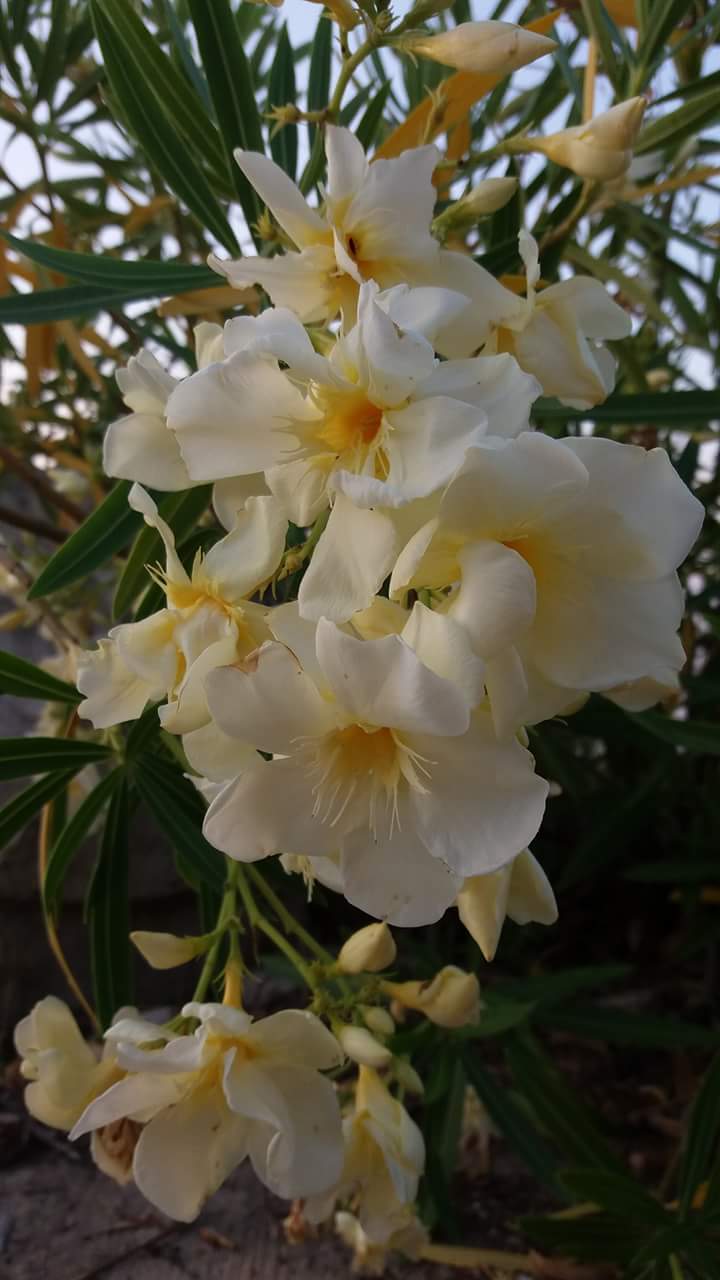
Beautiful lemon yellow Nerium oleander found at limonari beach meganisi
[IMAGE: https://steemitimages.com/DQmbwYLqz1TmUKv8YwCptAY6XUPTGLBT3bJH66FEBsFC7b8/FB_IMG_1522994965513.jpg]
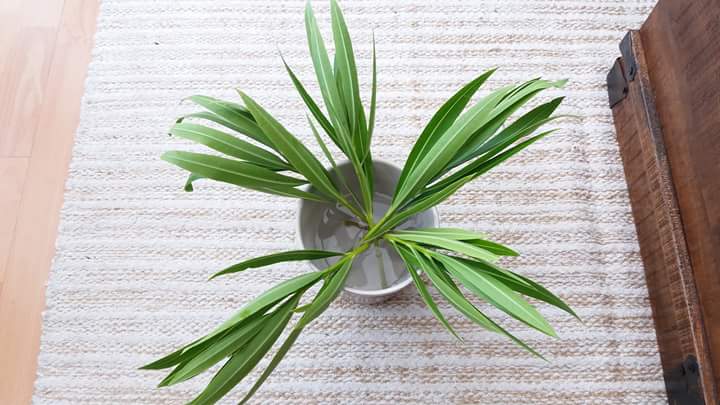
placed in water in the grey container
[IMAGE: https://steemitimages.com/DQmPFfW4TBRN2StSZayFjYENgZhSrnjtUuUjZC31AiJrwJV/FB_IMG_1522994960730.jpg]
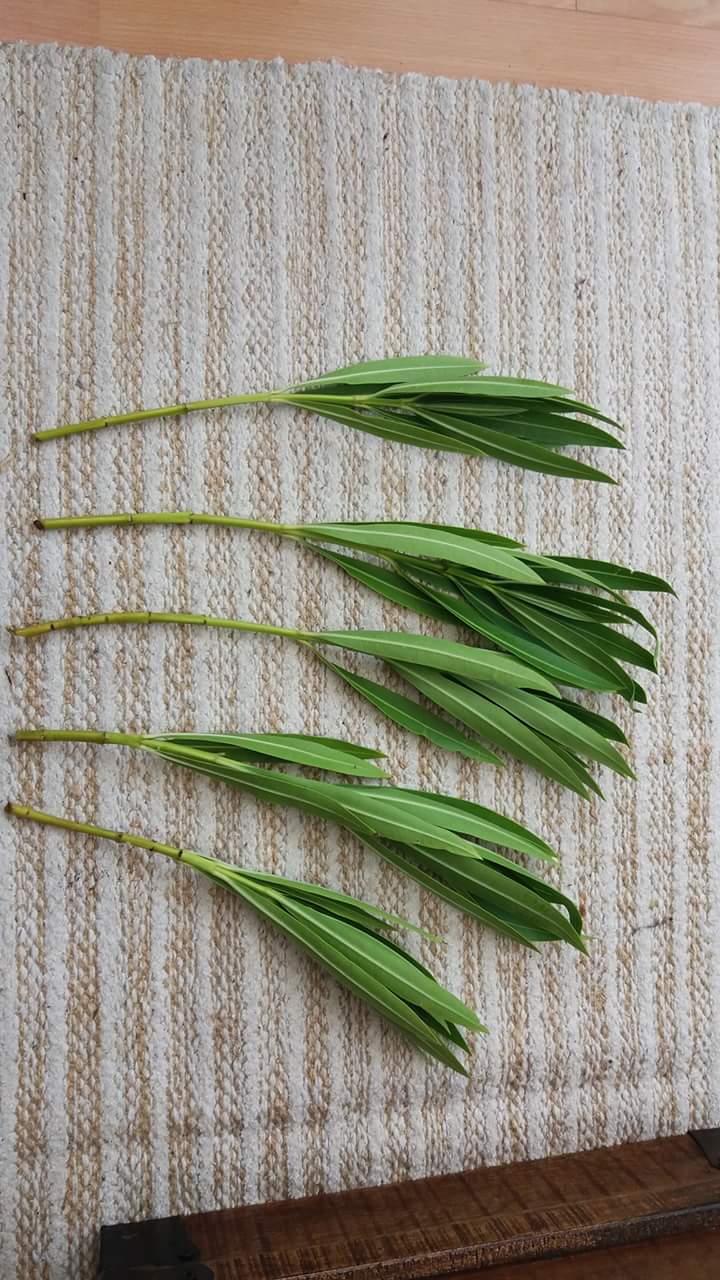
The cuttings stripped of lower leaves
This is great article and wonderful photography.
@ctrl-alt-nwo
Upvote Resteem
https://steemitimages.com/DQmUVv52zTWBgBAe249LdiGDzzWrJQ7sAokXVioYHWqEpbG/NEW%203%20087.JPG
https://s3-us-west-2.amazonaws.com/media-tentree-com/wp-content/uploads/2017/03/idNjZlMDJjMzlhNGJk-e5ed9d6ae84356a2e7113765141c54a1.jpg
oleander
Oleander can be found throughout the world in tropical and subtropical locations. It's originally from Asia, but has become a popular landscape plant in warm climates of North America. The reason for its popularity is the beautiful clusters of flowers that grow at the end of each branch. It's also hardy and drought tolerant.
If eaten, the poisonous effects of this plant can be felt almost immediately. It targets the gastrointestinal and cardiac systems with symptoms of blurred vision, irregular heartbeat, nausea, vomiting, drooling, and bloody diarrhea. Every single part of this plant is poisonous. There have even been cases of people being poisoned by inhaling the smoke from burning oleander.
https://jamesjmurray.files.wordpress.com/2015/02/stag_001858.jpg
magoo-2 found a series of multi accounts of a same owner is following your articles to cheat your generous rewards.
magoo-2 found these accounts are suspicious & can be multi accounts of a single owner. Conclusion is based on last 30 days transactions:
@rik432, @ratul8940, @rahul72, @taylor10, @villani, @wilson6, @masud90, @purepinag, @sumonsha, @perry1, @max1994
magoo-2
Check our latest multi comment spam update report
The oleander is a shrub typical of the Mediterranean where it grows naturally but it is also cultivated for ornamental purposes.
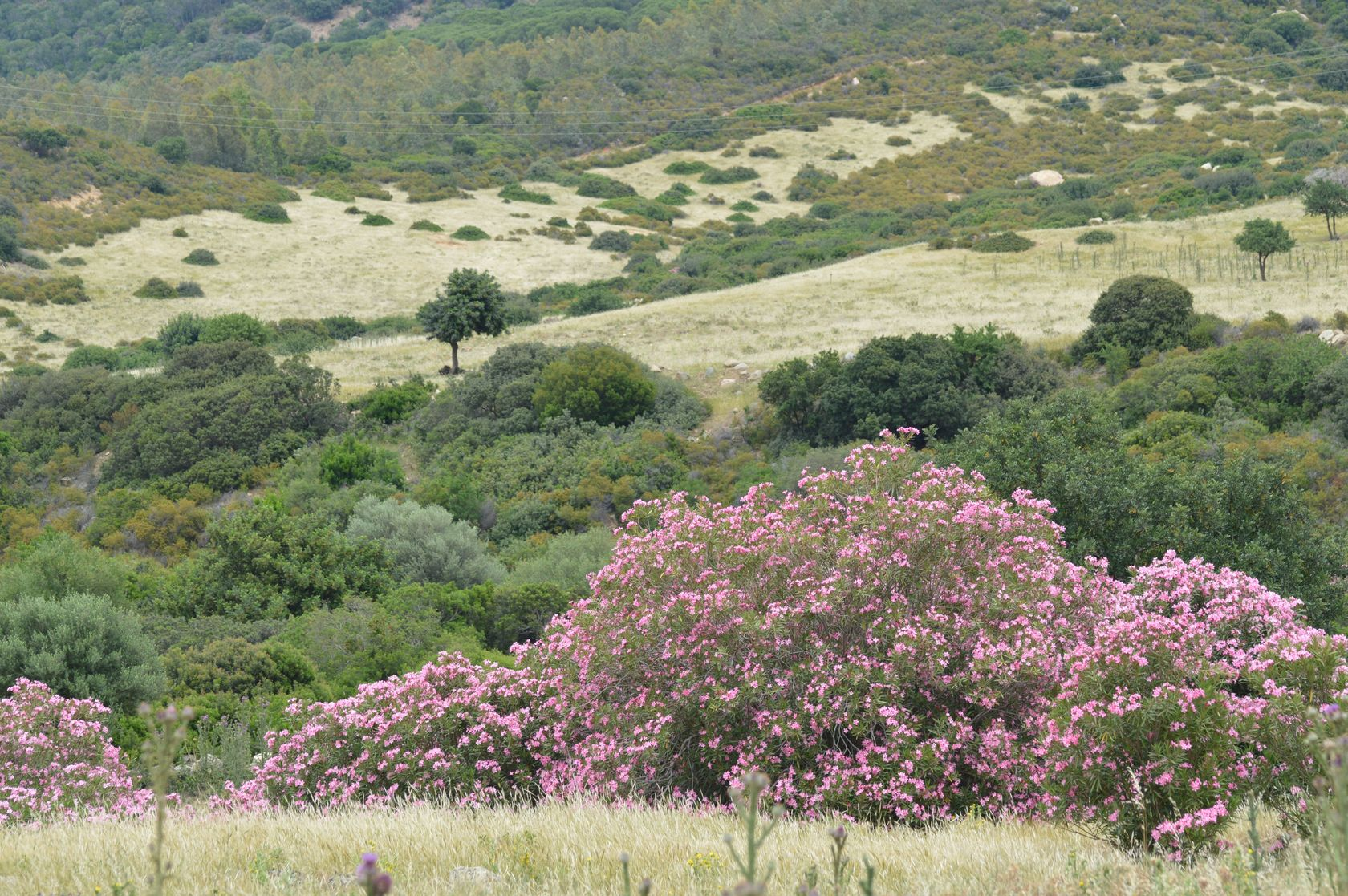
In the flowering period it is easy to see this beautiful flowering plant along the roads or in home gardens, in urban parks or in the countryside, especially along rivers and near the sea. This plant will grow healthy and strong especially in the Mediterranean where he finds a perfect climate for its cultivation and does not like the cold weather.
[IMAGE: https://steemitimages.com/DQmTwXxRyKi2Re5ay7zyJ29tk1SChToySvkq33kYVUiobMq/image.png]
Oleander in the countryside, Sardinia (Italy)
[IMAGE: https://steemitimages.com/DQmeEiAK3Ua7v4G87RxD28pU8ih66EAqPJUq8G7tTW5HxDg/image.png]
But the great looks should not be fooled: the oleander is in fact one of the most toxic plants that are known. The whole plant is toxic to any animal species and ingesting oleander parties may also lead to death.
It is said that several soldiers of Napoleon's troops died from poisoning after using oleander branches as skewers for cooking meat on the grill during the military campaigns in Italy.
The film "White Oleander" played by actress Michelle Pfeiffer tells the story of a woman who kills her lover through the white oleander extract
[IMAGE: https://steemitimages.com/DQmeodWKRqxMkPtqnfEqvSjz4x28G1Sp4qEyarbj4qjgq5m/image.png]
magoo-2 found a series of multi accounts of a same owner is following your articles to cheat your generous rewards.
magoo-2 found these accounts are suspicious & can be multi accounts of a single owner. Conclusion is based on last 30 days transactions:
@moniristi, @shishiristi
magoo-2
Check our latest multi comment spam update report
Beautiful but deadly: The oleander is one of the deadliest of all shrubs. Both their flowers and leaves can be fatal. It can be a good idea to look at what plants are poisonous before planning your garden.
https://3.bp.blogspot.com/-U52mtsU_hL4/WKZukEKGVJI/AAAAAAAAN2w/b9ehvbCQpZkJV2tYz6LN_sYHWN3FRzuoACLcB/s1600/2017-02-17%2B13.23.06%2BMelbourne%2BGardens.jpg
Certain shrubs, perennials and annuals can be quite toxic, and if consumed by young children, can even be fatal.
When planning a new garden it is wise to exclude poisonous plants until your children are of an age to understand the danger these plants can pose.
It is surprising, when researching into what is poisonous and what is not, what one can discover.
Among these, some plants have quaint or colourful flowers that are attractive, yet to chew the petals or eat the berries can cause vomiting and palpitations.
https://upload.wikimedia.org/wikipedia/commons/thumb/8/8b/Nerium_oleander_pink.jpg/640px-Nerium_oleander_pink.jpg
The oleander is one of the deadliest of all shrubs. Both their flowers and leaves can be fatal.
When pruning an oleander, a white sap exudes from the stems which should not be licked from your hands. Just wash it off when you have finished pruning.
The popular indoor plant dumbcane is also poisonous and, if the leaves are chewed or bitten, salivating and burning of the mouth can occur. The Roman patricians would sometimes give a leaf of this plant to their slaves, the tongue would swell and the slave would be silent for some time to come.
http://media.doisongphapluat.com/2014/01/06/cay10.jpg
Castanospermum australie (the Moreton Bay chestnut) grows to a height of 10 metres. It is an evergreen tree and its clusters are very pretty yellow and orange flowers that appear in mid-summer, even along the stems.
There is a fine specimen at the back of the rehab department at the Tamworth Base Hospital. The seeds are poisonous to cattle and horses which, after eating, lose condition.
Datura (angel's trumpet) formerly known as Brugmansia, has white, trumpet-shaped flowers which hang down. It is now hard to obtain.
When I visited the Fragrant Gardens at Erina some time ago, there was a beautiful orange variety growing there. Any part of the this plant, especially the flowers, can cause delirium and death.
Growing in the bush around Tamworth and along the Peel River, a small shrub about 1.5 metres tall with a small yellow flower which develops into a small back berry can be seen.
https://s-media-cache-ak0.pinimg.com/originals/18/0d/5c/180d5cdc5f84e1441933f3604f6b9125.jpg
This plant is the Cestrum parqui, a native to Chile. It is cultivated as a garden plant in the higher rainfall areas of Australia. Cattle have been poisoned from eating this bush.
While most climbers are attractive, the roots and flowers of the pretty Carolina jasmine are toxic.
Other poisonous plants include the arum lily, the leaves and buds of azaleas, the sap of the belladona lily, the berries of the cottoneaster, sap and bulbs of daffodils, all parts of delphiniums, fruits of the lantana camara, seeds of lupins and morning glory, pointsettia latex and seeds, primula leaves, fruit of privets, roots and leaves of violets and all parts of wisteria.
Bye for this month and happy gardening.
magoo-2 found a series of multi accounts of a same owner is following your articles to cheat your generous rewards.
magoo-2 found these accounts are suspicious & can be multi accounts of a single owner. Conclusion is based on last 30 days transactions:
@moniristi, @shishiristi
magoo-2
Check our latest multi comment spam update report
no @shishiristi is my friend account . You are wrong @magoo-2
https://hgtvhome.sndimg.com/content/dam/images/grdn/fullset/2012/8/20/0/0719_090.jpg.rend.hgtvcom.1280.1024.suffix/1452644666051.jpeg
Oleander Is a Dangerous Beauty
How can some of the most beautiful plants be so toxic? Take oleander—that wonderfully large shrub that, despite high winds and salt spray along our coastlines, somehow manages to produce clusters of gorgeous blooms in summer in white, yellow, peach, salmon, pink or red. And yet oleander is considered one of the most poisonous plants in the world. All parts of this gracefully mounded shrub contain poison; a single leaf ingested by a child is known to be deadly.
But, as with thorny roses, prickly cacti, and toxic holiday plants, knowledge is key in preventing hazardous encounters with these landscape beauties. Native to the Far East and the Mediterranean, oleanders, Nerium oleander, grow easily—and rapidly—in the United States, especially southern coastal climes, where they’re often planted along highways as a noise and pollution barrier. These evergreens thrive with little care and are very tolerant of heat and drought. Most will survive temperatures as low as 15 to 20 degrees, though their foliage may get damaged. Yet even then, the shrubs recover quickly in spring so long as their roots are not harmed.
Oleanders grow best in full sun, and most reach 8 to 15 feet tall and as wide, so make sure you give these big guys plenty of space in the landscape. They flower from early summer until mid-autumn with large clusters of 2-inch single or double blossoms. Their long, narrow leaves are smooth but leathery.
A few cultivars to consider include:
'Algiers' features single, dark red flowers.
‘Calypso’ is cold hardy with cherry red single flowers.
‘Hardy Red' is extremely cold hardy with deep red single blooms.
‘Petite Salmon’ is a dwarf plant but less cold hardy than most oleanders.
‘Sister Agnes’ is hardy, grows to 12 feet and has large single white flowers.
https://st.depositphotos.com/1007809/3602/i/950/depositphotos_36028061-stock-photo-oleander.jpg
magoo-2 found a series of multi accounts of a same owner is following your articles to cheat your generous rewards.
magoo-2 found these accounts are suspicious & can be multi accounts of a single owner. Conclusion is based on last 30 days transactions:
@rik432, @ratul8940, @rahul72, @taylor10, @villani, @wilson6, @masud90, @purepinag, @sumonsha, @perry1, @max1994
magoo-2
Check our latest multi comment spam update report
Thanks for the info !
@ctrl-alt-nwo, check you my last 30 day transaction
[IMAGE: https://steemitimages.com/DQmV7xE9x1WTG3Ag5tVx7dTLxxNMtebdVmYq7M3vMCS46rf/Screenshot_20180407-074421.png][IMAGE: https://steemitimages.com/DQmSMu4SVisAnjgXNqvJS4k5AZxvJaSHXmUyauSSNDYzHcp/Screenshot_20180407-074410.png][IMAGE: https://steemitimages.com/DQmTKZZbAfkuKWzFffv4zSctyugpeRBnQW5bFwuqpikscpJ/Screenshot_20180407-074433.png]![IMAGE: https://steemitimages.com/DQmQ6arTGBJcUJxhuedgfzjbBKxggdgNgMZXhf6mvfZdjuj/Screenshot_20180407-075445.png]




No one should trust anyone based on a false grave. @sumonsha was my school friend. first time transfer him some SBD because i was no any bittrex and blocktrades account.in came to steemit in his heart.
I don't know another id.
I think @perry @villani @taylor and other phillipines girl..
I'm #Bangladeshi girl.বাংলাদেশে আমি থাকি.
If anyone can prove that I have taken use anyone comment copy/paste, then I will not use steemit.
[IMAGE: https://steemitimages.com/DQmd3XRi33mB7SCC1Tegm68hwj83Rwad1HxizdZp1KXiozF/image.png]
@ masud90 to @ rik432 $ transfered.
Transfer from @purepinag to
@sumonsha.

@masud90 has the link to @rik432 with
this id. This is understandable. And
@masud90, @purepinag and @sumonsha
interact with each other at the comment.
One of the owners of all these IDs. Be
careful. This guy is very clever. One day
of police's 10 days of thief. do not forget.
@sumonsha is my friend.
I don't know @masud90.
You are s theif @magoo-2
If the thief is caught and stolen, he has
many such things. You're lying. I'm
checking all your ID's wallet. I did not say
these things. @purepinag
You are a layer [IMAGE: https://steemitimages.com/DQmdvDozKp5YWUBREvE367nTS39185GxgzpmDiwbacMsVS9/Screenshot_20180407-100328.png][IMAGE: https://steemitimages.com/DQmRddg4rjR8MDUfr66ug2wS5KkF1zBZkxbD2SwBf3Z12Xf/Screenshot_20180407-100342.png]
Original @magoo say you are a spammer.


A few days earlier my brother said Gaargh!’ as he sprang back from the Oleander bush (Nerium oleander) in our yard. He was inspecting the little nest that a sunbird had built deep inside the foliage. When he turned a leaf over, he found himself nose-to-nose with what looked like the hugest, stripiest caterpillar in the world. These are beautiful pictures.
The exotic blooms of the oleander are a wonderful sight to see. However, despite being an everyday sight in the Mediterranean, this flower has the poisonous ability to cause diarrhoea, convulsion and vomiting.
http://goree.rice.edu/files/images/Nerium%20oleander_Goree.preview.JPG
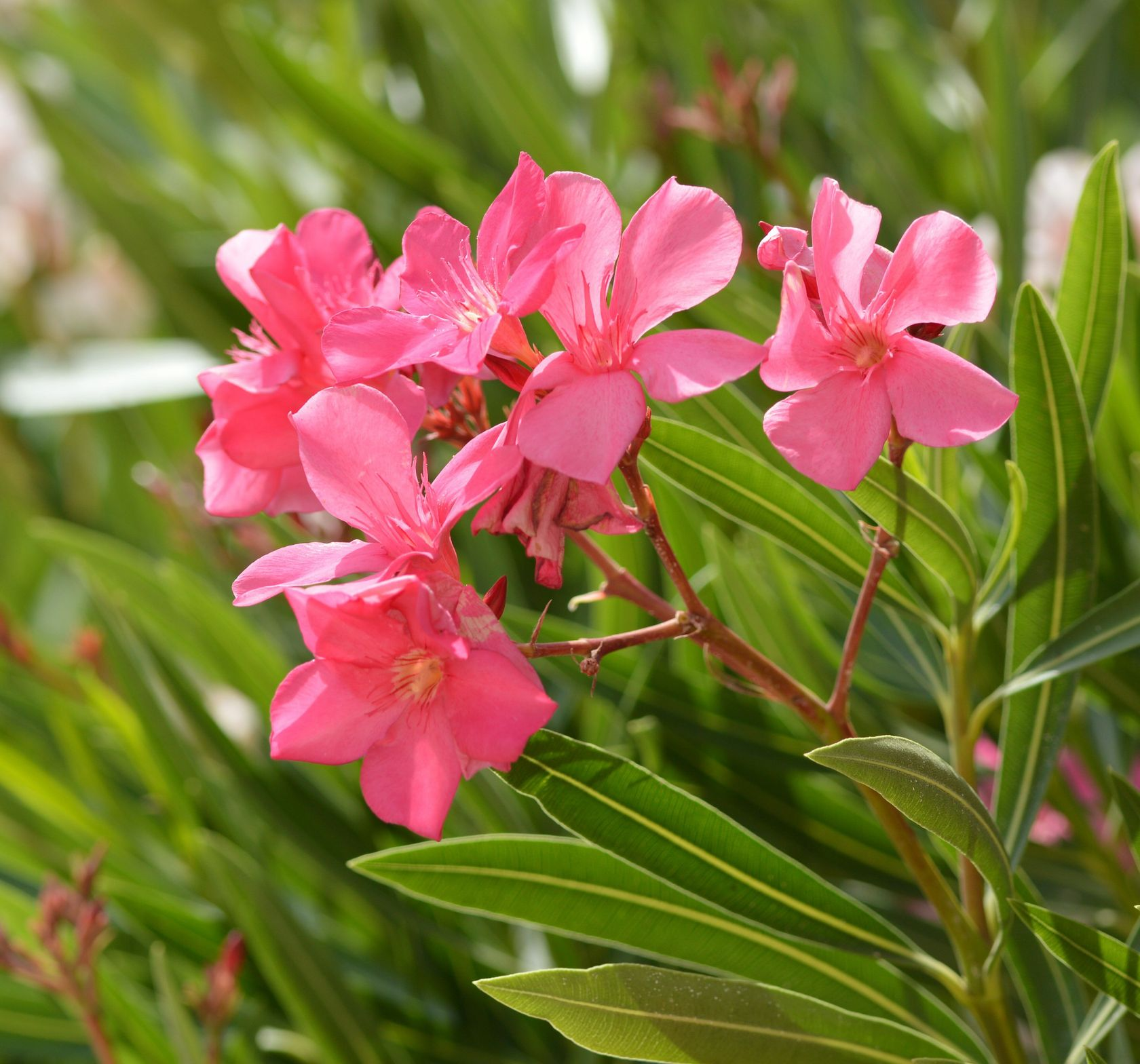
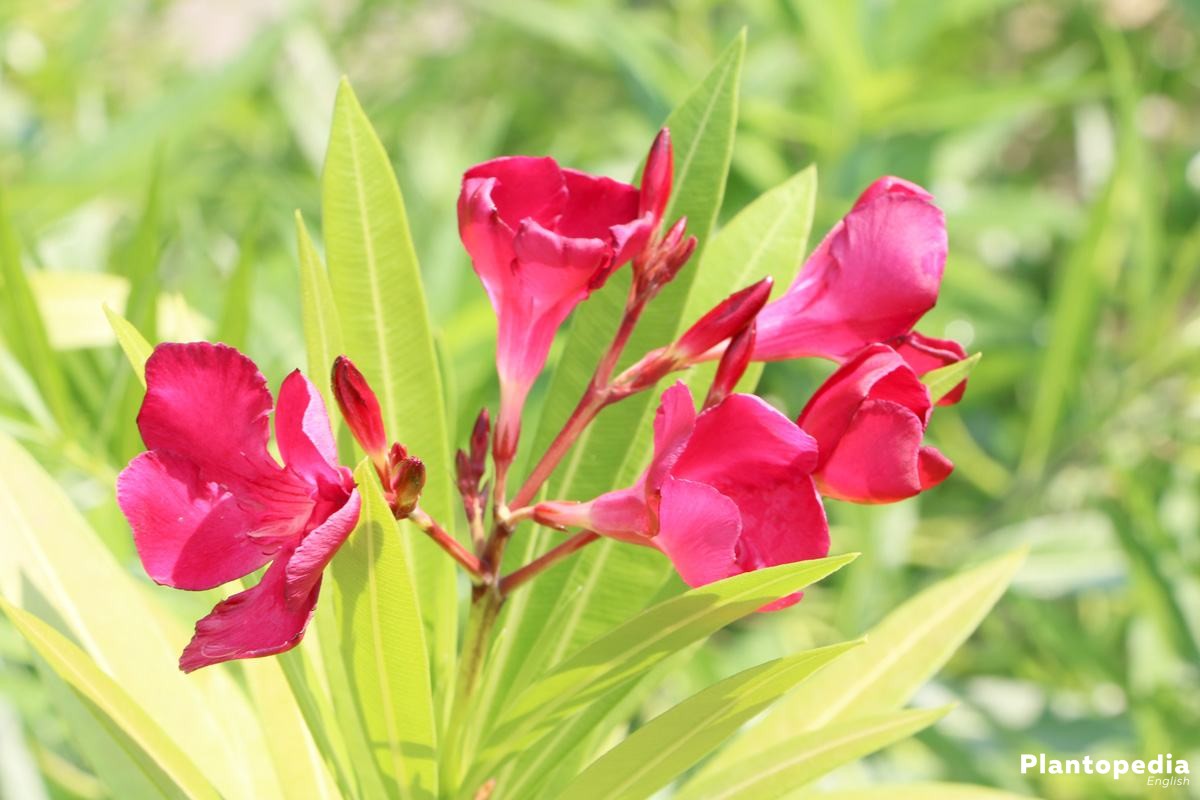
The oleander is an evergreen and blossoming bush that can grow up to 3 metres, if you let it grow. The leathery leaves come in a lance-like form and can grow up to 15 cm. The oleander’s blossoms grow in clusters, while single blossoms are three to five centimetres in diameter. Most blossoms are available in white, different rose colours, or reds and they can appear throughout the whole year, or in colder regions starting in May. By now, you can not only get the original kinds with unfilled blossoms, but also hybrids with filled ones.
If you have a warm climate you can plant oleander in your garden during the spring. Since most plants’ winter hardiness is not enough in our realms, they can only be planted and exist outside in viticultural areas during the colder months. For this purpose you should only choose kinds that are more frost-resistant and have unfilled blossoms.
[IMAGE: https://steemitimages.com/DQmYoRhQVGHSVeGdaXaSCpGb61we7LLhDfgw7NVZehDLR3N/nerium-oleander-n6.jpg]
[IMAGE: https://steemitimages.com/DQmZUxh6v8fHgMoWrHtDCUAe85Yuvk7bC6gdfLnWUJQBMwu/nerium-oleander-n1.jpg]
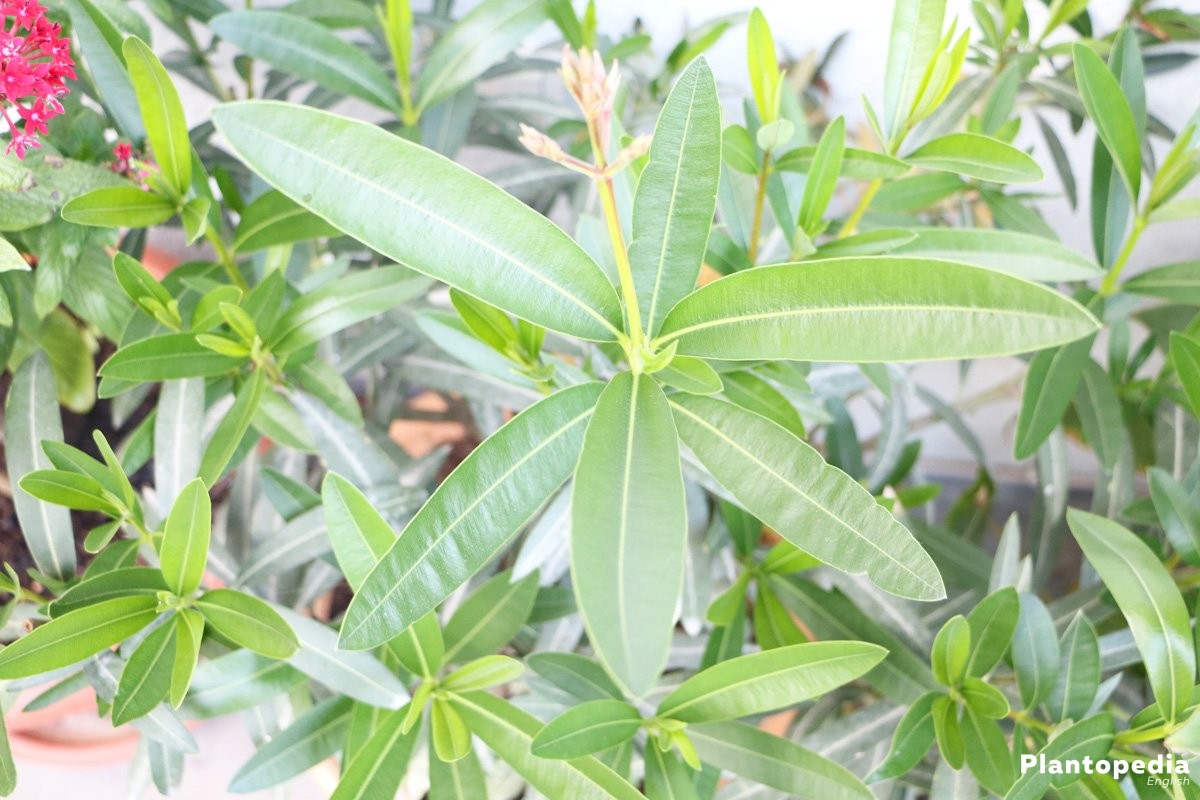
https://www.plantopedia.com/nerium-oleander/
really beautiful flowers sir...👌☺
i clicked yesterday [IMAGE: https://steemitimages.com/DQmTHyon9nstaXsF6smLM7PF7wJSjnGfxW2u3MsgnbaTJZm/IMG_20180330_173957.jpg]
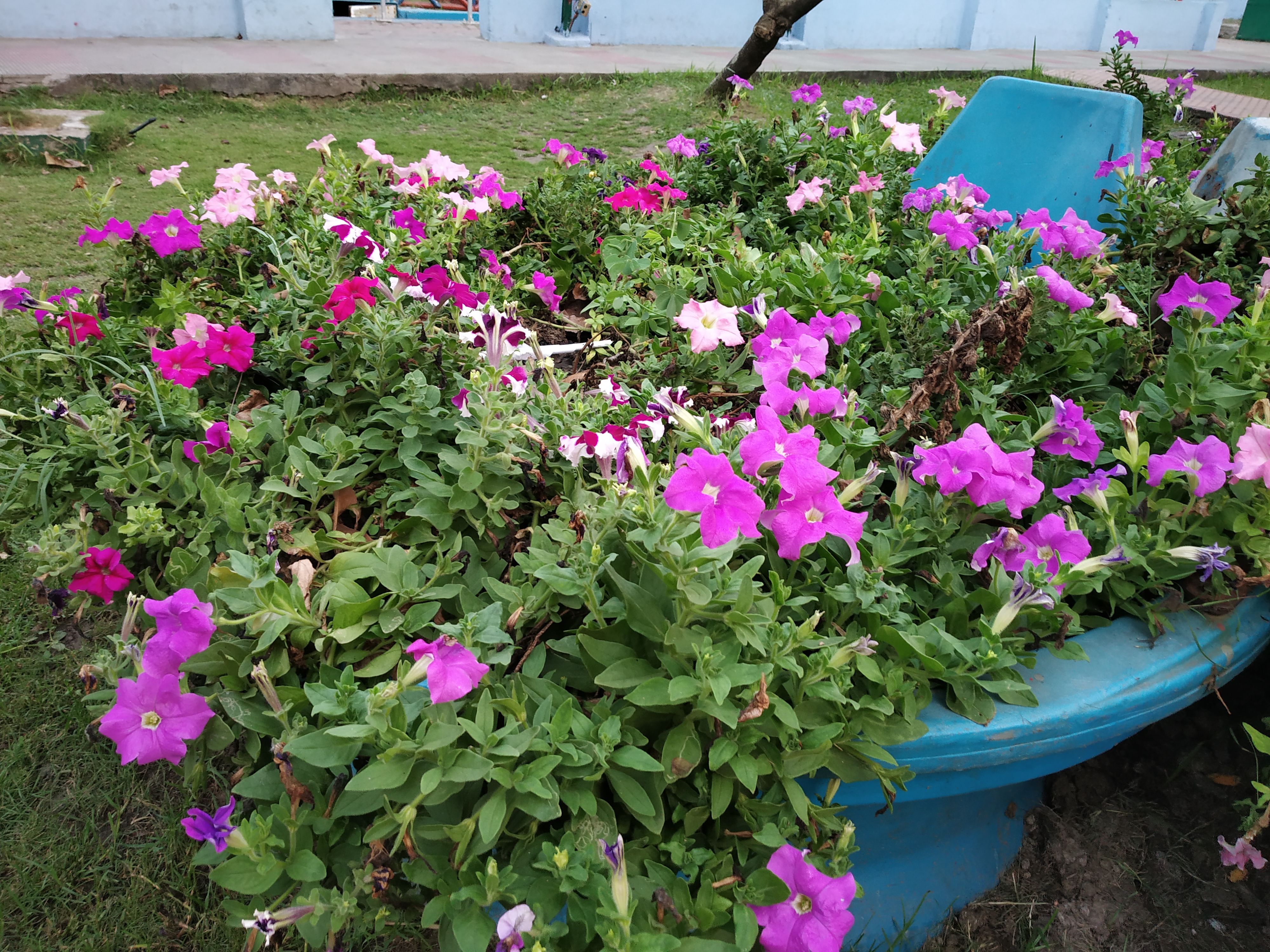
A bloom that can be admired at this time in my region. The oleander is a shrub typical of the Mediterranean where it grows naturally but it is also cultivated for ornamental purposes.
In the flowering period it is easy to see this beautiful flowering plant along the roads or in home gardens, in urban parks or in the countryside, especially along rivers and near the sea.
[IMAGE: https://steemitimages.com/DQmTs3XpCUc6rRotifor4csbkRCpgnLxvNjvm1Fw8okHctw/image.png]
This plant will grow healthy and strong especially in the Mediterranean where he finds a perfect climate for its cultivation and does not like the cold weather.
The oleander plant is very hardy and its flowering is abundant: the flowers usually simple can be pink, red also white... but there are also beautiful varieties that have a flower with lots of petals like a rose.
[IMAGE: https://steemitimages.com/DQmWnBTivXYoV2sLNJAvaxcjdWRGNUHQYrnp86a9TYPRNvT/image.png]
Oleander is a long-term bright and evergreen shrub with elongated leaves and very bright fragrant flowers. His native land is the Western part of China and tropical areas of Portugal. Now it is already growing in Russia.
[IMAGE: https://steemitimages.com/DQmepFjvJu6uP4tkZwp9DPYNxKZFdFea7rtsdhBDj14NTJ9/image.png]
However, when growing oleander should be careful and remember that the plant contains poisonous juice. Do not allow children to touch the flowers, so as not to cause allergies. These bushes come in a variety of types: common oleander, Indian and sometimes fragrant.
[IMAGE: https://steemitimages.com/DQmQ5VnDfNx9vrD7jRgcPWzznKHhjjuwcFMQrmypQ6itkda/image.png]
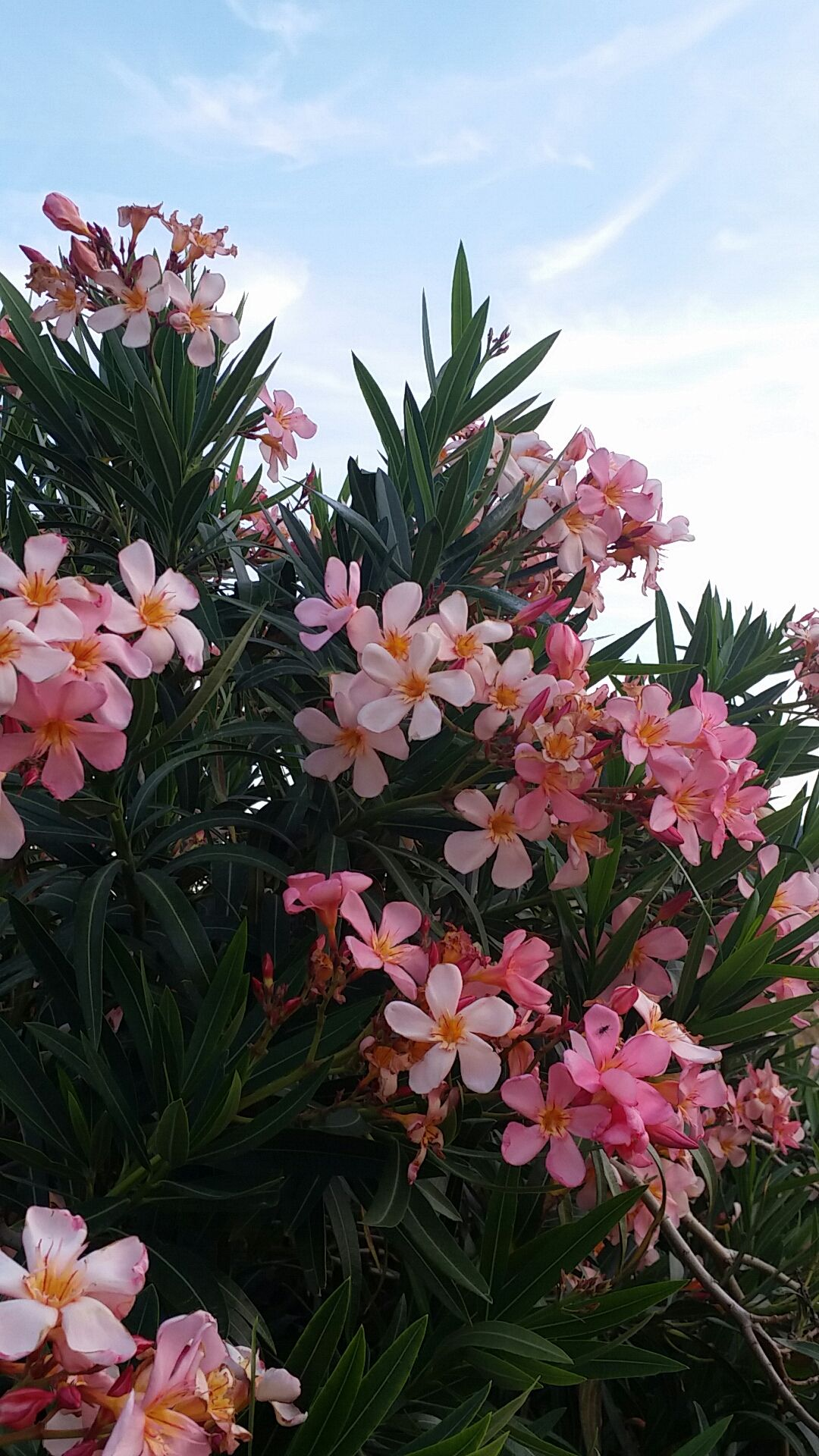
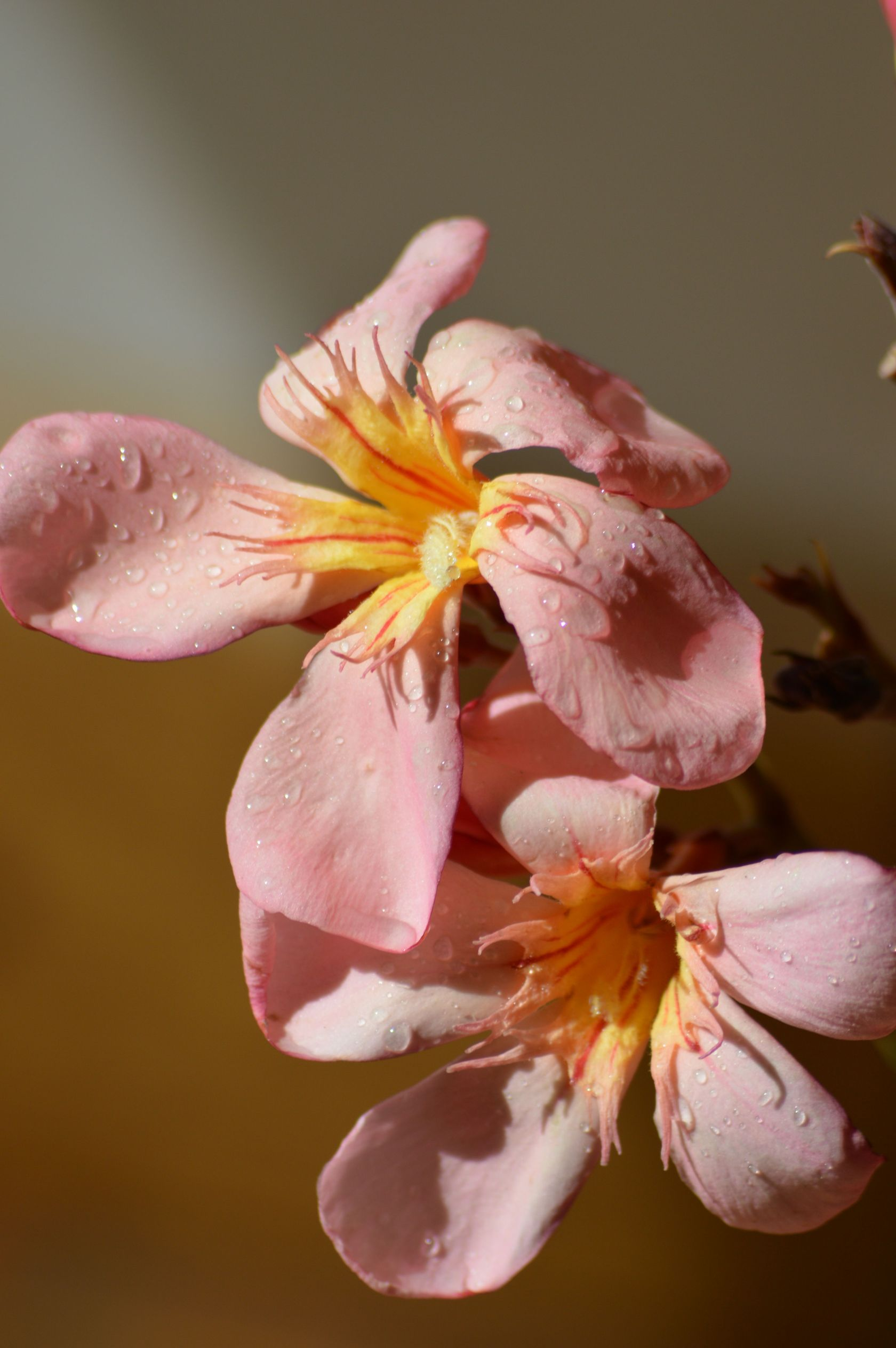
Wow fantastic garden . wonderful work. i like this Oleander trees .
https://steemitimages.com/0x0/https://steemitimages.com/DQmXPLif5dQoc816hSsPmZJcC7X86MGHXoePs686nqDBdAz/NEW%203%20073.JPG
https://steemitimages.com/DQmUVv52zTWBgBAe249LdiGDzzWrJQ7sAokXVioYHWqEpbG/NEW%203%20087.JPG
resteem
http://2.bp.blogspot.com/-YlVW0nIKWN0/VbTZn8ltHSI/AAAAAAAAEMY/G-lJtDnO1GY/s1600/13546162052178987400015363044dsOeJm_fs.jpg
This lovely Mediterranean bush isn't solid in our general vicinity, yet is much of the time utilized as a holder plant for summer porches. Developing to 10 feet or more in a holder, the oleander (Nerium oleander) is frequently prepared as a standard or with a plaited trunk. The spear formed weathered leaves take after the leaves of the olive tree (Olea), in this way the species name.
White, red, pink, salmon, and light yellow-blossomed assortments sprout all mid year when arranged in a bright area outside. The oleander is utilized like Crepe Myrtles in southern Florida, lining boulevards, for supports, or as garden examples. It can be kept over the winter in a bright window inside, despite the fact that it will most likely shed a lot of its foliage. Give as cool a spot as could be allowed. Keep soil clammy while outside in sun, yet enable the dirt to dry tolerably inside finished the winter.
https://upload.wikimedia.org/wikipedia/commons/c/cc/Nerium_oleander_flowers_leaves.jpg
One disadvantage to this lovely plant is its danger to people and different warm blooded creatures. All parts are poisonous if ingested, and contact with the sap may cause dermatitis. My mom used to recount the narrative of her school companion who endured an extreme response to the smoke from a campfire on which branches of oleander had been set. There have been not very many revealed incidental passings from Nerium oleander, however munching dairy cattle and stallions have been known to bite the dust from expending an excessive number of clears out. The plant ought to be kept from the compass of little kids or biting pets.
https://www.gardensonline.com.au/Uploads/Plant/4037/Nerium-Oleander-Dwarf-4.jpg
http://www.phytoimages.siu.edu/users/paraman1/7_21_09/Upload21July09/NeriumOleander14.jpg
https://www.gardens4you.co.uk/ShopImages/product/FD17379WM.JPG
magoo-2 found a series of multi accounts of a same owner is following your articles to cheat your generous rewards.
magoo-2 found these accounts are suspicious & can be multi accounts of a single owner. Conclusion is based on last 30 days transactions:
@rik432, @ratul8940, @rahul72, @taylor10, @villani, @wilson6, @masud90, @purepinag, @sumonsha, @perry1, @max1994
magoo-2
Check our latest multi comment spam update report
https://upload.wikimedia.org/wikipedia/commons/0/00/Nerium_oleander_Ouarzazate_wild1.jpg
http://upload.wikimedia.org/wikipedia/commons/8/8b/Nerium_oleander_pink.jpg
The oleander, or Nerium oleander, is considered by numerous to be the most harmful plant on the planet. All parts of the wonderful oleander contain harm - a few kinds of toxic substance. Two of the most strong are oleandrin and neriine, known for their capable impact on the heart. An oleander's toxic substance is so solid, truth be told, that it can harm a man who essentially eats the nectar made by honey bees that have processed oleander nectar.
The oleander is an appealing plant, and in spite of its lethal notoriety is frequently planted for brightening purposes. Albeit local to the Far East and the Mediterranean zones, oleander has been presented in the United States, where it develops effectively. It's tolerant of low quality soil and dry climate. The plant develops as a thick bush, and is normally 6 to 18 feet (1.8 to 5.4 meters) tall at development. It has thick, dim green leaves, and the blossoms, which develop in bunches, can be yellow, red, pink or white.
Indeed, even in infertile regions, the oleander creates dazzling blooms and aroma. Creatures naturally maintain a strategic distance from the plant, and it develops quickly, so it's regularly utilized for interstate boundaries and different regions that require screening from commotion and contamination. Its quick development additionally settles on it a prominent decision around new development zones, as it avoids disintegration.
Dissimilar to some harmful plants, the oleander is noxious to most creatures and in addition people. A solitary ingested oleander leaf can murder a youngster. Ingestion of oleander brings about the runs, spewing, extreme stomach torment, sluggishness, tipsiness, a sporadic pulse, and regularly, passing. On the off chance that the casualty survives the underlying 24 hours after ingestion, his or her chances of surviving increment drastically. For effective treatment, the patient is instigated to regurgitation, his or her stomach might be pumped, or he or she might be encouraged actuated charcoal to retain however much of the toxin as could be expected.
https://plants.ces.ncsu.edu/media/images/Nerium-oleander--Paul-Cooper--cc-by-nc-2-0.jpg
https://upload.wikimedia.org/wikipedia/commons/thumb/e/e9/Pink_Oleander_tree.jpg/1280px-Pink_Oleander_tree.jpg
https://cdn.shopify.com/s/files/1/1527/8799/products/Nerium-oleander-Hardy-Pink.i-3786.s-19321.r-1_c628aaa2-0f31-4a0d-93d9-0328347c7f3f_1024x1024.jpg?v=1516744184
https://cdn.pixabay.com/photo/2016/07/16/12/50/oleander-1521525_960_720.jpg
https://nurserylive.com/images/stories/virtuemart/product/nurserylive-kaner-nerium-oleander-yellow.png
Nerium oleander, commonly known as oleander, is a highly toxic plant that has been cultivated since ancient times. Nerium oleander is a highly toxic ornamental shrub widely cultivated in the Mediterranean.thanks to sharing for your good post.. @ctrl-alt-nwo[IMAGE: https://steemitimages.com/DQmRuztNgJboAEZbV2DzTZ45uBc8VYGgLMaSUAmj1Dh8R4w/FB_IMG_1522996232057.jpg][IMAGE: https://steemitimages.com/DQma9yEi2rycHcwPaN4UWgraE2oHaKDYrEXfpdBkYbMTyvm/FB_IMG_1522996264251.jpg][IMAGE: https://steemitimages.com/DQmZn77YpTywH2PLprfv773hTZ5NvAuCogMNji3csyPUVCz/FB_IMG_1522996239274.jpg][IMAGE: https://steemitimages.com/DQmZDUY5azcLzFeJ84sgBMSkfw6PWhwcTRs3AtzgbLXbmur/FB_IMG_1522996261372.jpg]
[IMAGE: https://steemitimages.com/DQmaeSdzwDhBiE6CHnpmycvX6RAJS4dwQerbFRb22RMue8r/images(23).jpg]
All About the Oleander Flower
The oleander is an ornamental plant that is used throughout the world as a great flower for decorations and such. There are a lot of people that know the oleander well and grow it so that they can use it in bouquets. However, this is a poisonous flower, so it is very important to understand how this flower works, what it looks like, and how you should handle it, this way you are prepare with the toxic poison that it can put forward. This is probably way the oleander has a floral meaning of caution; it is very suited for how dangerous that this flower can be even in small amounts.
[IMAGE: https://steemitimages.com/DQmNPhVDkn1EGHZBhobz53zRcvNpCYnhiR5coPFm64Q8StB/images(22).jpg]
Description of the Oliner flower
Oleander is indeed part of a evergreen neat that is called dogbane family. This plant is extremely toxic, in fact all parts of the plant are poisonous, so it is very important to be almost careful. It is indeed one of the most toxic plants which is grown in the common people garden, and for this reason, it is very important to see the people and animals around. In the right quantities, you can actually make yourself a lot of damage with this plant itself. It is a plant that is tall and can grow up to 20 feet tall. In the first year, the plant looks different from the following years and there is increase in the tree at the branches. You will find that this flower can be red, pink, and white.
[IMAGE: https://steemitimages.com/DQmcFzSuHTd2cpUrKRdcwLMHEAFxtdd4MaJP9aqxmppTSRW/images(24).jpg]
Use for oleander flowers
Since Olidder is poisonous, people are very careful with him. However, this flower is beautiful and for that reason you will see it arranged a lot. People should take precautions if they were going to use it in the bauxite because they can spread poisonous material easily but, for other people, it is a plant that they prefer to use for natural scenes. You will find it in many areas to take care of landscapes where many areas and animals do not use it. It is a plant that is alerted about you as long as it looks great and it is a great fit for landscapes and fountains. Check out the oleander you are looking for the landscape and really have a great looking area.
[IMAGE: https://steemitimages.com/DQmYiHLdVKmpBwojcGovYFimZqPU7H6g61yx67rYvp7vWJT/Hibscus.jpg]
Why do people feel like Olinar Flower?
You'll find the whole native oleander in Morocco, Portugal, and the Mediterranean regions. It is also found throughout China and Asia. Although this plant wants to stretch around the dry bed and actually likes more tropical and subtropical areas, but it can be found in nature as North Carolina as North Korea. In the case of farming, these flowers are used throughout the United States for planting medial strip. If you're going to increase it in the cold areas, you're going to use a greenhouse or you're going to want to keep it as an indoor plant
.jpg)
.jpg)
.jpg)
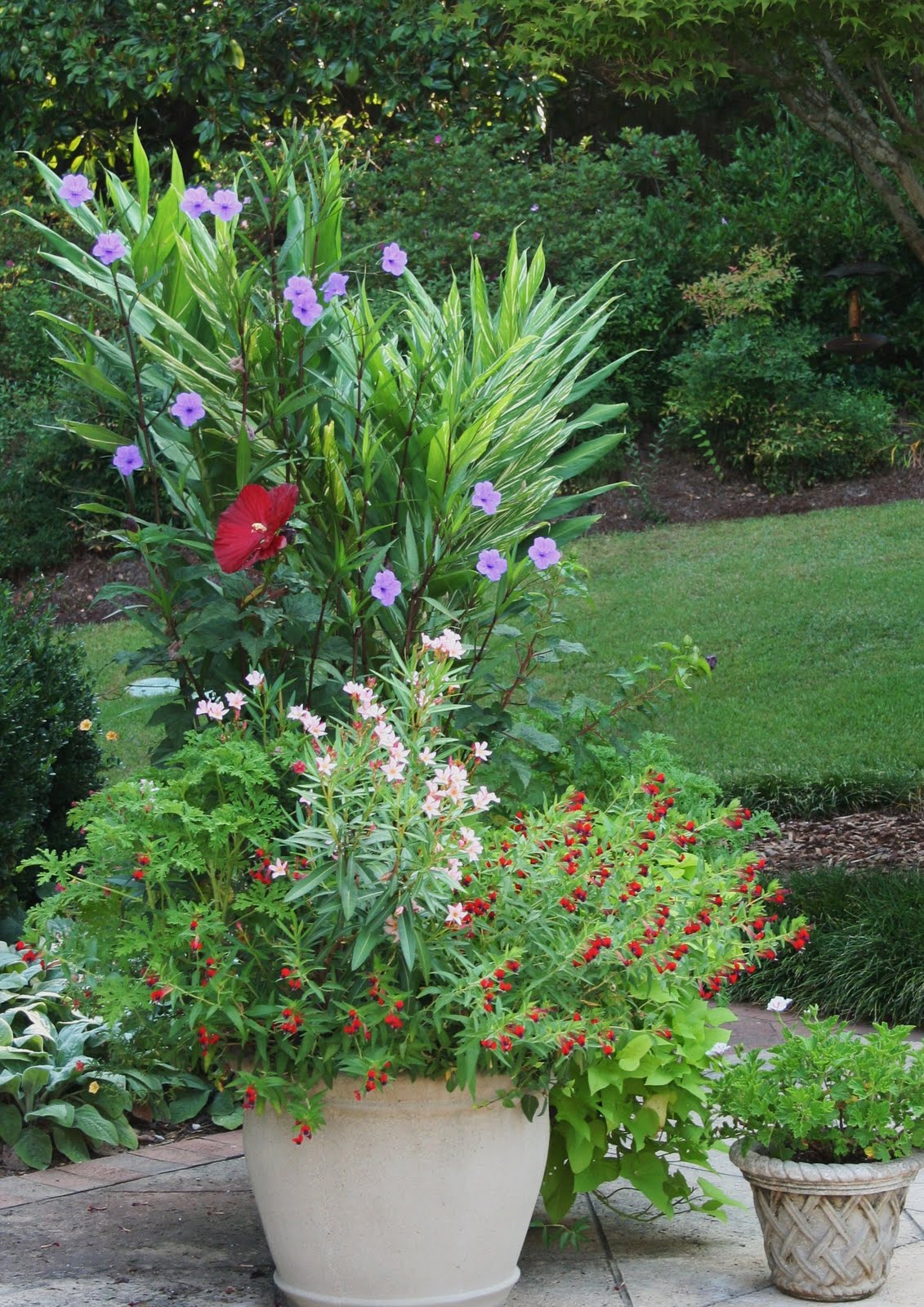
Nerium oleander, you are right, he is handsome and dangerous!
Culture
Winter hardy to USDA Zones 8-10. In St. Louis, grow in containers or tubs that are overwintered indoors or as year-round houseplants. Container plants may be grown as shrubs or trained as ornamental standards. Plants generally grow best when overwintering period is short. Since plants will tolerate some frost, consider leaving containers outside in fall until temperatures dip below 20 F. and return containers to a protected outdoor as soon as temperatures permit in spring. Overwinter in a cool location (40s F.) with moderate light and very little water or as a houseplant in a bright sunny but cool room with reduced water. Grows well in average, medium moisture soils in full sun to part shade. Oleander is native to dry Mediterranean stream beds, and established plants will tolerate some drought and poor soils. However, container plants seem to do best in fertile soils with good drainage. Water regularly but let plant soils dry out between waterings. Promptly deadhead spent blooms to prevent formation of non-ornamental seed pods. Cuttings may be taken in late summer. Prune lightly as needed to shape after flowering (late summer to fall).
[IMAGE: https://steemitimages.com/DQmRzFvcUUBdK6WqPxzbRHUbLCnHiqkninn7HEEiAZWUGmP/image.png]
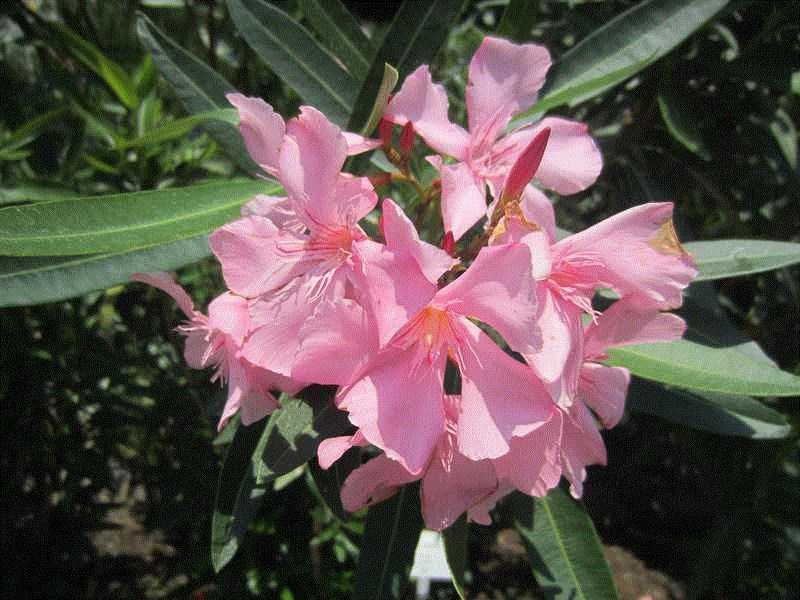
Noteworthy Characteristics
Nerium oleander, commonly called oleander, is an upright, rounded evergreen sub-tropical to tropical shrub that is valued for its abundant, fragrant, summer to fall flowers. Purple, pink or white five-petaled funnel-shaped flowers in clusters (terminal cymes). Narrow, willow-like, linear-lanceolate, glossy dark green leaves (to 5” long) have distinctive midribs. All parts of this plant are poisonous if ingested. Plant saps can cause allergic skin reactions in some people. Smoke from burning plant material can also be quite toxic. May be trained as a standard. Many cultivars are available in commerce with single or double flowers and in dwarf (2-4’ tall), medium (5-8’ tall) and large (9-20’ tall) plants. Sometimes also commonly called rosebay.
Genus name comes from the classical Greek name.
Specific epithet comes from the Italian oleandro for its olive-like leaves.
http://images.mobot.org/PlantRecords1/prod/large960/00040000/40145.jpg
Problems
No serious insect or disease problems. Watch for mealybugs, aphids and scale. Caterpillars may chew on the foliage. Remove and destroy any leaves damaged by leaf spot.
https://www.gardensonline.com.au/Uploads/Plant/4037/Nerium-Oleander-Dwarf-4.jpg
Garden Uses
Container plant for sunny decks, patios and other locations around the home. In Zones 8-10, these plants are used in a variety of landscape applications including hedges, screens, foundation plantings and borders.
http://www.missouribotanicalgarden.org/PlantFinder/PlantFinderDetails.aspx?kempercode=a532
https://www.youtube.com/watch?v=GHh9BtjTznQ
https://www.youtube.com/channel/UCKHdclVAOVJjGa7CyZB4jJA
Beauty to see not to touch .... This is how plants have been saving themselves for years.. A similar e.g of saviour is of rose plant....
@ctrl-alt-nwo,
This is one of the most poisoned plant. Locally we called it as KANERU!
Cheers~
Nerium is one of the most rare shrub of the South Asia but it could be found in the upper Punjab of the Pakistan, due to the natural climatic condition in the region. It demands the warm climatic weather at the same time needs proper care to grow to touch it's natural peak. In ancient time, people used the crushed leaves of Nerium for the hidden pains in the body.
[IMAGE: https://steemitimages.com/DQmZNXVaahsXC97CQiDaKqTjAqzqMKCBABjbJcD7GETdMYU/image.png]
Source
>The origins of the taxonomic name Nerium oleander, first assigned by Linnaeus in 1753, are disputed. The genus name Nerium is the Latinized form of the Ancient Greek name for the plant Nerion (νἠριον), which is in turn derived from the Greek for water, 'neros' (νἠρος), because of the natural habitat of the Oleander along rivers and streams. Oleander is more problematic to source. Merriam-Webster believes it is a Medieval Latin corruption of either arodandrum, lorandrum (Late Latin), or more plausibly rhododendron (another Ancient Greek name for the plant), with the addition of Olea because of the superficial resemblance to the Olive tree. Another theory posited is that Oleander is the Latinized form of a Greek compound noun: 'Ollyo' (ολλύω), which means 'I kill', and the Greek noun for man, 'aner' or 'andros' (άνἠρ, άνδρος).This is because of the Oleander's toxicity to humans.
[IMAGE: https://steemitimages.com/DQmUVy3QUYEQqzA2nvw7avRCL1suKTc2xD5smXMtVTnsRy8/image.png]
Source
>The etymological association of oleander with the bay laurel has continued into the modern day: in France the plant is known as "Laurier Rose",while the Spanish term, "Adelfa", is the descendant of the original Ancient Greek, daphne, which subsequently passed into Arabic usage and thence to Spain
The opening of it's follower depends upon the intensity of the radiations Sun is throwing upon it. That is why it is a called a shrub of Sun-rays in Urdu Language.
>Beyond the traditional Mediterranean and Subtropical range of Oleander, the plant can also be cultivated in mild Oceanic climates with the appropriate precautions
[IMAGE: https://steemitimages.com/DQmQc9inx1B2mQJFWfRDTaqUKhD2r62MuruHzJydGW2rcqN/image.png]
Source
When it comes to Art & Culture Oleander gained a very keen attention from the several creative minds to show the diversity it owns ;)
>Janet Fitch's 1999 novel White Oleander is centered around a young Southern California girl's experiences growing up in foster care after her mother is imprisoned for poisoning an ex-boyfriend with the plant. The book was adapted into a 2002 film of the same name starring Michelle Pfeiffer and Alison Lohman.
The rock band Oleander took its name from the plant because it lines miles of highways in the band's native Sacramento.
Oleanders were famously referenced by the band Steely Dan in their song "My Old School.
[IMAGE: https://steemitimages.com/DQmZS3esAg5XYhAdriBRLyqTeG8rHfkkYiX2MP2aefA2F4o/image.png]
Source
Thank you so very much for highlighting this important shurb tomake the folks aware of it.
Have a nice weekend @ctrl-alt-nwo :) :)
beauty with toxic.. great details and I have learn something today.
thanks @ctrl-alt-nwo
Cheers!
Nerium oleander is a shrub or small tree in the dogbane family Apocynaceae, toxic in all its parts. It is the only species currently classified in the genus Nerium. It is most commonly known as nerium or oleander, from its superficial resemblance to the unrelated olive Olea. It is so widely cultivated that no precise region of origin has been identified, though southwest Asia has been suggested. The ancient city of Volubilis in Morocco may have taken its name from the Berber name oualilt for the flower.Oleander is one of the most poisonous commonly grown garden plants.
[IMAGE: https://steemitimages.com/DQmd2wKRuKw2re4139qguVQrLbejF224z2MrPLiaLdRbQ6V/1.jpg]
Range Description:
This species is considered to be native to Spain, the Balearic Islands and Morocco east through Mediterranean coastal countries to the Arabian Peninsula, Ethiopia, Niger, Afghanistan, Iran and Iraq to India and central China. It occurs as a non-native in parts of Africa, the Azores, Japan, Indonesia, Australia, New Zealand, the United States, central and eastern Mexico, Central and South America.
[IMAGE: https://steemitimages.com/DQmbmaucirPshL7rxFoMTwR2VDoUx3V2gn6uubhdGBDcRny/2.jpg]
Countries occurrence:
Native:Afghanistan; Albania; Algeria; China; Cyprus; Ethiopia; France (Corsica, France (mainland)); Greece (East Aegean Is., Greece (mainland)); India; Iran, Islamic Republic of; Iraq; Italy (Italy (mainland), Sardegna, Sicilia); Lebanon; Libya; Morocco; Myanmar; Nepal; Oman; Pakistan; Palestinian Territory, Occupied; Portugal (Azores - Introduced, Portugal (mainland)); Saudi Arabia; Slovenia; Spain (Baleares, Spain (mainland)); Tunisia; Turkey (Turkey-in-Asia, Turkey-in-Europe); United Arab Emirates
[IMAGE: https://steemitimages.com/DQmZqM5PgByX1TPGmAWVyKJ4AHSxP484Rtax1Atr8oxuEbZ/5.jpg]
Introduced:Australia (New South Wales); Brazil; Cameroon; Chile (Juan Fernández Is.); French Polynesia (Society Is.); Honduras; Indonesia (Jawa); Japan; Kenya; Kiribati (Gilbert Is.); Madagascar; Mexico; New Zealand (Kermadec Is., North Is.); Niger; South Africa (Eastern Cape Province, Western Cape); United States (Arkansas); United States Minor Outlying Islands (US Line Is.); Western Sahara; Zimbabwe.
[IMAGE: https://steemitimages.com/DQmeQWb7nHpV1UcXTk5a7vN5qHzBVpQxARKB2EEddcVGzuf/6.jpg]
Habitat and Ecology:
This species does not typically grow in water, but is a characteristic plant of the margins of waterbodies.
[IMAGE: https://steemitimages.com/DQmbmaucirPshL7rxFoMTwR2VDoUx3V2gn6uubhdGBDcRny/14.jpg]
Use and Trade: This species is very widely cultivated as an ornamental. All parts of the plant are poisonous and so it is not grazed or eaten. Steam from boiled leaves is inhaled to relieve sinusitis, pounded leaves are applied to the skin to relieve itching, ulcers and tumours (Jongbloed 2003); the leaves are used as an insecticide.
@ctrl-alt-nwo sir because of you now a lots of people are getting interested in different kinds of plant's.I always try to follow your post,it's makes me interested about something new all the time.Here is some information about oleander.
Common Name:Oleander
Cultivar:Petite Pink
Categories:Poisonous Plants, Shrubs
Comment:All parts of the plant are toxic; heat, drought, wind, air pollution and salt spray tolerant; can be severely pruned. Particularly resistant to damage by deer.
Description:Evergreen shrub or small tree with thick, gummy, clear sap; leaves opposite or whorled, simple, leathery, with smooth margins and conspicuous pinnate veins; flowers clustered at tip of twigs, 5-parted, funnel-shaped, white, pink, red, or yellow.
Height:7-12 ft.
Foliage:Opposite to whorled simple, leathery dark green leaves; 3-5 in. long.[IMAGE: https://steemitimages.com/DQmRpELNBcxxdbgZJwpNMj1CDaewhtXVGYyqP7VvAzQbBjU/NeriuOl2.jpg]
Flower:1-1.5 in. flowers on terminal cyme in summer on new growth; white, cream, pink, red, lilac, apricot, yellow, purple; single.
[IMAGE: https://steemitimages.com/DQmRXJQ1g1DhLSdfCavAhGiTQMh1N1XF2Roke4GATGCQbx4/NeriuOl6.jpg]
Zones:8-11
Habit:Evergreen.
Site:Sun to partial shade; well-drained soil; tolerates harsh conditions and poor soil.
Texture:Fine to medium.
Form:Rounded; upright, bushy shrub with strong cane-like stems.
Family:Apocynaceae.
Origin:Eurasia.
Poison Part:All parts, green or dry.
Poison Delivery Mode:Ingestion.
Symptoms:Nausea, vomiting, stomach pain, dizziness, slowed pulse, irregular heartbeat, dilation of pupils, bloody diarrhea, drowsiness; may be fatal.
Toxic Principle:Cardiac glycosides: nerioside and oleandroside; saponins, and unknowns.
Severity:HIGHLY TOXIC, MAY BE FATAL IF EATEN.
Found in:Landscape cultivated as ornamental woody shrub and occasionally escaped.
Width:6-10 ft.
Tags:fragrant, deer resistant, evergreen.
Can you burn oleander?:Toxic. Be careful if you ever need to burn oleander; its smoke is also toxic and can cause intoxication. When the plant is cut and burned, it releases poisons that can affect any living creature breathing the fumes.
Can you grow oleanders from cuttings?:Cut all the lower leaves off your oleander cutting, leaving only the tip growth. You can either place these oleander cuttings in a mixture of water and rooting stimulant until you are ready to plant or simply plant them right away. Plant oleander cuttings in rich organic potting material, like compost.
How long does it take for an oleander to grow?:Most oleander cultivars reach a height of 8 to 12 feet and spread to cover an area of about 10 feet when fully grown. Each year, a plant generally adds 1 to 2 feet to its height, although dwarf cultivars add proportionally less, depending on their mature size.
How do you trim oleanders?:Method 1 Pruning Oleander Annually
1-Prune in late summer or early fall. On the whole, oleanders are low-maintenance plants that don't need regular pruning.
2-Wear gloves.
3-Snip off new shoots at the base of the plant.
4-Cut oleander stems to about half height you'd like for the overall plant.
5-Shape your oleander.
The most important thing is don't ever forget about it's harmful side.I think this information will help you.Information source-Google.@upvoted
Common Name(s):Oleander
Cultivar(s):Petite Pink
Categories:Poisonous Plants, Shrubs
[IMAGE: https://steemitimages.com/DQmRAjvc6LupQofvQLVu5ivpCGWMaLt1esJnYUdLCpxXFWx/9.jpg]
Comment:All parts of the plant are toxic; heat, drought, wind, air pollution and salt spray tolerant; can be severely pruned. Particularly resistant to damage by deer.
[IMAGE: https://steemitimages.com/DQmXEAoKKvw3SHWktyzyW5vGXPmFe7Xib3NknQEKZXpA42k/12.jpg]
Description:Evergreen shrub or small tree with thick, gummy, clear sap; leaves opposite or whorled, simple, leathery, with smooth margins and conspicuous pinnate veins; flowers clustered at tip of twigs, 5-parted, funnel-shaped, white, pink, red, or yellow.
[IMAGE: https://steemitimages.com/DQmRy6XNV7XCXpYwkit68Ds253vx8DbKhcwnpRQsyTRGeE9/18.jpg]
Height:7-12 ft.
Foliage:Opposite to whorled simple, leathery dark green leaves; 3-5 in. long
Flower:1-1.5 in. flowers on terminal cyme in summer on new growth; white, cream, pink, red, lilac, apricot, yellow, purple; single
Zones:8-11
Habit:Evergreen
[IMAGE: https://steemitimages.com/DQmZt7FSNvKsZoVarc8KPzSsacA3S3BpqhBmmbRUuVigDy5/21.jpg]
Site:Sun to partial shade; well-drained soil; tolerates harsh conditions and poor soil
Texture:Fine to medium
Form:Rounded; upright, bushy shrub with strong cane-like stems
Family:Apocynaceae
Origin:Eurasia
[IMAGE: https://steemitimages.com/DQmPxmsZ36b1yWvpRtyvfuxrpS4brvASiuJjbn79MDMguc3/20.jpg]
Poison Part:All parts, green or dry
Poison Delivery Mode:Ingestion
Symptoms:Nausea, vomiting, stomach pain, dizziness, slowed pulse, irregular heartbeat, dilation of pupils, bloody diarrhea, drowsiness; may be fatal.
[IMAGE: https://steemitimages.com/DQmRy6XNV7XCXpYwkit68Ds253vx8DbKhcwnpRQsyTRGeE9/18.jpg]
Toxic Principle:Cardiac glycosides: nerioside and oleandroside; saponins, and unknowns
Severity:HIGHLY TOXIC, MAY BE FATAL IF EATEN!
Found in:Landscape cultivated as ornamental woody shrub and occasionally escaped
Width:6-10 ft.
wow these are amazing,thanks a lot you have made my day.
Nerium oleander:
Nerium oleander is a highly toxic ornamental shrub widely cultivated in the Mediterranean. It has been grown since ancient times and features in many of the Roman wall paintings in Pompeii.
[IMAGE: https://steemitimages.com/DQmWeU49K1ENHmMdCgnQdrR2S8cYsQ3rhBehohyR4gcyiRm/NeriuOl8.jpg]
General Description
Nerium oleander, commonly known as oleander, is a highly toxic plant that has been cultivated since ancient times.
Nerium oleander is a highly toxic ornamental shrub widely cultivated in the Mediterranean. It has been grown since ancient times and features in many of the Roman wall paintings in Pompeii.Alexander the Great in his military campaigns is said to have lost men as a result of eating meat skewered on highly poisonous Nerium twigs.
[IMAGE: https://steemitimages.com/DQmRXJQ1g1DhLSdfCavAhGiTQMh1N1XF2Roke4GATGCQbx4/NeriuOl6.jpg]
Geography and distribution:
Native to the Mediterranean region, Iran, the Indian subcontinent and southern China.
Overview:
An evergreen shrub (or small tree) that grows to approximately 6 m. A sticky latex is exuded if the stem is cut.
Leaves:
Leaves are usually in groups of three and narrowly lanceolate.
[IMAGE: https://steemitimages.com/DQmRpELNBcxxdbgZJwpNMj1CDaewhtXVGYyqP7VvAzQbBjU/NeriuOl2.jpg]
Flowers:
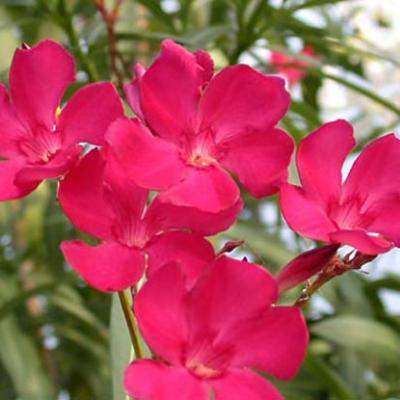
The flowers are tubular with five lobes, red or pink in the wild, but may be white, cream, yellow or purple in cultivars, and double forms have also been selected. Some are scented.
Fruits:
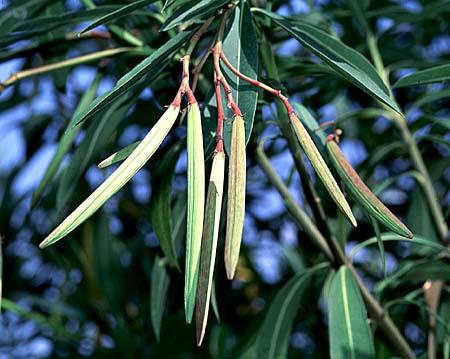
The fruit is composed of a pair of follicles that split along one side to release the seeds. The seeds are oblong, with a plume of hairs at one end.
[IMAGE: https://steemitimages.com/DQmcoxBHN8oWzD4cW2rs2ndkccjET1LYgrG5uTVGjSYnDhr/NeriuOl7.jpg]
Threats and conservation:
Oleander is not threatened globally. Plants are threatened in the wild in some areas through excessive development, but will persist in cultivation.
Uses Ornamental:
Nerium oleander is widely cultivated as an ornamental shrub or as an informal hedge in warm-temperate and dry subtropical regions, and as a plant for the conservatory in cooler climates.
Pest control:
Oleander is highly poisonous to humans, pets, livestock and birds due to the presence of cardiac glycosides, mainly oleandrin. Ingestion causes nausea, vomiting, cardiac arrhythmias, hypotension (low blood pressure) and death. Its sap has been used as rat poison. The leaves also show insecticidal activity against sugarcane mite and citrus leafminer.
[IMAGE: https://steemitimages.com/DQmPdSgs8JXbyNaFXzY1LFinoeQYpi5HU1c9GhXBT4pwnZq/STAG_001925_thumbnail.jpg]
Medicinal:
Oleandrin is used for treating cardiac conditions in patients who cannot tolerate digitalis. In traditional medicine, the leaves have been used for a variety of medicinal purposes, including the treatment of heart diseases, as a diuretic, antibacterial, and against snake-bite.The roots have been used externally in traditional medicine for treating cancer, ulcers and leprosy.
[IMAGE: https://steemitimages.com/DQmRy6XNV7XCXpYwkit68Ds253vx8DbKhcwnpRQsyTRGeE9/18.jpg]
Other:
In Western Sahara the ash from Nerium oleander is mixed with saltpetre to make gunpowder.
Millennium Seed Bank: Seed storage
Kew's Millennium Seed Bank Partnership aims to save plant life world wide, focusing on plants under threat and those of most use in the future. Seeds are dried, packaged and stored at a sub-zero temperature in our seed bank vault.
[IMAGE: https://steemitimages.com/DQmZt7FSNvKsZoVarc8KPzSsacA3S3BpqhBmmbRUuVigDy5/21.jpg]
Two collections of Nerium oleander seeds are held in Kew’s Millennium Seed Bank based at Wakehurst in West Sussex.See Kew's Seed Information Database for further information on Nerium oleander seeds
[IMAGE: https://steemitimages.com/DQmdCPkp44Ub9eF27NHxguFexcC3Qvgmb4agqtv66C8wshk/17.jpg]
Cultivation:
A tender plant, Nerium oleander can survive light frosts, but show signs of frost damage. It is a common landscape plant in tropical and subtropical climates and grows in a wide range of soils. It can withstand drought and salt spray, being widely used in coastal areas, and reacts well to full sun or partial shade. The species can be propagated by semi-ripened cuttings in summer or seeds. Hard pruning helps to maintain its shape.
[IMAGE: https://steemitimages.com/DQmXEAoKKvw3SHWktyzyW5vGXPmFe7Xib3NknQEKZXpA42k/12.jpg]
Distribution:
China, India
Ecology:
Found mostly in seasonally dry rocky watercourses, in full sun.
Conservation:
Least Concern according to IUCN Red List criteria.
Hazards:
All parts of the plant are extremely toxic if eaten; contact with the sap may cause dermatitis; avoid inhaling smoke if burning plants.
Source: http://powo.science.kew.org
Nerium oleander is a highly toxic ornamental shrub widely cultivated in the Mediterranean. It has been grown since ancient times and features in many of the Roman wall paintings in Pompeii.
[IMAGE: https://steemitimages.com/DQmX1X5xmr4E2BEYWhMiJEaC4awNokHSrxPoXT716U8AcxS/Nerium_oleander_crop_main_web_fullsize.jpg]
An evergreen shrub (or small tree) that grows to approximately 6 m. A sticky latex is exuded if the stem is cut.The flowers are tubular with five lobes, red or pink in the wild, but may be white, cream, yellow or purple in cultivars, and double forms have also been selected. Some are scented.
Medicinal:
Oleandrin is used for treating cardiac conditions in patients who cannot tolerate digitalis. In traditional medicine, the leaves have been used for a variety of medicinal purposes, including the treatment of heart diseases, as a diuretic, antibacterial, and against snake-bite.The roots have been used externally in traditional medicine for treating cancer, ulcers and leprosy.
Cultivation:
A tender plant, Nerium oleander can survive light frosts, but show signs of frost damage. It is a common landscape plant in tropical and subtropical climates and grows in a wide range of soils. It can withstand drought and salt spray, being widely used in coastal areas, and reacts well to full sun or partial shade. The species can be propagated by semi-ripened cuttings in summer or seeds. Hard pruning helps to maintain its shape.
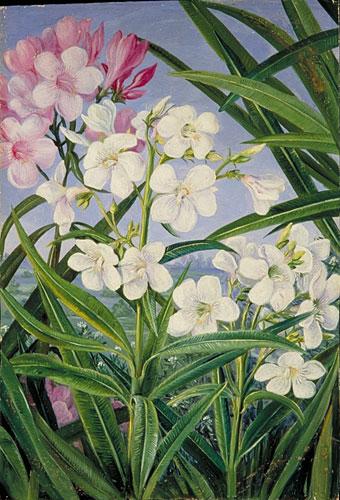
[IMAGE: https://steemitimages.com/DQmdbGj9y4zhbeN7R8XFMdRX1YuZK9Y1PP8rgTiKLCCphNX/STAG_001925_fullsize.jpg]
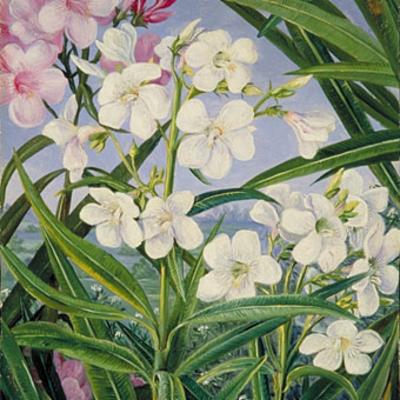
Nerium oleander illustration - Painting of Nerium oleander by Marianne North
[IMAGE: https://steemitimages.com/DQmf8jtyez3ctphcv73vSf7Zj9RTv4Rmvo1hkyhsG7WdZQz/images.jpeg]
[IMAGE: https://steemitimages.com/DQme9wTEeNH9PJNk6ZhVW8u2RmzGtZPt2s1k4pHH2AhWM5A/images%20(1).jpeg]
[IMAGE: https://steemitimages.com/DQmPEudfnETtXWzjfjkiSxaKyi8KsMAsx9HerQ3HK3tdrLF/images%20(2).jpeg]
.jpeg)
.jpeg)
Thanks for reading @ctrl-alt-nwo
Magoo-2 found a series of multi accounts of a same owner is following your articles to cheat your generous rewards.
Magoo-2 found these accounts are suspicious & can be multi accounts of a single owner. Conclusion is based on last 30 days transactions:
@dangerux
@cointurk
@thegossip
@bburak30
@embesilikat
@kagantrky
@amalinavia
@gesund
@kksafak
@bado
@fkorkmaz
@bahriyeli
@ygmraykt
@ucmuharfli
@mertkrtsss
@curious4
@alkmaar
magoo-2
Check our latest multi comment spam update report
Hey @magoo-2
I don't know this account!!!
I don't use multi account
You can't blame me!!!!!
Oleander is a plant. Its use as a poison is well known. In fact, oleander is reportedly a favorite suicide agent in Sri Lanka, where oleander poisonings exceed 150 per 100,000 each year. That’s a high number. Approximately 10% of these ingestions are fatal.
[IMAGE: https://steemitimages.com/DQmQ1cEDtwAEQSqqDcjt3vXexydw3JXNC2iKon5WyZGy8oR/17293094_m.jpg]
Other Names:
Adelfa, Baladre, Cascabela thevetia, Cerbera thevetia, Common Oleander, Exile Tree, Huang Hua Jia, Jia Zhu Tao, Kaner, Karvir, Karvira, Laurel Rosa, Laurier-Rose, Laurier Rose, Laurose, Nérier à Feuilles de Laurier, Nérion, Nerium indicum, Neriu.
[IMAGE: https://steemitimages.com/DQmP5oBzSsxLUhBykGsmEqqmVnG27zzvuLNSjeC8anSK4DV/20958045_m.jpg]
Despite the danger, oleander seeds and leaves are used to make medicine. Oleander is used for heart conditions, asthma, epilepsy, cancer, painful menstrual periods, leprosy, malaria, ringworm, indigestion, and venereal disease; and to cause abortions.
[IMAGE: https://steemitimages.com/DQmcLDpH6b1oZC3Q8UgV3uGCNVTSRFcGWZ5V8Doh7XoNvPC/464308_m.jpg]
A fixed combination of oleander leaf powdered extract, pheasant's eye fluid extract, lily-of-the-valley fluid extract, and squill powdered extract has been used for treating mild heart failure.
[IMAGE: https://steemitimages.com/DQmRXJQ1g1DhLSdfCavAhGiTQMh1N1XF2Roke4GATGCQbx4/NeriuOl6.jpg]
Oleander is sometimes applied to the skin to treat skin problems and warts.
How does it work?
Oleander contains chemicals called glycosides, which can affect the heart. These chemicals can slow the heart rate down.
[IMAGE: https://steemitimages.com/DQmPdSgs8JXbyNaFXzY1LFinoeQYpi5HU1c9GhXBT4pwnZq/STAG_001925_thumbnail.jpg]
Oleander poisoning occurs when someone eats the flowers or chews the leaves or stems of the oleander plant (Nerium oleander), or its relative, the yellow oleander (Cascabela thevetia).
Congrats, you won the Fav.comment Award ! Great pics selection and good info. Well done !
Thank you so much @ctrl-alt-now for select my Reply for the Fav.comment Award.
Oleander (Nerium oleander) is an evergreen shrub or small tree that is prized by home gardeners for its showy, funnel-shaped blooms. Hardy to U.S. Department of Agriculture plant hardiness zones 8 through 10, oleander is part of the Apocynaceae or dogbane family. Oleanders are fast-growing and easy to care for, which makes them an appealing landscape plant. However, all parts of this plant are highly toxic and in some locations is considered invasive.
https://garden.org/pics/2012-08-28/flaflwrgrl/9e9837.jpg
Plant Description
Oleander plants are durable shrubs or trees that contain a gummy, clear sap. The leathery lance-shaped foliage is deep green and may be arranged opposite along the stems or in whorls. Oleander’s funnel-shaped flowers bloom in clusters at the twig tips from summer to fall, and come in shades of white, pink, red, or yellow. The flowers are often abundant, and some oleander varieties give off a pleasant fragrance. Oleanders typically grow to between 6 and 12 feet tall, with a spread of the same width, but some may be trained to grow into small trees that reach up to 20 feet tall.
https://garden.org/pics/2014-06-08/DavidofDeLand/5d001e.jpg
Poisonous Parts
Oleander plants contain several toxic elements, including cardiac glycosides, saponins, digitoxigenin, oleandrin, oleondroside, nerioside and other unknown toxins. These poisons are found in all parts of the oleander plant and are toxic whether the plant parts are dried or green. Ingestion of any part of the oleander plant can lead to serious illness and possibly death.
https://garden.org/pics/2018-01-09/Fleur569/946605.jpg
Symptoms of Poisoning
Ingesting oleander plant parts can result in a variety of symptoms ranging from moderate to severe or fatal. These include skin rash, blurred vision, visual disturbances such as halos, diarrhea, nausea, stomach pain, vomiting, loss of appetite, irregular or slowed heartbeat, weakness, low blood pressure, confusion, dizziness, headache, fainting, depression, drowsiness, or lethargy. Symptoms such as depression, loss of appetite, and halos in the vision are typically only present in cases of chronic or severe poisonings.
https://garden.org/pics/2012-07-10/TexasPlumeria87/00ef29.jpg
https://garden.org/pics/2017-06-21/cliftoncat/5a2c4f.jpg
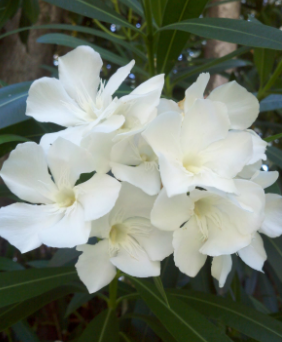
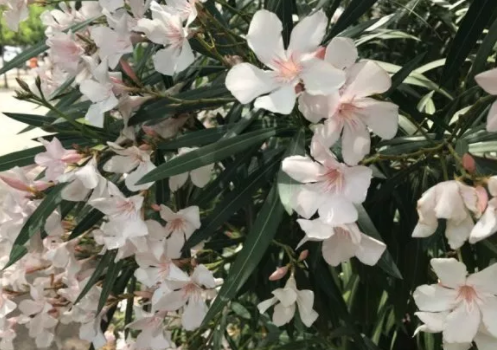
Oleander flowers color are many. Some of oleander flowers color are white .Oleander is the common and species name for a poisonous evergreen shrub or small tree, Nerium oleander, in the dogbane family Apocynaceae, characterized by dark green, lanceolate leaves, flowers with a deeply 5-lobed corolla clustered at the end of the branches, and fruit in the form of a long, narrow capsule with numerous comose seeds. Oleander is one of the most poisonous plants to humans known. It is found from Portugal in Europe and Morocco in Northern Africa to China. Among other common names is rosebay.
Here those :
White oleander
[IMAGE: https://steemitimages.com/DQmQJshh18S23UfEJuF2cDMPhUMBEDnj44QrTNfdic1vQQB/2018-04-06_152641.png]
[IMAGE: https://steemitimages.com/DQmXsENRFP1eV26NSgJYeFbfnaV3QwqPv8jshNSK186RGwC/2018-04-06_152654.png]
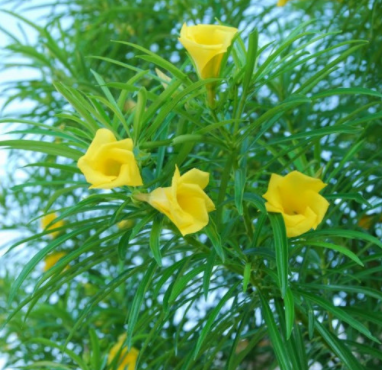
Some of oleanders colors are yellow... I pick some of those photo here
Yellow Oleander
[IMAGE: https://steemitimages.com/DQmfTdvqw7iLpRrNf4sAkDCavoCHZft8sQZGF4bpv1Jf3Gx/2018-04-06_152347.png]
[IMAGE: https://steemitimages.com/DQmV7a7VTJxpHEKnEjC1fS4RDmF5mQMTD32aub3NghHQzC5/2018-04-06_152254.png]
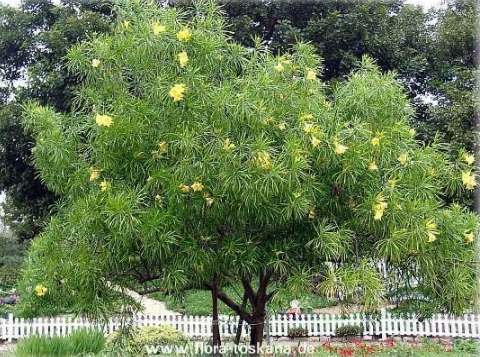
[IMAGE: https://steemitimages.com/DQmfTdvqw7iLpRrNf4sAkDCavoCHZft8sQZGF4bpv1Jf3Gx/2018-04-06_152347.png]
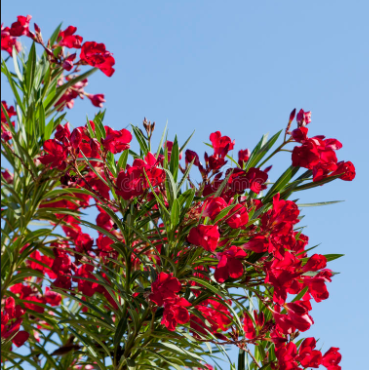
Some oleanders has red color flowers...
# Red Oleander
[IMAGE: https://steemitimages.com/DQma5N56nP3utS1WbknriRPj3thQvqU7CjyuYpiq4WUv3NV/2018-04-06_152415.png]
Oleander Plant Diseases Bacterial pathogens are the culprits behind the primary oleander plant diseases, although some fungal pathogens may also infect oleanders. These organisms can infect plants through pruning cuts, and they’re often transmitted by insects that feed on the plant tissue.
[IMAGE: https://steemitimages.com/DQmRXqoiUswSYKqYC6euwjChQy78uR3JtJqcVqmVuScsiga/2018-04-06_153250.png]
Oleander has seeds also... I pick some of snap shot.. Here
[IMAGE: https://steemitimages.com/DQmPvFNeYr7UiUpMF73TbjsTqyiWmLCb4Qk4H9WSsLpesex/2018-04-06_152431.png]
Nerium oleander is a popular ornamental garden plant due to its beauty and tolerance of poor soil and drought, but unfortunately it’s very toxic to many species of animals.
Dogs, cats, goats, cattle, sheep, camelids, budgerigaries, rabbits and horses are all species that have been affected by oleander. Studies indicate mice, rats and chickens may be more resistant to the cardiac effects of Oleander; however, at higher doses neurological signs may be seen in these animals.
Mechanism of Action
Oleander contains cardiac glycosides, which inhibit the sodium/potassium ATPase pump, causing hyperkalemia and also increased intracellular calcium leading to early depolarization, cardiac irritability and arrhythmias.
Last but not least, glycosides decrease sympathetic tone and increase vagal tone, resulting in bradycardia and heart block.
Clinical signs may include:
Gastrointestinal (vomiting, diarrhea)
Arrhythmias (bradycardia, tachycardia, ventricular tachycardia, premature ventricular contractions, AV block)
Blood pressure changes (hypotension or hypertension)
Neurological signs (lethargy, depression, ataxia, tremors, seizures)
Dehydration
Shock
Laboratory Findings
Hyperkalemia is the most common; however, hypoglycemia has been reported as a direct result of the toxins.
Due to potential severity of signs, other changes such as hemoconcentration, prerenal azotemia and electrolyte abnormalities may be seen secondary to the gastrointestinal effects and/or poor perfusion.
Treating the Asymptomatic Pet
If the pet has presented without symptoms and is a recent exposure (generally three hours or less post exposure), emesis may be considered. Activated charcoal also should be considered, with repeated doses considered in large exposures.
Monitor the patient in hospital for a minimum of 12 hours. If signs develop, they may last up to three days. Encouraging passage of plant material, particularly in large exposures, is advised. Obtaining baseline electrolytes, glucose, and biochemistry profile is ideal.
Treating the Symptomatic Pet
Manage vomiting with an antiemetic if needed.
Administer IV fluids with a balanced electrolyte solution (avoid calcium containing fluids) for rehydration and cardiovascular support.
Evaluate and address cardiovascular signs—typically hypotension is secondary to arrhythmias. Atropine is appropriate for bradycardia or AV block, lidocaine for tachyarrhythmias.
Benzodiazepines may be used for seizures.
Hyperkalemia may need to be addressed with sodium bicarbonate or insulin/dextrose therapy.
Specific antagonist: digibind (if available).
Drugs are designed to cure illnesses, but at times they can also become200px-Oleandrin-skeletal.svg instruments of death. And historically, many drugs originated as botanicals. Even today, many drugs and their active ingredients come from plant sources.
Awhile back, I came across an interesting report that described a drug from plant origin that can both cure and kill. As I read the article describing what is being developed from the sap of the oleander plant, I remembered what my mother used to tell me. “Stay away from the oleander. It’s poison!
The oleander plant (Nerium oleander) is a common shrub found in warm Southern climates. It grows as tall as twelve feet and produces beautiful, fragrant, colorful blossoms.
Oleander is indeed a poisonous plant. The milky sap from the leaves and stems contain oleandrin, a powerful cardiac glycoside so toxic that ingesting one leaf has been reported to kill a small child. Although documentation is poor regarding the exact toxicity of the sap, it’s been estimated that ingesting 15-20 leaves would kill a normal adult (Yes, I also wonder who would enjoy a lunch of oleander leaves).
Symptoms of an overdose include gastrointestinal (nausea, vomiting, diarrhea), cardiac (interestingly, both lethal slowing and rapid increases in heart rates) and neurological (tremors, loss of muscle control, seizures).
Accidental poisoning from oleandrin ingestion can be deadly and articles are published so that physicians have established medical protocols to deal with such potentially lethal poisoning.
On the other hand, oleandrin—when properly prepared as a drug—has been used beneficially for years. In Russia and China, it is used to treat congestive heart failure and cardiac arrhythmias. An interesting tidbit is that it is also a popular method of suicide in both of those countries. Such actions are also becoming a growing concern in Sri Lanka.
Presently, oleandrin is being studied as a promising anti-cancer treatment. Patented drug extracts are being investigated at the Memorial Sloan Kettering Cancer Center for various innovative treatments of cancers. Other studies have investigated the cytotoxic properties of oleandrin for treating melanomas.
As I’ve read about these new drug developments, I thought about how drugs have been used throughout the ages to cure and kill. Ancient alchemy, as a precursor to modern pharmacology, produced wonderful life-saving medicines while at the same time spawning lethal poisons for primitive weapons such as darts and arrows.Modern pharmacology has furthered this balance of curative and lethal science in much the same way—so many ways to heal, and yet so many methods to kill. I find it especially interesting that many modern drugs have a narrow therapeutic window in that a small amount of drug is good, but a little more can be deadly
Oleander does seems pretty beautiful and like you said quite dangerous as it seems !
Nice of you to buddy to introduce it to us !
Can I suggest this beautiful flower a new name?
Nerium 'dont touch too much' oleander
Oleander is a shrub or small tree that blooms in summer with large, striking flowers in shades of red, white, light yellow, and pink. Because of its dense branching and rapid growth rate it is a popular hedge. Planting an oleander hedge is an excellent way to hide utilities, chain link fences, and other eyesores in the landscape. It also makes an attractive specimen plant if planted singly or in a garden border.
While it can reach twenty feet, oleander takes well to pruning and is typically kept at six to ten feet. Tolerant of dry soils and hot sun, oleander is an excellent plant for the desert, but can thrive in warm, humid climates as well.
Growing Requirements for Oleander
For the best flowering, plant oleanders in full sun, but in very hot climates they bloom more reliably in light shade. Oleanders tolerate a range of soil conditions, from dry sandy soils to moist clay soils. They grow best where the weather stays above freezing, although they can tolerate short periods of below-freezing temperatures.
Depending on how the plants are to be used and the size of the cultivar, the ideal planting distance ranges from five to ten feet. In the right climate oleander is easy to grow and requires no special care beyond annual pruning and feeding.
Pruning Oleander
Prune after flowering to stimulate new branches, control size and shape, avoid leggy growth, and encourage next year’s flower buds. Remove suckers, which can interfere with flowering, and dead branches.
Oleander Propagation
Propagate oleanders by taking cuttings of healthy, young stems in summer and rooting them in a mix of sand and peat.
Oleander Toxicity
All parts of oleander are poisonous. They contain a toxic chemical that can cause illness, skin irritation, or even death if eaten in enough quantity. Fortunately the plant has an acrid taste that causes a gagging reaction in most people that causes them to throw up. Burning oleander also causes toxicity, so it should never be put in a burn pile, nor should it be used as a stake for roasting food over a fire.
Wearing gloves while working with oleander may prevent allergic skin reactions. Because of its toxicity, oleander is not recommended for playgrounds or other places children play.
[IMAGE: https://steemitimages.com/DQmY6u7EacqqpjZLzv3yhicHHXKj18H94A2gRKqSUmhRAd4/5675.jpg]
[IMAGE: https://steemitimages.com/DQmQK9zSRQh7xScvqQRqAVA97wrK7Z1hxXbaFsvZMge53yK/oleander.jpg]
[IMAGE: https://steemitimages.com/DQmaSzk8DuWRbJzK9Aj11aAZe7ncbe8s599f55VS2DUwUaA/oleander-lovely-flower.jpg]
[IMAGE: https://steemitimages.com/DQmY4QnXNM6bmjRoZ8wGySavpSCQNcVzyQ4JEjEVS6NxEGr/512FkZOGX0L._SY400_.jpg]
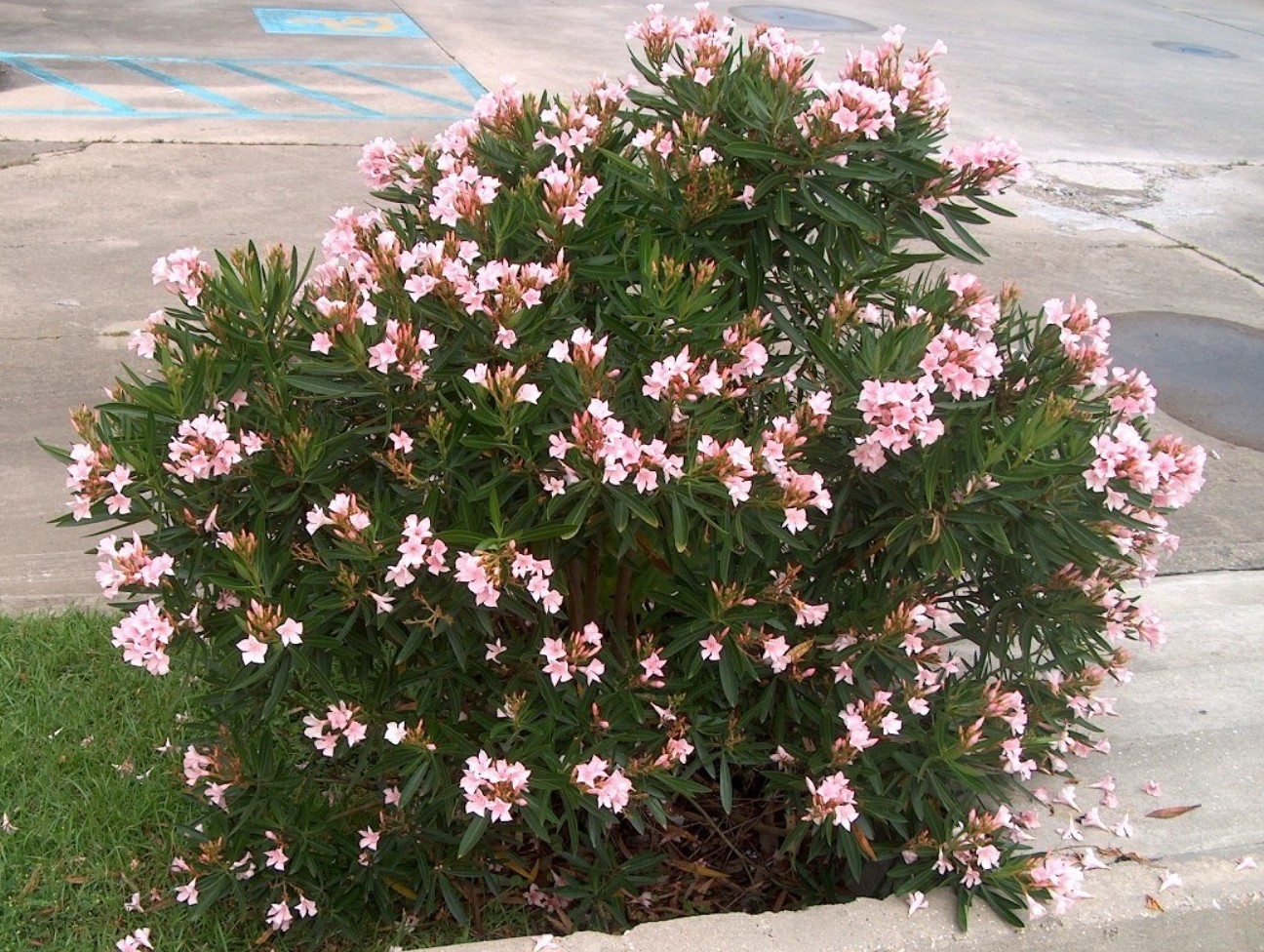
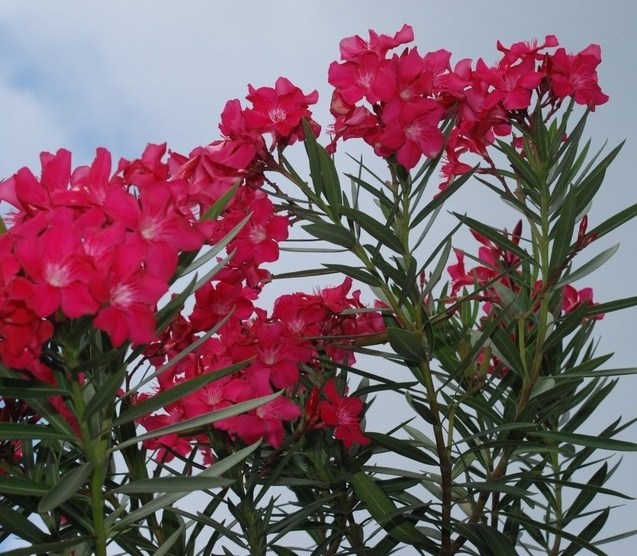
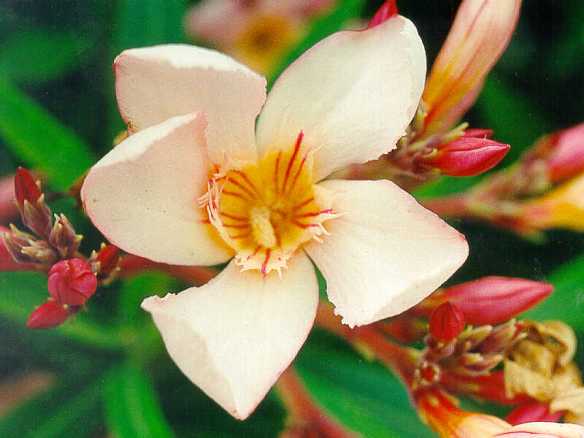
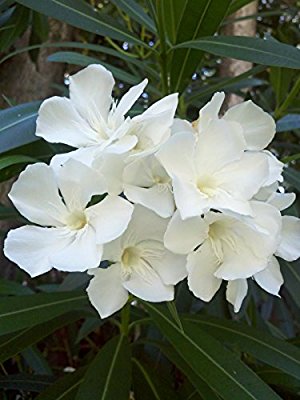
Source: From google free to search and use*
This very beautiful garden and beautiful photography
thanks @ctrl-alt-nwo
Have a great day.
[IMAGE: https://steemitimages.com/DQmPTATvRxmwTCf3ZsxjBW2SE5zgfhb37WdyRWd4PigaNzL/DSC02082.JPG]
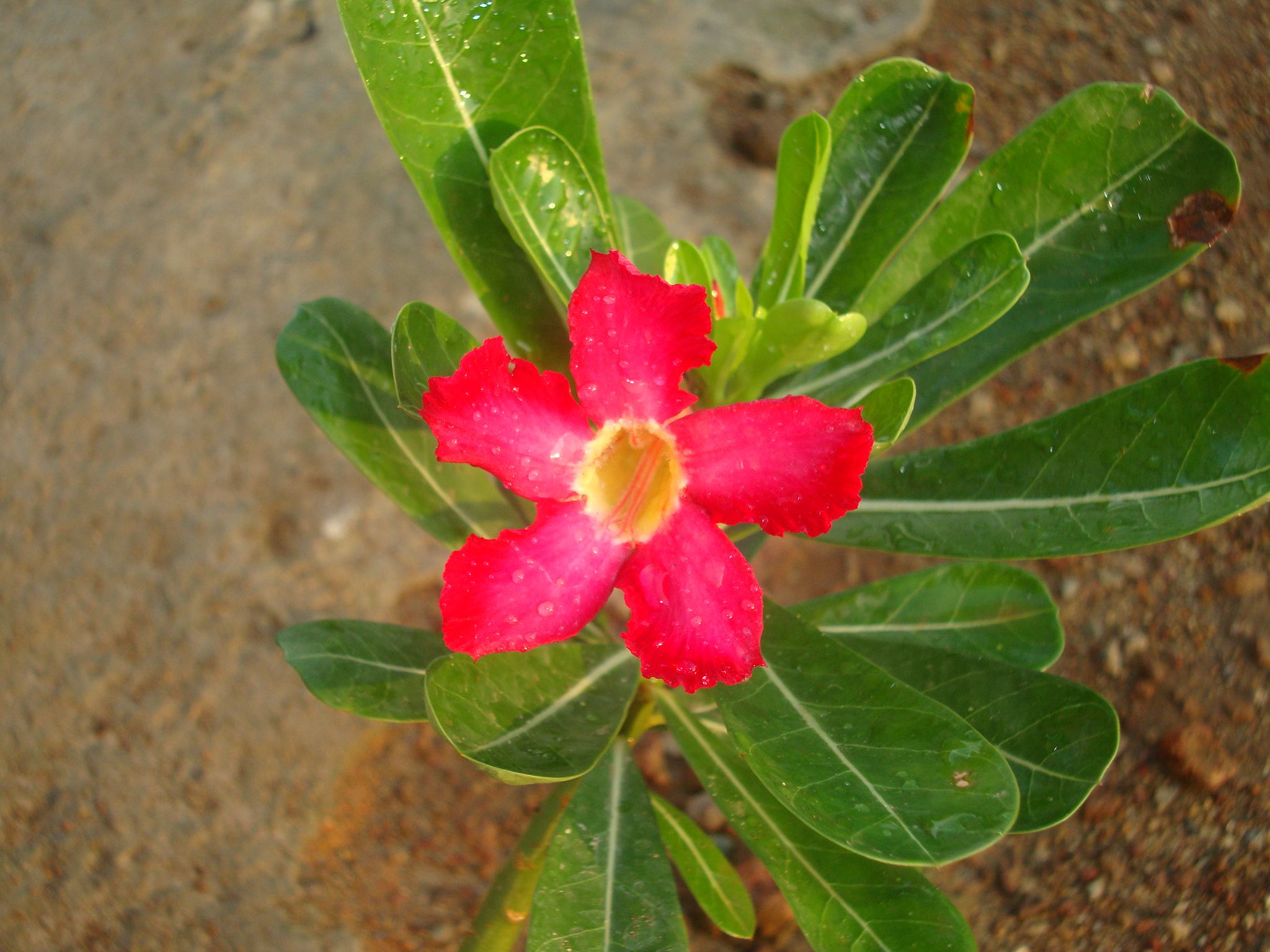
https://www.haus-garten-magazin.de/wp-content/uploads/2018/02/oleander.jpg
https://s.hdnux.com/photos/04/32/51/1157705/3/rawImage.jpg
https://cdn.pixabay.com/photo/2011/09/14/12/06/oleander-9189_960_720.jpg
Another wonderful post by @ctrl-alt-nwo sir...
Nerium oleander is a shrub or small tree in the dogbane family Apocynaceae, toxic in all its parts. It is the only species currently classified in the genus Nerium. It is most commonly known as nerium or oleander, from its superficial resemblance to the unrelated olive Olea. It is so widely cultivated that no precise region of origin has been identified, though southwest Asia has been suggested. The ancient city of Volubilis in Morocco may have taken its name from the Berber name oualilt for the flower.Oleander is one of the most poisonous commonly grown garden plants.
[IMAGE: https://steemitimages.com/DQmP4F7ALLRuooD3F63jgFFLz6CUuxKxPxtuNKwypwgMM7g/download%20(3).jpeg]
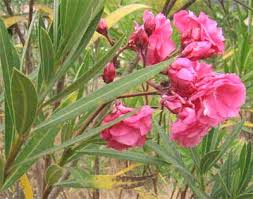.jpeg)
Scientific classification...
1. Kingdom: Plantae
2. Clade: Angiosperms
3. Clade: Eudicots
4. Clade: Asterids
5 Order: Gentianales
6. Family: Apocynaceae
7. Subfamily: Apocynoideae
8. Tribe: Wrightieae
9. Genus:Nerium L.
10. Species: N. oleander
[IMAGE: https://steemitimages.com/DQmfFm9AesEDSCzvftuhpLtRuf4moUeA4HYcpnRkZm5ADCk/images%20(29).jpeg]
.jpeg)
Wel done and perfect work sir...
I used to work in a horticultural nursery as a teenager and these were a great seller for us.
@ctrl-alt-nwo sir...
I have Oleander trees is my home garden with flowers...I'm always maintain my garden...it is my hobby sir...
This is my little kid with flowers...all pictures taken my samsung galaxy phone...
[IMAGE: https://steemitimages.com/DQmQNxEo1tkHjYtxzJXqRFYmN1WFprg5q4dWHCCouwLJkMz/20180124_074846.jpg]

[IMAGE: https://steemitimages.com/DQmSsPzfL1MgHCPCgBvfSPcBmpqBUioDBHsjMRk49APY2Zg/20180124_074844.jpg]

Oleander care is easy and this makes the shrub popular with highway departments. You’ll often see masses of oleander shrubs planted in highway beautification projects where they provide an outstanding display of long-lasting flowers with very little maintenance. Even in the garden, oleander shrubs require minimal care. Although the shrubs are drought-tolerant, they look their best when they are watered during dry spells. However, take care not to over water them. Yellowing leaves indicate that the plant is getting too much water. If the soil is poor, feed the plant lightly with a balanced fertilizer during its first spring. Once established, oleander shrubs don’t require routine fertilization. Pinching out the tips of young stems reduces legginess and encourages the shrub to branch out. Pruning oleanders can also be performed. Prune to remove damaged or diseased limbs any time and prune to shape the shrub in late fall.
Happy garderning...
Another wonderful and interesting flower post by @ctrl-alt-nwo sir....
[IMAGE: https://steemitimages.com/DQme7s5taJKSim7YzKBKfyvBqj7oidxEahiLrJUAtd64h2a/images%20(30).jpeg]
Oleander plants (Nerium oleander) are among the most versatile of shrubs, with dozens of uses in southern and coastal landscapes. They tolerate a wide range of conditions, including difficult soil, salt spray, high pH, severe pruning, reflected heat from pavements and walls, and drought. But the one thing they can’t withstand is winter temperatures below 20 degrees Fahrenheit. However, in cooler climates, you can grow an oleander plant in a container and bring it indoors when temperatures drop.
[IMAGE: https://steemitimages.com/DQmWeHKhTDNn7XRVQg39x4AF9PWQBayAqhnBgSMnjrBX8pt/images%20(32).jpeg]
Oleander flowers are showy, profuse, and often fragrant, which makes them very attractive in many contexts. Over 400 cultivars have been named, with several additional flower colors not found in wild plants having been selected, including yellow, peach and salmon. Many cultivars, like "Hawaii" or "Turner's Carnival", are multi-colored, with brilliant striped corollas.The solid whites, reds and a variety of pinks are the most common. Double flowered cultivars like "Mrs Isadore Dyer" (deep pink), "Mathilde Ferrier" (yellow) or "Mont Blanc" (white) are enjoyed for their large, rose-like blooms and strong fragrance. There is also a variegated form, 'Variegata', featuring leaves striped in yellow and white.Several dwarf cultivars have also been developed, offering a more compact form and size for small spaces. These include "Little Red", "Petite White", "Petite Pink" and "Petite Salmon", which grow to about 8 feet at maturity.
[IMAGE: https://steemitimages.com/DQmV6gBSndkZbhSkoxfWhfUE46FwYG8GWn9SJX8zPRYzHmD/images%20(31).jpeg]
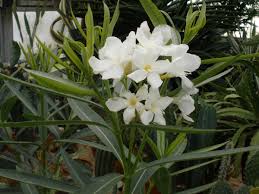.jpeg)
.jpeg)
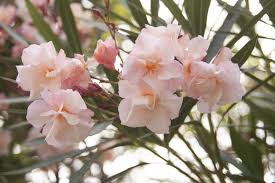.jpeg)
Wel done sir...waiting for ur next valuble post...
Soo beautiful white rose, my most favorite color in flowers!
But looks soo pretty also in this shape.
@ctrl-alt-nwo - Sir according to your article this is a very dangerous but beautiful plant... I like it's flower but Sir the beauty hidden the poison... Valuable description & photography Sir...
+W+
[IMAGE: https://steemitimages.com/DQmb3QpoimHncBtP22LoepeKAjYykiv6RAf6fVdFL5ACnJS/neriumoleander12.jpg]
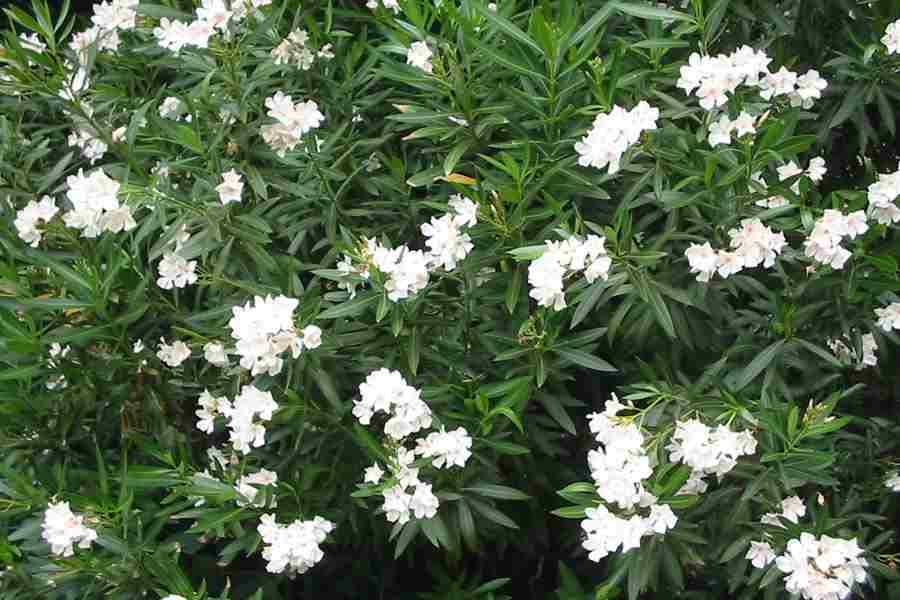
[IMAGE: https://steemitimages.com/DQmeY8JcD1q14ZXVoBKosk6KchqcKuMQDquRyYvkUwaSuBh/nerium-oleander2.jpg]
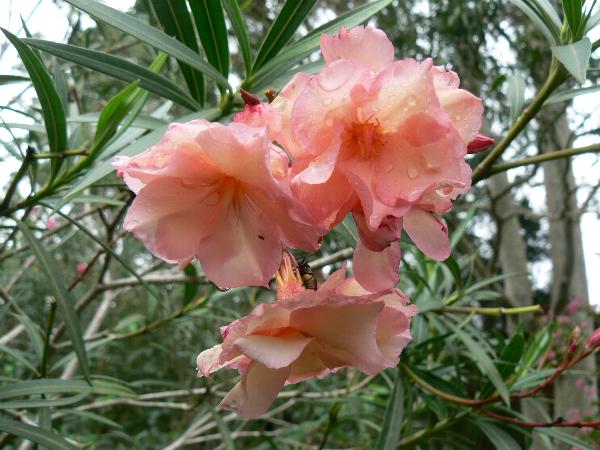
Nerium oleander , commonly known as oleander, is a highly toxic plant that has been cultivated since ancient times.
Nerium oleander is a highly toxic ornamental shrub widely cultivated in the Mediterranean. It has been grown since ancient times and features in many of the Roman wall paintings in Pompeii.
Alexander the Great in his military campaigns is said to have lost men as a result of eating meat skewered on highly poisonous Nerium twigs.
Geography and distribution
Native to the Mediterranean region, Iran, the Indian subcontinent and southern China.
Description
An evergreen shrub (or small tree) that grows to approximately 6 m. A sticky latex is exuded if the stem is cut.
Leaves
Leaves are usually in groups of three and narrowly lanceolate.
Flowers
The flowers are tubular with five lobes, red or pink in the wild, but may be white, cream, yellow or purple in cultivars, and double forms have also been selected. Some are scented.
Fruits: The fruit is composed of a pair of follicles that split along one side to release the seeds. The seeds are oblong, with a plume of hairs at one end.
Threats and conservation
Oleander is not threatened globally. Plants are threatened in the wild in some areas through excessive development, but will persist in cultivation.
Uses Ornamental
Nerium oleander is widely cultivated as an ornamental shrub or as an informal hedge in warm-temperate and dry subtropical regions, and as a plant for the conservatory in cooler climates.
Pest control
Oleander is highly poisonous to humans, pets, livestock and birds due to the presence of cardiac glycosides, mainly oleandrin. Ingestion causes nausea, vomiting, cardiac arrhythmias, hypotension (low blood pressure) and death. Its sap has been used as rat poison. The leaves also show insecticidal activity against sugarcane mite and citrus leafminer.
[IMAGE: https://steemitimages.com/DQmaNCFS3p7oxJUA7XZ4LuJxPF5QoZdzgmbHJfUayK3sTye/5663296_f520.jpg]
[IMAGE: https://steemitimages.com/DQmXXZiDxUqzXSXFFbV9XzndThwCdQcEfUDgyGcLtj5ckrd/8091601.jpg]
[IMAGE: https://steemitimages.com/DQmdmjeTF8yzwmKr2Cf91hHXxPBhkX5Rf7HaZt3xgHz1Zih/5674477_f520.jpg]
source
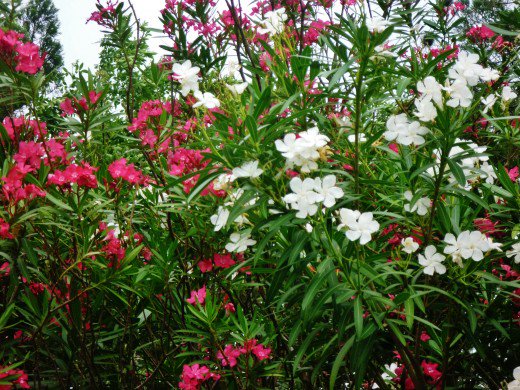
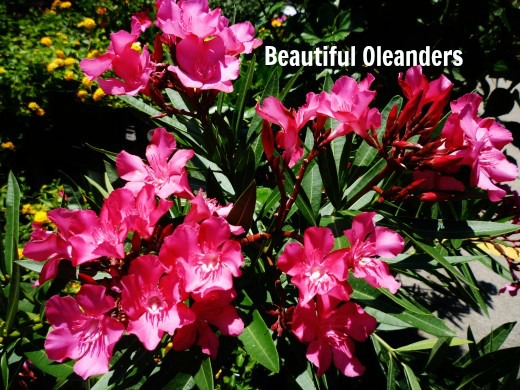
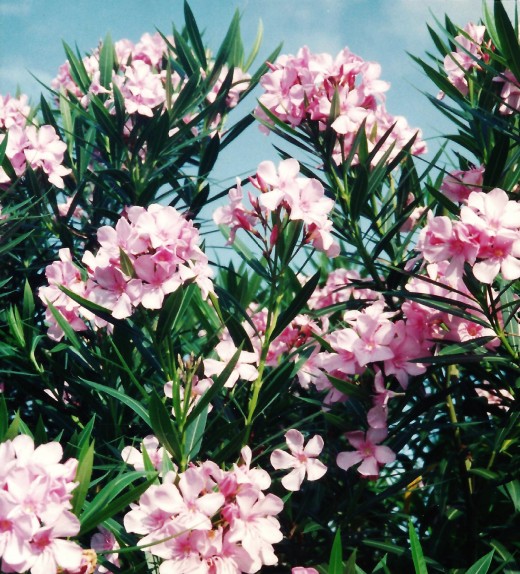
Thank you @ctrl-alt-nwo for your kind support and time.
Beautiful photography.Awesome great work sir.have a great day.
That's so beautiful to see very different and amazing they look thanks for sharing :D
Another very interesting post by @ctrl-alt-nwo sir.I am sure you are a true nature lover.Let me find something interesting for you.
Introduction:
Nerium oleander is a shrub or small tree in the dogbane family Apocynaceae, toxic in all its parts. It is the only species currently classified in the genus Nerium. It is most commonly known as nerium or oleander, from its superficial resemblance to the unrelated olive Olea. It is so widely cultivated that no precise region of origin has been identified, though southwest Asia has been suggested. The ancient city of Volubilis in Morocco may have taken its name from the Berber name oualilt for the flower. Oleander is one of the most poisonous commonly grown garden plants.Oleander grows to 2–6 m (6.6–19.7 ft) tall, with erect stems that splay outward as they mature; first-year stems have a glaucous bloom, while mature stems have a grayish bark. The leaves are in pairs or whorls of three, thick and leathery, dark-green, narrow lanceolate, 5–21 cm (2.0–8.3 in) long and 1–3.5 cm (0.39–1.38 in) broad, and with an entire margin filled with minute reticulate venation web typical to Eudicots. Leaves are light green and very glossy when young, before maturing to a dull dark green/greenish gray. The flowers grow in clusters at the end of each branch; they are white, pink to red, 2.5–5 cm (0.98–1.97 in) diameter, with a deeply 5-lobed fringed corolla round the central corolla tube. They are often, but not always, sweet-scented. The fruit is a long narrow pair of follicles 5–23 cm (2.0–9.1 in) long, which splits open at maturity to release numerous downy seeds.
Ecology:Some invertebrates are known to be unaffected by oleander toxins, and feed on the plants. Caterpillars of the polka-dot wasp moth (Syntomeida epilais) feed specifically on oleanders and survive by eating only the pulp surrounding the leaf-veins, avoiding the fibers. Larvae of the common crow butterfly (Euploea core) also feed on oleanders, and they retain or modify toxins, making them unpalatable to potential predators such as birds, but not to other invertebrates such as spiders and wasps.
The flowers require insect visits to set seed, and seem to be pollinated through a deception mechanism. The showy corolla acts as a potent advertisement to attract pollinators from a distance, but the flowers are nectarless and offer no reward to their visitors. They therefore receive very few visits, as typical of many rewardless flower species. Fears of honey contamination with toxic oleander nectar are therefore unsubstantiated.
Colors and varieties:Oleander flowers are showy, profuse, and often fragrant, which makes them very attractive in many contexts. Over 400 cultivars have been named, with several additional flower colors not found in wild plants having been selected, including yellow, peach and salmon. Many cultivars, like "Hawaii" or "Turner's Carnival", are multi-colored, with brilliant striped corollas.[29] The solid whites, reds and a variety of pinks are the most common. Double flowered cultivars like "Mrs Isadore Dyer" (deep pink), "Mathilde Ferrier" (yellow) or "Mont Blanc" (white) are enjoyed for their large, rose-like blooms and strong fragrance. There is also a variegated form, 'Variegata', featuring leaves striped in yellow and white. Several dwarf cultivars have also been developed, offering a more compact form and size for small spaces. These include "Little Red", "Petite White", "Petite Pink" and "Petite Salmon", which grow to about 8 feet at maturity.
Cultivation history:Nerium oleander has a history of cultivation going back millennia, especially amongst the great ancient civilizations of the Mediterranean Basin. Some scholars believe it to be the rhodon (rose), also called the 'Rose of Jericho', mentioned in the Bible (Ecclesiastes XXIV, 13) dating back to between 450 and 180 BC. This is because no form of the traditional rose occurs in the wild in Palestine, but pink-flowering Oleander is common throughout the region.
The ancient Greeks had several names for the plant, including rhododaphne, nerion, rhododendron and rhodon.[56] Pliny confirmed that the Romans had no Latin word for the plant, but used the Greek terms instead.
Toxicity:Oleander has historically been considered a poisonous plant because some of its compounds may exhibit toxicity, especially to animals, when consumed in large amounts. Among these compounds are oleandrin and oleandrigenin, known as cardiac glycosides, which are known to have a narrow therapeutic index and can be toxic when ingested.[IMAGE: https://steemitimages.com/DQmXp8FFD624aw8YNK7dHKpkL7w35VEtk2SbjKcQeJn4KfP/330px-%CE%9A%CE%B1%CF%81%CF%80%CE%BF%CE%AF_%CF%80%CE%B9%CE%BA%CF%81%CE%BF%CE%B4%CE%AC%CF%86%CE%BD%CE%B7%CF%82-%CF%81%CE%BF%CE%B4%CE%BF%CE%B4%CE%AC%CF%86%CE%BD%CE%B7%CF%82.jpg]
Toxicity studies of animals administered oleander extract concluded that rodents and birds were observed to be relatively insensitive to oleander cardiac glycosides. Other mammals, however, such as dogs and humans, are relatively sensitive to the effects of cardiac glycosides and the clinical manifestations of "glycoside intoxication".[IMAGE: https://steemitimages.com/DQmYw8ryzEWawezD7YWKhA9zrjQWFEbK3Xm7cJBT4s1H5sv/330px-Nerium_Oleander_(yellow%2C_unusual--may_be_Sue_Hawley_Oakes).jpg]
Effects of poisoning:Ingestion of this plant can affect the gastrointestinal system, the heart, and the central nervous system. The gastrointestinal effects can consist of nausea and vomiting, excess salivation, abdominal pain, diarrhea that may contain blood, and especially in horses, colic. Cardiac reactions consist of irregular heart rate, sometimes characterized by a racing heart at first that then slows to below normal further along in the reaction. Extremities may become pale and cold due to poor or irregular circulation. The effect on the central nervous system may show itself in symptoms such as drowsiness, tremors or shaking of the muscles, seizures, collapse, and even coma that can lead to death.[IMAGE: https://steemitimages.com/DQmZj6bVLaDcGSBg91VLr3Cy134qfr4W7agJTVyDNfTZFd4/Nerium_oleander_Ouarzazate_wild2.jpg]
Oleander sap can cause skin irritations, severe eye inflammation and irritation, and allergic reactions characterized by dermatitis.
Treatment:Poisoning and reactions to oleander plants are evident quickly, requiring immediate medical care in suspected or known poisonings of both humans and animals. Induced vomiting and gastric lavage are protective measures to reduce absorption of the toxic compounds. Charcoal may also be administered to help adsorb any remaining toxins. Further medical attention may be required depending on the severity of the poisoning and symptoms. Temporary cardiac pacing will be required in many cases (usually for a few days) until the toxin is excreted.
Digoxin immune fab is the best way to cure an oleander poisoning if inducing vomiting has no or minimal success, although it is usually used only for life-threatening conditions due to side effects
Drying of plant materials does not eliminate the toxins. It is also hazardous for animals such as sheep, horses, cattle, and other grazing animals, with as little as 100 g being enough to kill an adult horse. Plant clippings are especially dangerous to horses, as they are sweet. In July 2009, several horses were poisoned in this manner from the leaves of the plant. Symptoms of a poisoned horse include severe diarrhea and abnormal heartbeat. There is a wide range of toxins and secondary compounds within oleander, and care should be taken around this plant due to its toxic nature. Different names for oleander are used around the world in different locations, so, when encountering a plant with this appearance, regardless of the name used for it, one should exercise great care and caution to avoid ingestion of any part of the plant, including its sap and dried leaves or twigs. The dried or fresh branches should not be used for spearing food, for preparing a cooking fire, or as a food skewer. Many of the oleander relatives, such as the desert rose (Adenium obesum) found in East Africa, have similar leaves and flowers and are equally toxic.
It's a beautiful yet dangerous flower.Keeping safe distance is adviced.Thanks for the post.@upvoted
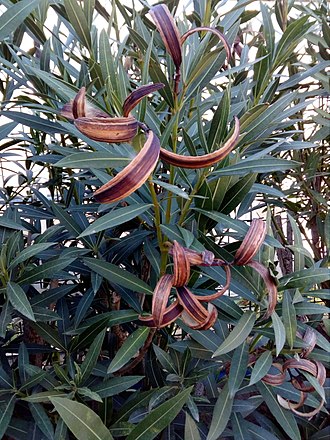
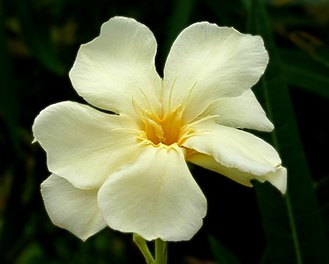.jpg)
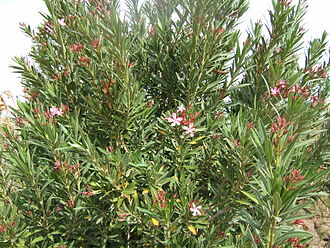
- Oleander is especially grown in the creek beds and on the water sides. Thirst is the most durable plants and does not shed its leaves in winter.
[IMAGE: https://steemitimages.com/DQmS2VyyPT3Lw9fpFfEH1aD1Es6GTtRViqijt3Pa2MMFqpV/flowers-1408015__340.jpg]
source:
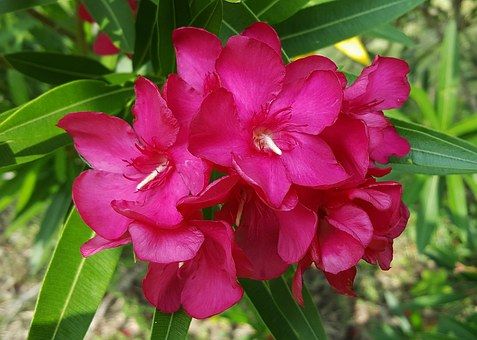

- They are also grown as ornamental plants in the gardens. It is a plant with beautiful fragrance and wonderful summer flowers that decorate the winter gardens with effortless flowers.
[IMAGE: https://steemitimages.com/DQmS5rvnDBcccooJ7e1vPW62Vn64YphamTDKZPFUueSrDbK/oleander-1521525__340.jpg]
Source:
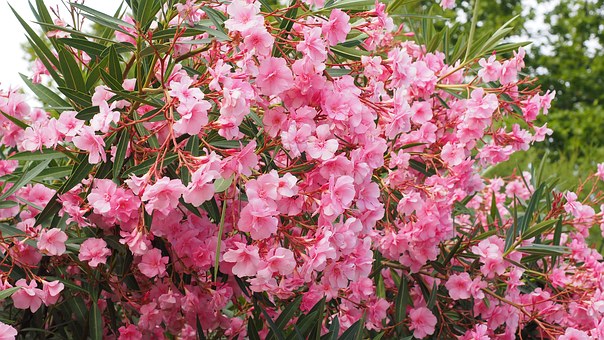

Oleander is a medically used plant. Experiments are done in cancer drugs. Oleandrin which is in the chemical content of oleander is used medically. Included are diuretic and heart strengthening effects. If the prescribed amount of treatment is exceeded, it causes severe poisoning which is manifested by heart failure, vomiting and diarrhea.
These medications are given only by the doctor's supervision. The maceration with olive oil is externally applied to the skin. It is used against parasites such as biting in the body.
[IMAGE: https://steemitimages.com/DQmaVamSo6g98rXG2ATBKJ1diUYXKrqYrF8fSwk3CQEJuZn/ventimiglia-187052__340.jpg]
Source:
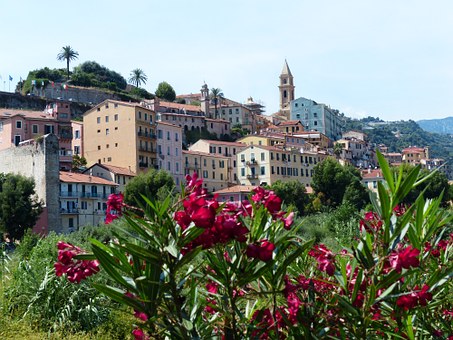

[IMAGE: https://steemitimages.com/DQmd9Ebyx9qkPK5d17VzcZCYvuQ9J2BNwTPRk6mtV7GxC4Q/oleander-9895_960_720.jpg]
Source:
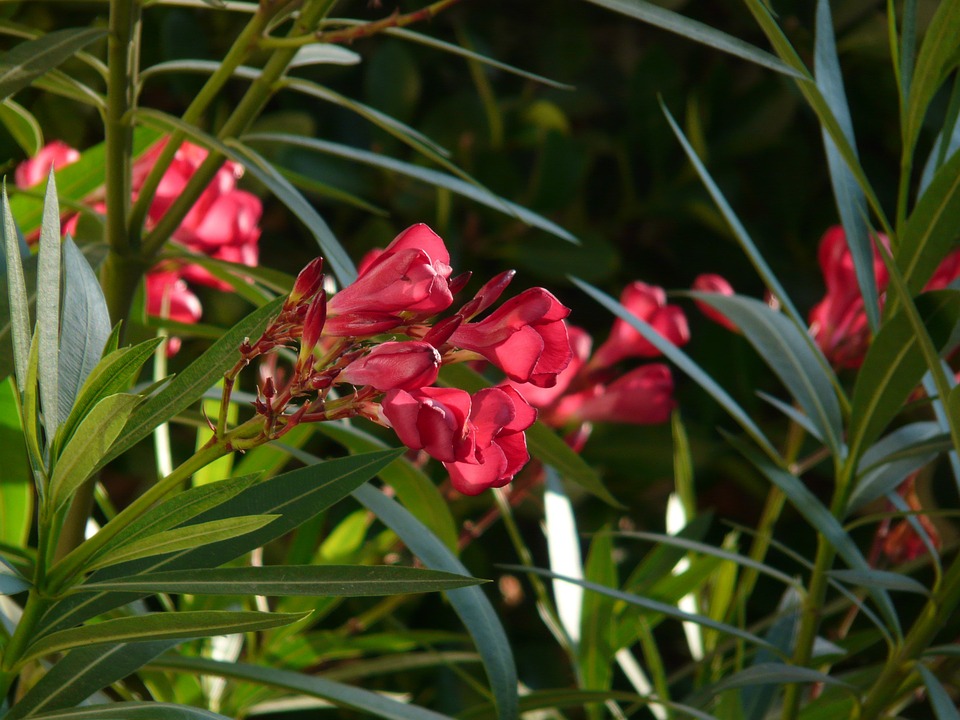

First of all ı want to say that ı am so happy cause ı was the first for last post. So ı want to share a story for this plant.
It is a bitch oleander that has been mentioned in legends and religious books in every period of history. Well, what makes this plant so important is what makes it popular every time? In other words, if oleander was grown not in the Mediterranean basin but in another geography, was it so well known and known?
The fact that the first civilizations were established around the Mediterranean, the emergence of single and very godly religions in this geography, olive and zekeum also made an important plant.
On the other side of the garden there is an oleander (like oleander). I can not get to know this plant better.
[IMAGE: https://steemitimages.com/DQmYWA89A67rJ7bEVzyNWQ3dXbAJuf19yug92KMEVTAYm2m/IMG_1214.JPG]
Source:
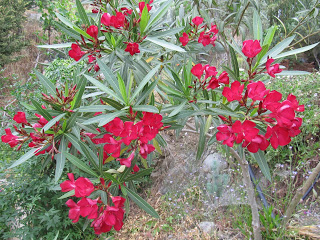

Oleander (Nerium oleander), a member of the Apocynaceae family, is a drought-tolerant tree that does not plow its leaves in the summer and winter, and is also called the extinction of the people.
This plant, which naturally grows in places where the Mediterranean climate is seen, attracts attention with beautiful flowers that are opened in summer. Due to its dependence on drought, inability to care, and the opening of beautiful flowers in different colors, Oregan has made parks and gardens one of the most planted flowers in the road.
Whereas Zakkumun emerges as an antagonist everywhere; the reason that the seeds are fuzzy and that they can be carried easily by the wind everywhere.
One characteristic of Zakkumun is that it is very poisonous with everything.
If Oleander is really popular; the social and cultural scene comes from its role. While some societies deified Zedong as sacred, according to Islamic, they were regarded as 'hell'. Today, it has even been suggested that cancer may be a drug. Since ancient times, oleander has always been on the agenda.
[IMAGE: https://steemitimages.com/DQmW7aw4H6HXNJ1Htitm6ADTnew2z7aJp4MjTpAUZ84bBTP/IMG_1146.JPG]
Source
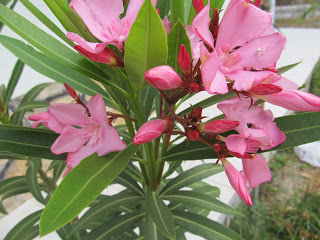

[IMAGE: https://steemitimages.com/DQmTFC2FrVZR4x9qxp9UbQnbWGp29y767d7jwauphWH5agA/IMG_1333.JPG]
Source
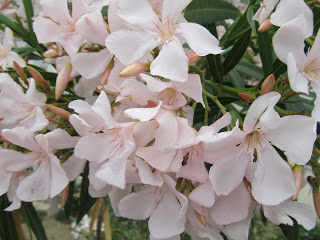

If you see Greek mythology; A young man named Leonder sailed into the sea every night and met with the love of the opposite side. The storm came on suddenly for a night and this time Leonder's lifeless body is sandwiched in sand. After that day, this flower begins to decorate the sea shores. It is said that oleander, the Latin name for oleander, comes from this genus.
Most oleander planted in Europe, especially in the period of the Romans, as ornamental plants in gardens. On the titles of the tobacco, oleander flower motifs were used on the tables.
In India, the oleander called 'kaner' is sacred and represents the god Shiva. One of the three trees that are considered holy by the Jews is oleander.
[IMAGE: https://steemitimages.com/DQmSu5ixQbJTN5NsNyDevSnWrjgdXFTgLTSavY9LpRCSCeo/IMG_1613.JPG]
Source
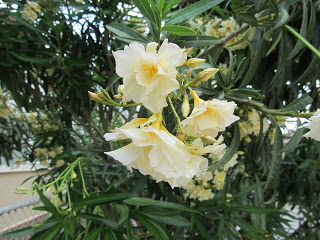

[IMAGE: https://steemitimages.com/DQmW7tFQwE9nJLCMCkxaQw1SHGQpNJPec8PGDNfzYwRTe3v/IMG_1631.JPG]
Source
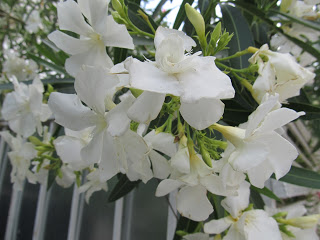

[IMAGE: https://steemitimages.com/DQmVUbMjjNhfhj9zPmdZm99hwiEY8pSYdwnbpH9MNcVgF4G/flower-3116535_960_720.jpg]
Source
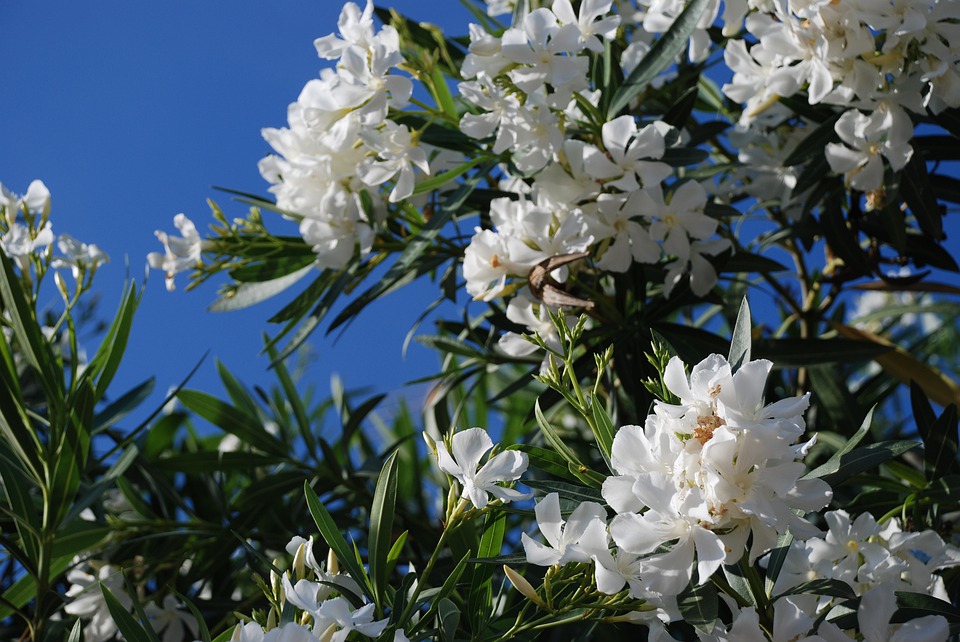
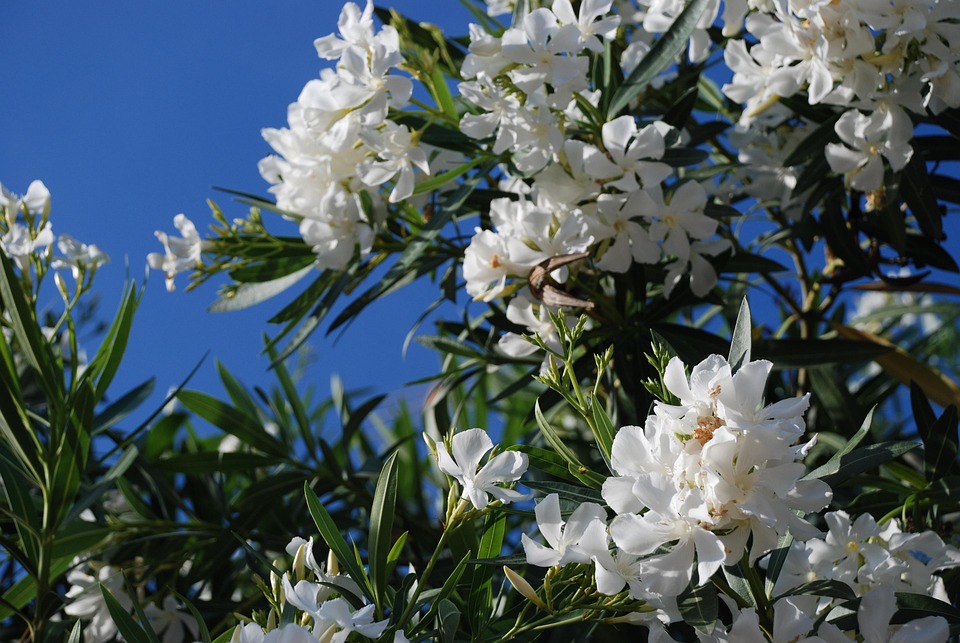
- An international festival is being held every year in Galveston, Texas for the most popular oleander in America.
- It is told that the oleander tree is sacred by the Jews, and the Quran is a hell tree.
The reasons why these two communities share the same geography and think so differently about this plant are due to history. Well, how long will this hatred and enmity last up to religious books?
Now this problem must be solved in one way and there must be peace between the two societies. Yakkum must also be considered as a symbol of this peace and friendship.
Thanks for reading !!!
@ctrl-alt-nwo another beautiful plant todey you share us.
Some information about Nerium oleander;;;
Nerium oleander is a shrub or small tree in the dogbane family Apocynaceae, toxic in all its parts. It is the only species currently classified in the genus Nerium. It is most commonly known as nerium or oleander, from its superficial resemblance to the unrelated olive Olea.It is so widely cultivated that no precise region of origin has been identified, though southwest Asia has been suggested. The ancient city of Volubilis in Morocco may have taken its name from the Berber name oualilt for the flower.Oleander is one of the most poisonous commonly grown garden plants.
Scientific classification;
Kingdom: Plantae
Clade: Angiosperms
Clade: Eudicots
Clade: Asterids
Order: Gentianales
Family: Apocynaceae
Subfamily: Apocynoideae
Tribe: Wrightieae
Genus: Nerium
L.
Species: N. oleander
Binomial name;;
Nerium oleander
L
Oleander Medik.
Nerion Tourn. ex St.-Lag.
Nerion oleandrum St.-Lag.
Nerium carneum Dum.Cours.
Nerium flavescens Spin
Nerium floridum Salisb.
Nerium grandiflorum Desf.
Nerium indicum Mill.
Nerium japonicum Gentil
Nerium kotschyi Boiss.
Nerium latifolium Mill.
Nerium lauriforme Lam.
Nerium luteum Nois. ex Steud.
Nerium madonii M.Vincent
Nerium mascatense A.DC.
Nerium odoratissimum Wender.
Nerium odoratum Lam.
Nerium odorum Aiton
Nerium splendens Paxton
Nerium thyrsiflorum Paxton
Nerium verecundum Salisb.
Oleander indica (Mill.) Medik.
Oleander vulgaris Medik [IMAGE: https://img.esteem.ws/5c5n2jlhtq.jpg] [IMAGE: https://img.esteem.ws/qlxq0gry0h.jpg] [IMAGE: https://img.esteem.ws/8rwmqndovm.jpg] [IMAGE: https://img.esteem.ws/j8uqbosgqy.jpg]
Source Google


Although the oleander plant is a stylish plant with its general characteristics, it is poisonous which causes it to be separated from other ornamental plants. The most common type of oleander with different flower colors are those with pink flowers. In addition to flowers and leaves, oleander, which also gives fruit in the form of pods, is a plant that poisons when poisonous parts are used. The most important varieties of oleander are the oleander flowers and red layered flowers, which are large white flowers. In order to grow any of the oleander varieties as ornamental plants, it is possible to grow the oleander sprout taken during the summer months by sprinkling in water for a while.
[IMAGE: https://steemitimages.com/DQmZkvvJ2VvQEoqBmuZqPCf9m9XdXWNJu4E9s7ZzTsyNTg7/plumeria-pudica-2686607_960_720.jpg]
Click for photo
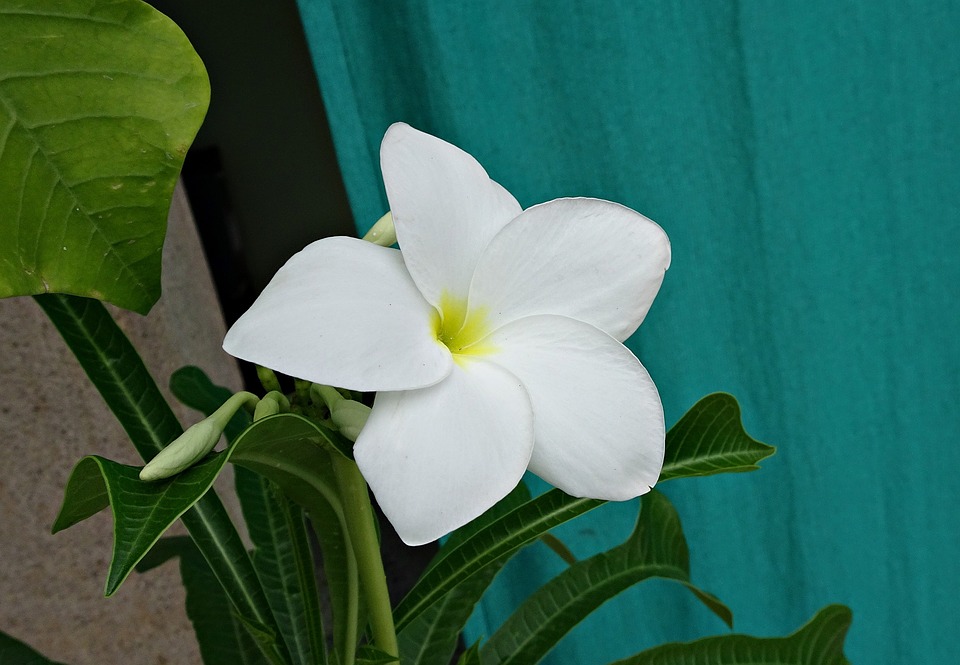

What are the features of Zakkumun?
Although oleander is very beautiful and attractive, it is poisonous, which makes it necessary for the oleander to grow in the houses. A cinstir that grows up to 5 meters in length when grown up in wetlands and grows even more efficiently when truncated. Furthermore, the fact that the plant is selective in terms of soil causes the oleander to be suitable for growing everywhere. Resistance to the cold even in the winter is resistant to the fact that the oleander grows in all seasons in a sheltered manner. It is a plant that loves sunny air and does not want fertilizer in the soil to grow efficiently. However, if the oleander is grown in the pot, it is beneficial to mix some amount of sheep grape.
[IMAGE: https://steemitimages.com/DQmQzLnUd5Ueu4iY2H1YC761wqm1zHyRC96CtgZ9RyBJb3j/zakkumun-ozellikleri.jpg]
Click for photo
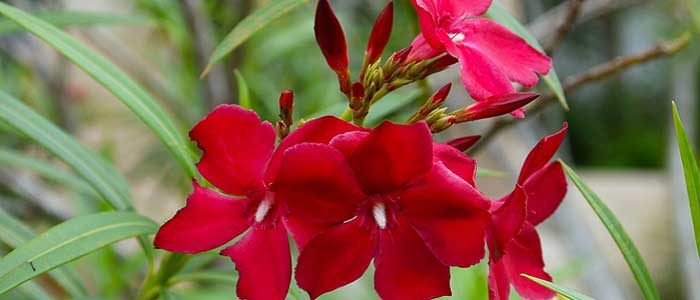
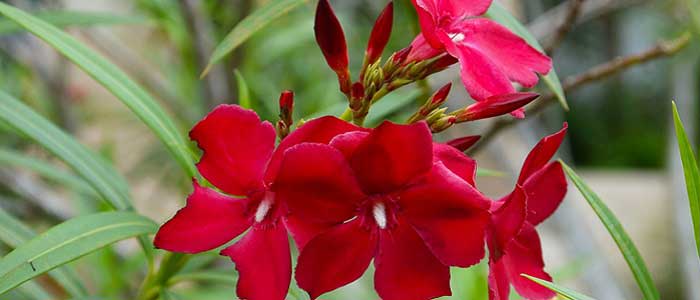
What are the Benefits of Zakkumun?
If it is a poisonous plant with branches and flowers, it does not mean that zakkacum will not be beneficial. When used within the doctor's proposal and control, it is extremely beneficial for health. First of all, it is a beneficial herb when it is externally applied against skin diseases, as well as the potency enhancer effect. Diuretic properties and the treatment of heart conditions are among the main benefits. In addition, researches on oleander have been found to be effective even in cancer. Especially for patients with skin cancer, it is recommended to use natural medicines derived from oleander seed extract. The use of Zakkum for health should be after the dried form. The oleander plant, which is recommended to be used by boiling, is externally used for diseases on the skin, and it is recommended by experts to use it by mixing with olive oil.
[IMAGE: https://steemitimages.com/DQmTMjqSDaQQoj5vk6PEwEn2EKuW1sWQNKKFDHdRKeEGNux/oleander-594377_960_720.jpg]
Click for photo
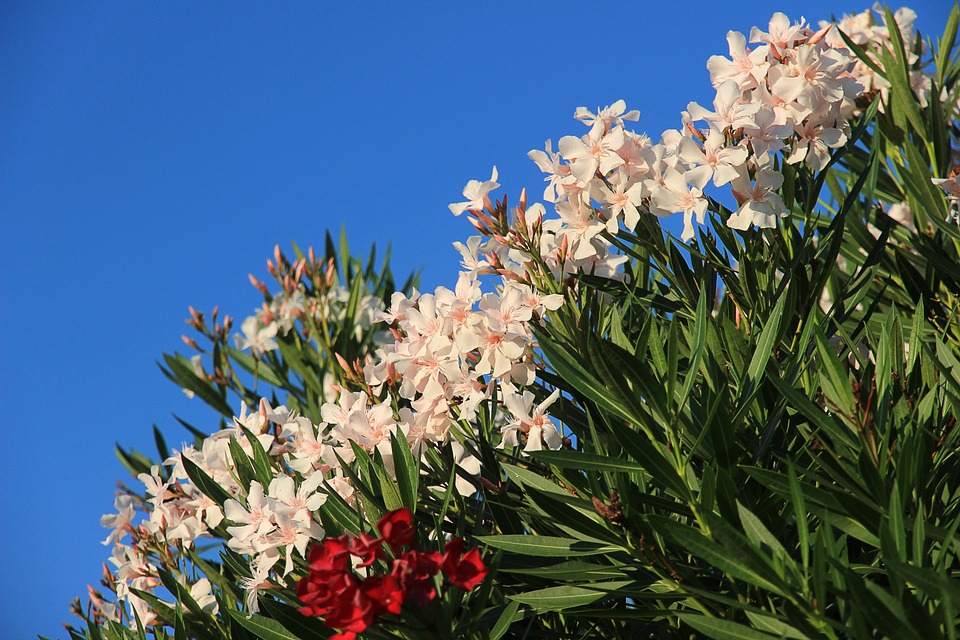

OLEANDER IN THE QUR'AN..
Oleander, meaning turkish bitterness and poison, is a deadly tree believed to be in Hell according to Islamic religion. Such narrations about the oleander tree are actually more than information, rather than discourse. Because in the Qur'an there is a clear surplus of oleander words for a few periods and months. I should not pass on these verses before sharing with you;
"Of course, the oleander tree is the food of sinners in Hell. The oleander tree is like a molten metal. It boils like a boil of hot water in people's wombs "(Ed-Duhan, 44 / 43-46)
"Is this meal better for a meal? Or is it an oleander tree? Surely We made him a trouble for the wrong-doers. It is a tree from the bottom of hell. His buds are like heads of demons. Hellstools then eat their places and their bellies with them. Then they shall be given drink upon their oleander tree, with drink mixed with boiling water "(es-Saffat, 37, 62-67)
"Then you, O those who stray from the right path and deny the truth! You will surely eat the oleander tree in hell. You will fill your bellies with it. You will drink boiling water on the threshing floor, "(al-Vakia, 56 / 51-55).
Apart from these; "If a drop of Hell's Zakkum was dropped on the earth, it would poison people's lives" (al-Musnad, Cairo 1313, I, 301).
[IMAGE: https://steemitimages.com/DQmRFyn1DGsPzTaWSNb8cNtgMZH5P79FJcigarXssHyKUCG/zakkumun-ozellikleri-nelerdir-nasil-kullanilir-faydalari-ve-zararlari-nelerdir-zakkum-fotograflari-8-gelgez-728x546.jpg]
Source:
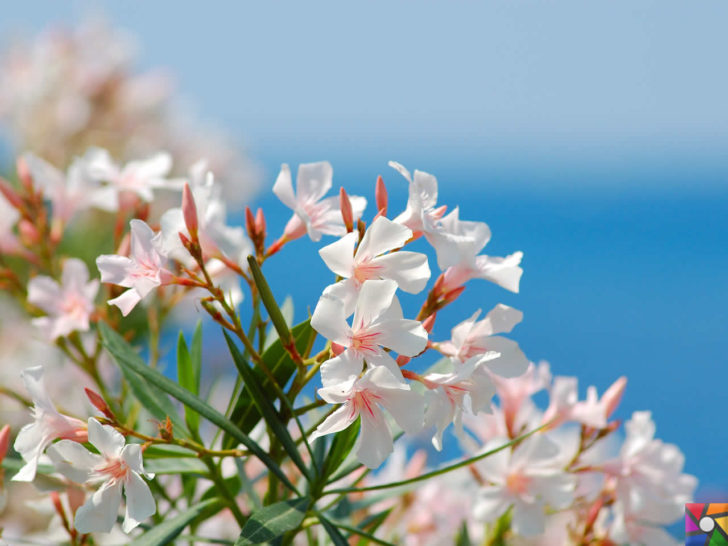
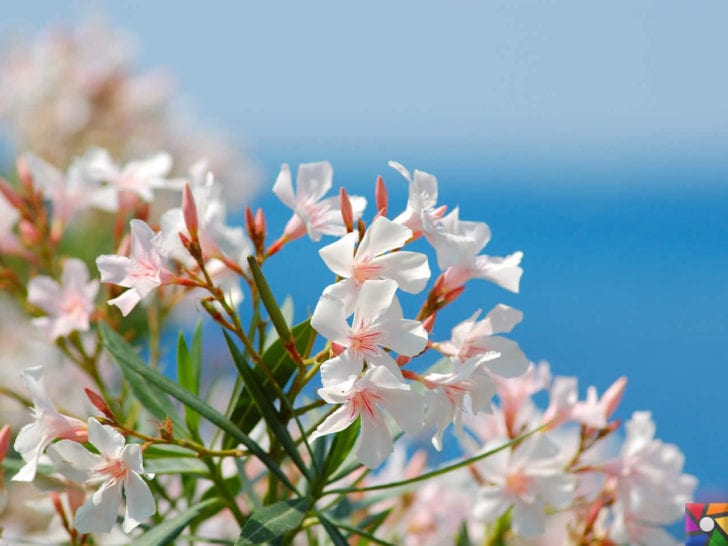
[IMAGE: https://steemitimages.com/DQmR2Prqb5L6oVQUDUJjy8EDU4wZMasABsoaYszWKmgZkyA/zakkum-cicegi-bakimi_646x340.jpg]
Source:
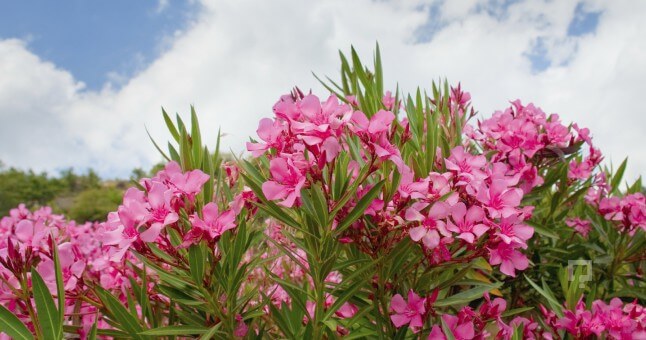

[IMAGE: https://steemitimages.com/DQmcyMs58zcVMg6w25iks4BBPAXmJ2QsGWtDcRwSMnCjCXv/IMG_1613.JPG]
Source:
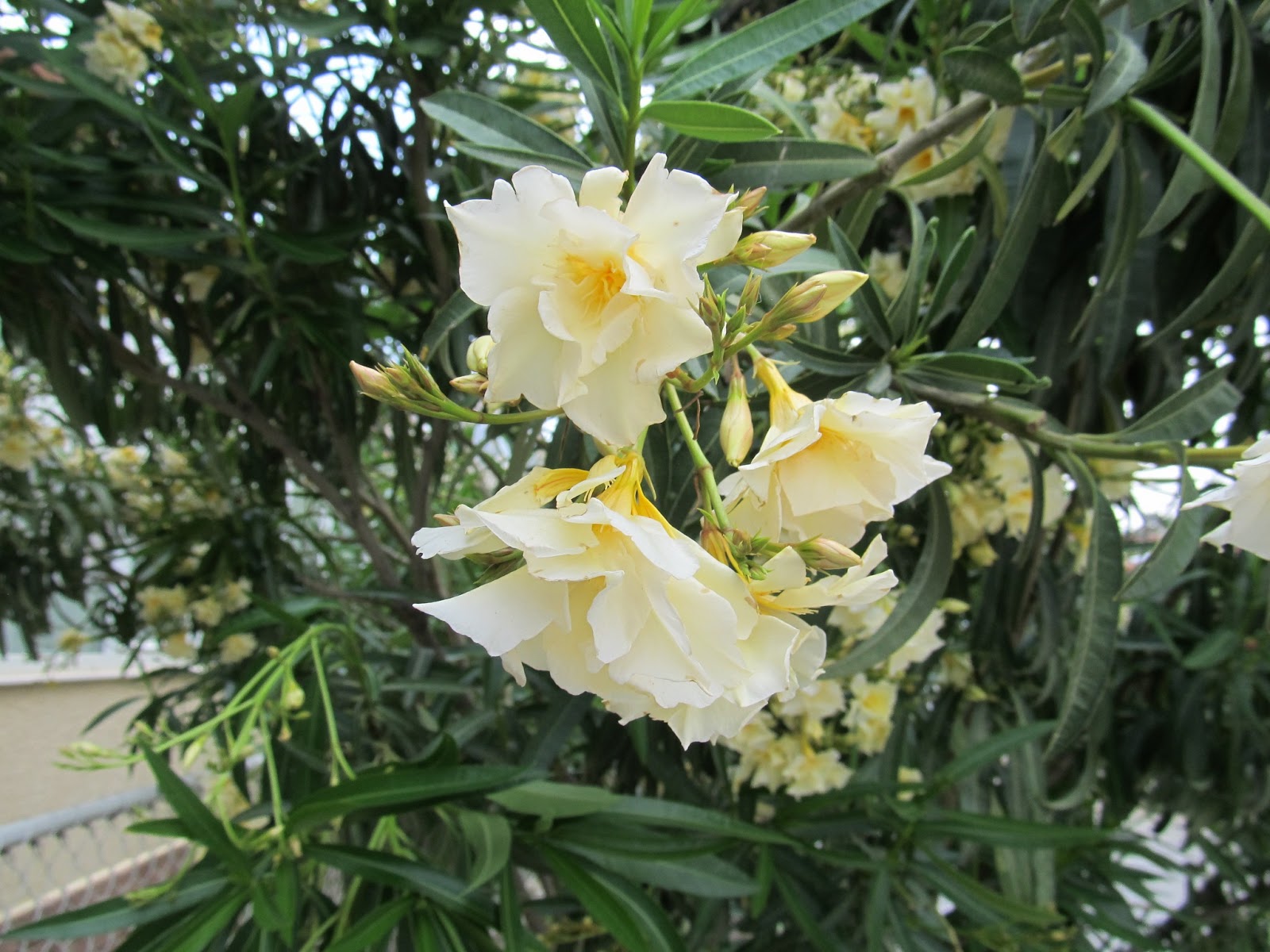

[IMAGE: https://steemitimages.com/DQmeSezmWnU4psm7coqzCrcWJ7PAfGKY1hS1mvpuqLUVmxe/IMG_1631.JPG]
Source:
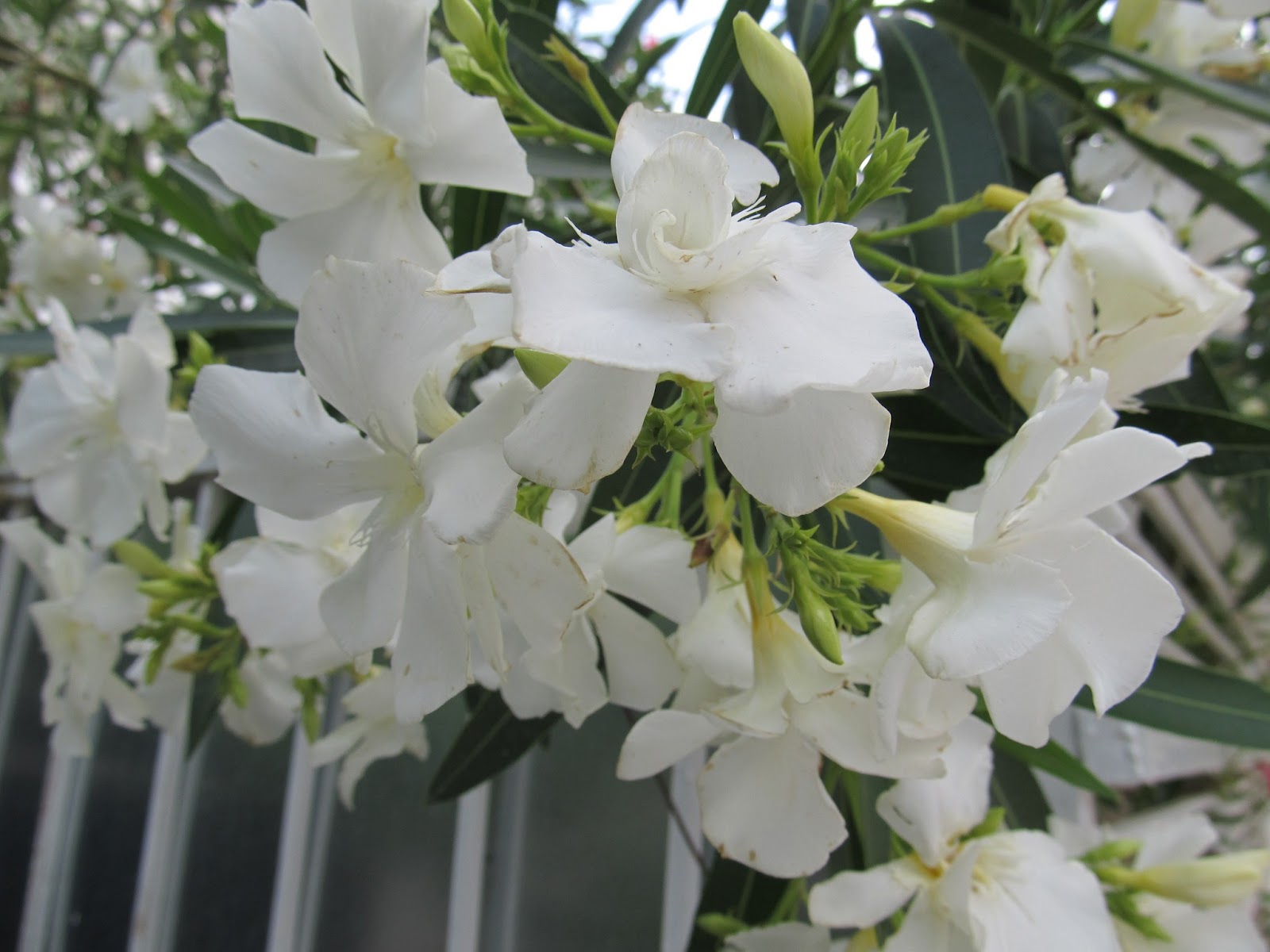
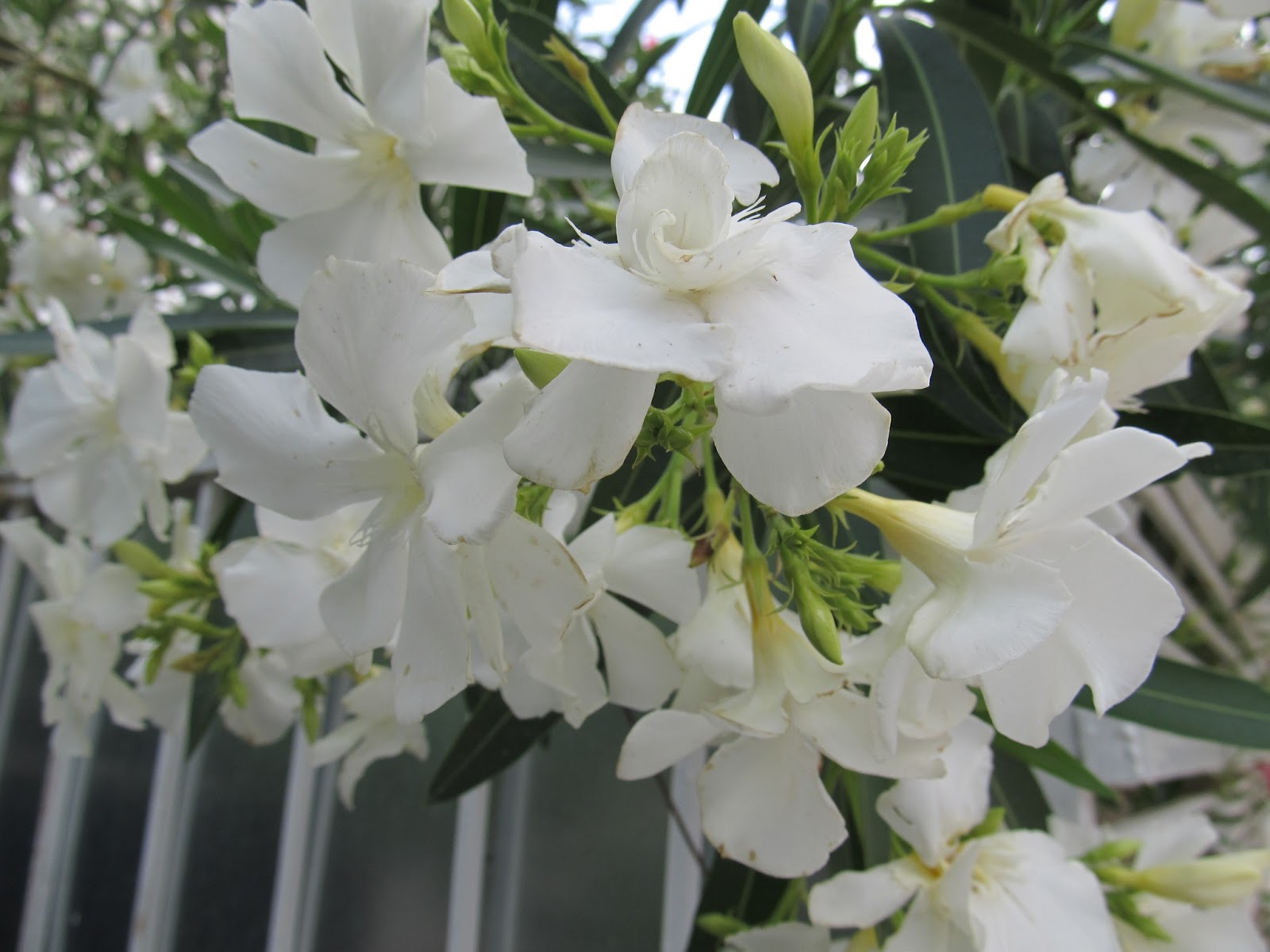
@ctrl-alt-nwo Nerium oleander wonderful plant.
Description:;
Nerium oleander is a shrub or small tree in the dogbane family Apocynaceae, toxic in all its parts. It is the only species currently classified in the genus Nerium. It is most commonly known as nerium or oleander, from its superficial resemblance to the unrelated olive Olea. It is so widely cultivated that no precise region of origin has been identified, though southwest Asia has been suggested. The ancient city of Volubilis in Morocco may have taken its name from the Berber name oualilt for the flower. Oleander is one of the most poisonous commonly grown garden plants.[IMAGE: https://steemitimages.com/DQmPwA6bjMWbjgew671oDszX5vZpTjiQ1YLDCda4FbEMKry/U5du5zpQTkxDqFeUntRkufuktm3D8iQ_1680x8400.jpg][IMAGE: https://steemitimages.com/DQmXWLzeeFMAfcq4Pu5N7unE1J2LfXiYNiSBSQtbXmpYrB8/U5drRSzzGfZawHCMq8ZNsCXem9VAoWy_1680x8400.jpg]
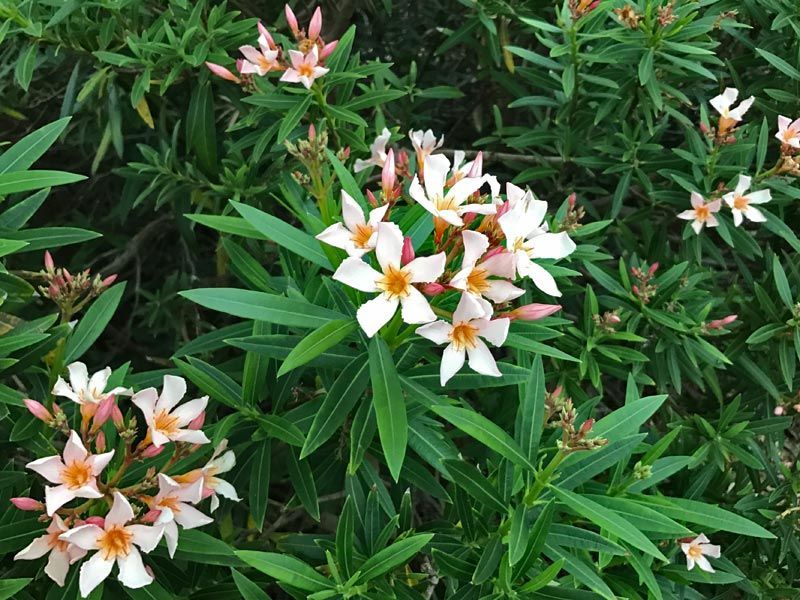
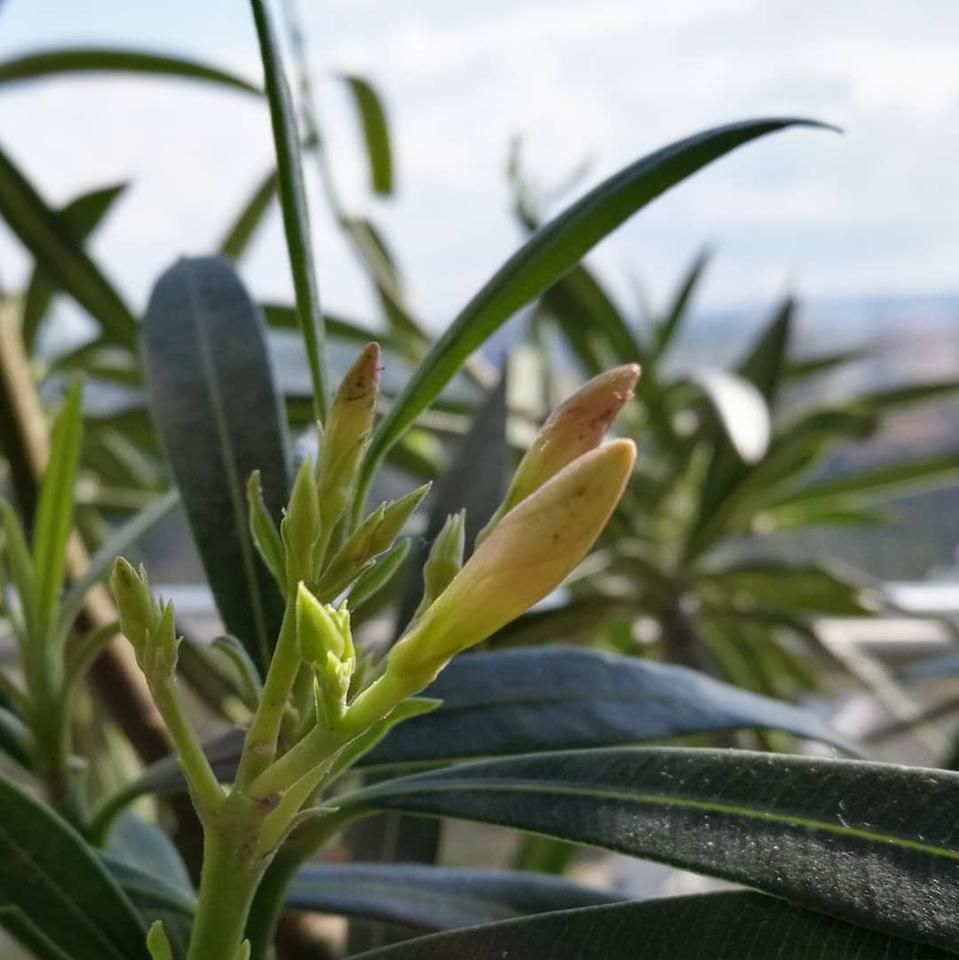
Oleander grows to 2–6 m (6.6–19.7 ft) tall, with erect stems that splay outward as they mature; first-year stems have a glaucous bloom, while mature stems have a grayish bark. The leaves are in pairs or whorls of three, thick and leathery, dark-green, narrow lanceolate, 5–21 cm (2.0–8.3 in) long and 1–3.5 cm (0.39–1.38 in) broad, and with an entire margin filled with minute reticulate venation web typical to Eudicots. Leaves are light green and very glossy when young, before maturing to a dull dark green/greenish gray. The flowers grow in clusters at the end of each branch; they are white, pink to red,[Note 2] 2.5–5 cm (0.98–1.97 in) diameter, with a deeply 5-lobed fringed corolla round the central corolla tube. They are often, but not always, sweet-scented.[Note 3] The fruit is a long narrow pair of follicles 5–23 cm (2.0–9.1 in) long, which splits open at maturity to release numerous downy seeds.
[IMAGE: https://steemitimages.com/DQmRU5RTfidyBndDXnyh7tMjAnpFSnL56Pvs3MZyPviSJRU/maxresdefault.jpg].[IMAGE: https://steemitimages.com/DQmUTte6gPqF4cFXszdqDivD8EVfDoxCnNSGoKfUKRUJA5b/65065cfa8ac8b0ade1ea05e2d68c6a45.jpg]
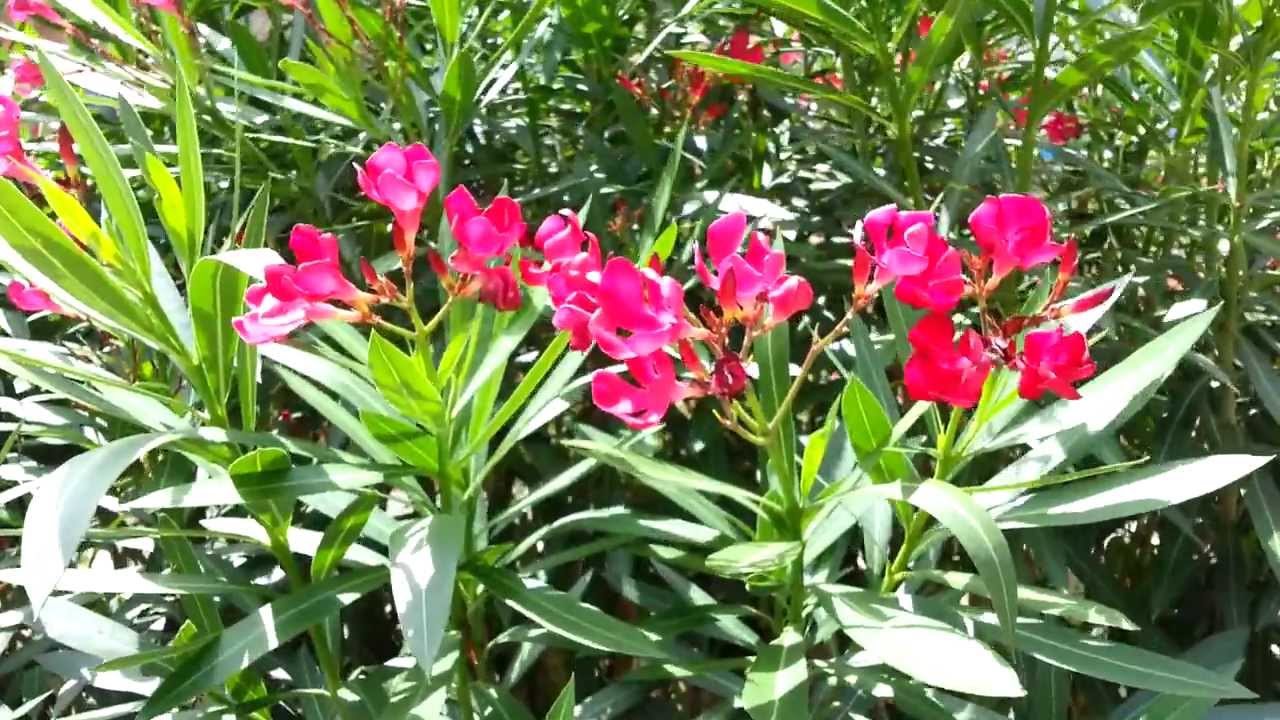
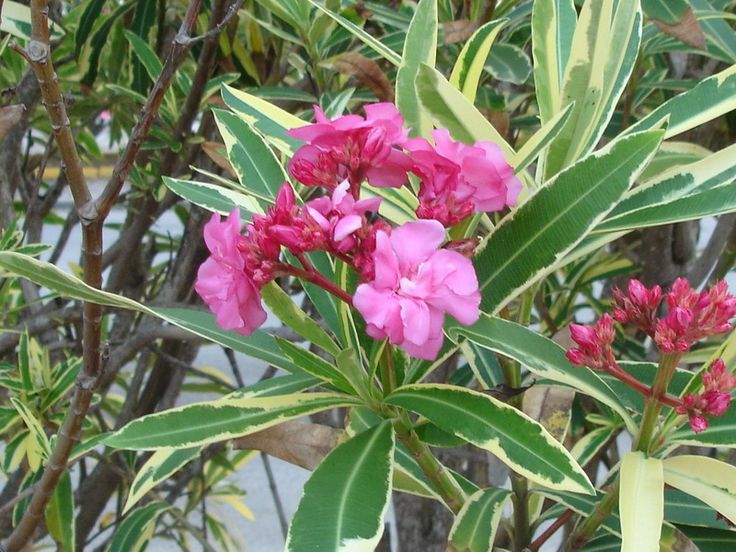
magoo-2 found a series of multi accounts of a same owner is following your articles to cheat your generous rewards.
magoo-2 found these accounts are suspicious & can be multi accounts of a single owner. Conclusion is based on last 30 days transactions:
@rik432, @ratul8940, @rahul72, @taylor10, @villani, @wilson6, @masud90, @purepinag, @sumonsha, @perry1, @max1994
magoo-2
Check our latest multi comment spam update report
oleanders is a red rose or white flower evergreen shrub. Scientific name: Nerium oleander or Nerium indicum , English name: Oleander, Other names Adelfa, Alheli Extranjero, Baladre, Espirradeira, Flor de Sao Jose, Laurel de Jardin, Laurel rosa, Laurier rose, Flourier rose, Olean, Aiwa, Rosa Francesca , Rosa Laurel, and Rose-Bay. The pink colored flower is called a blood vessel .
Literature is famous in the form of blood oleanders, white oleanders etc. It is cultivated for decoration in many places, because it can look beautiful and grow in a very rough environment. But the plant's entire intense poisoned. Playing a single leaf can lead to the death of the human, especially the baby. According to the TESS (Toxic Exposure Surveillance System), in 2002, 847 cases of toxicity were detected in the United States in the United States. Due to the drying of leaves or branches in grass, poisoning / death can be found in cattle (especially horse) - 100g (0.5 mg / kg) of adult horse.
[IMAGE: https://steemitimages.com/DQmQBqBbJXmr1J73hxyKw2RVCTjqjgspnN7docGRUw6jDda/FB_IMG_1523036197753.jpg]
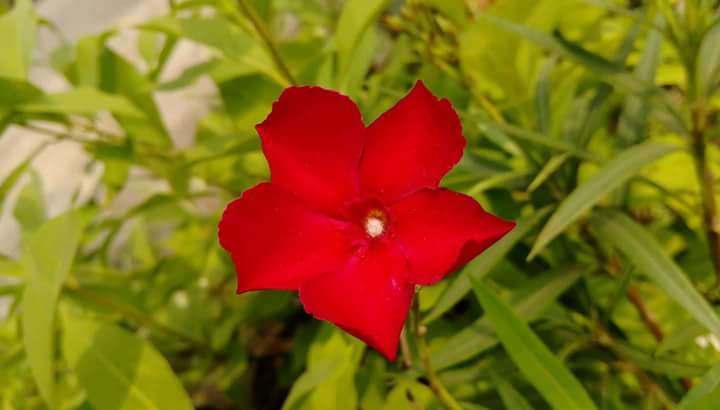
Description:
Caribbean and Asian species of Keri They are 2 to 2.5 meters high. They are evergreen trees. From the beginning, many branches grow like thorns. The leaves are more in the front of the pulse. Flowers in summer and rainy season. Red, pink, white - but red and shadai can be seen more. Cultivated farming, trim is worthless. Their seeds are poisonous.
[IMAGE: https://steemitimages.com/DQman1F2WBmGvv1TWB57zXcSgk6rW482VnMx7FKrTA1E5iG/FB_IMG_1523036137679.jpg]
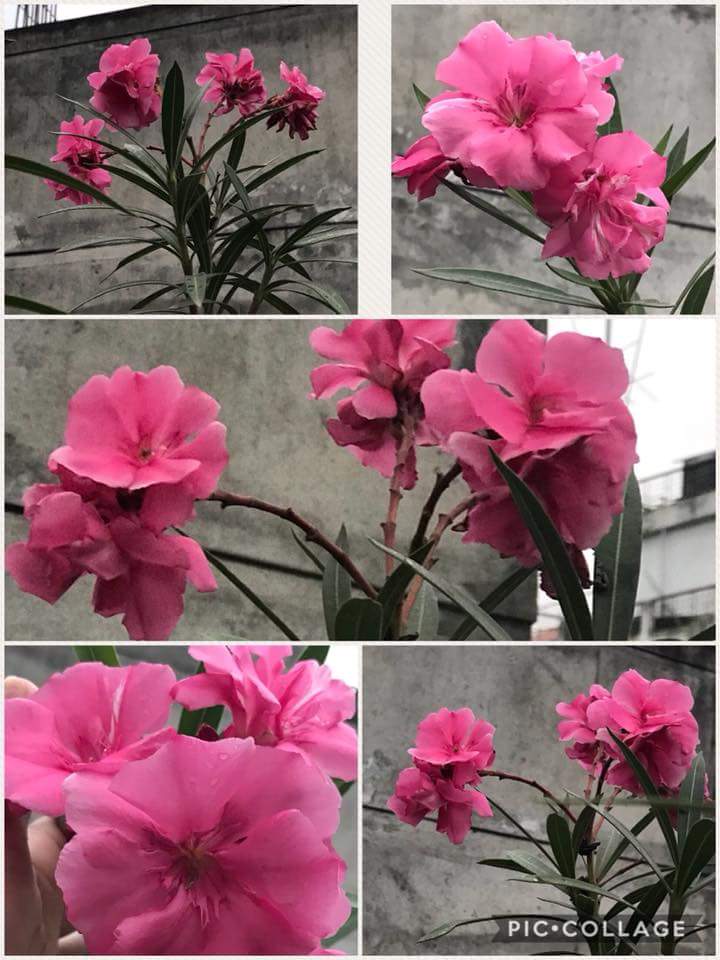
Merit:
→It is beneficial to reduce hair follicles early in the morning.
→Sprinkle it with its original sesame oil or coconut oil.
→Basal bark is beneficial to reduce acne.
[IMAGE: https://steemitimages.com/DQmTfqgewWpZD7rqCmu2v6qnJHtHRr1QxSDrTqJ3qB293e8/FB_IMG_1523036249664.jpg]
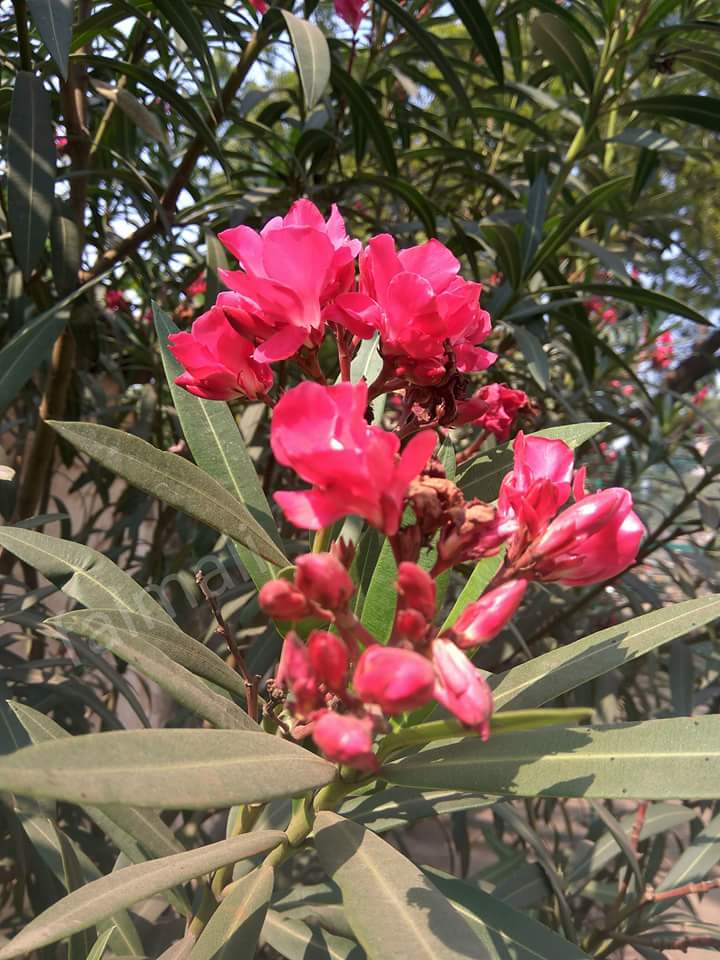
Poison:
→Hrtyantre work glaikosaida ( digitalis -like):
★Oliyandarina (Oleanderin)
★Neriina (Neriine)
→Susumnakandera glaisina riseptare actions of the Quran ( strikaninera like):
★Rosagenin (stem tissue).
[IMAGE: https://steemitimages.com/DQmQdxBiu1niKWZVgvMaiaAYSC4RB7re9rhWi5UQVJdKT8E/FB_IMG_1523036090499.jpg]
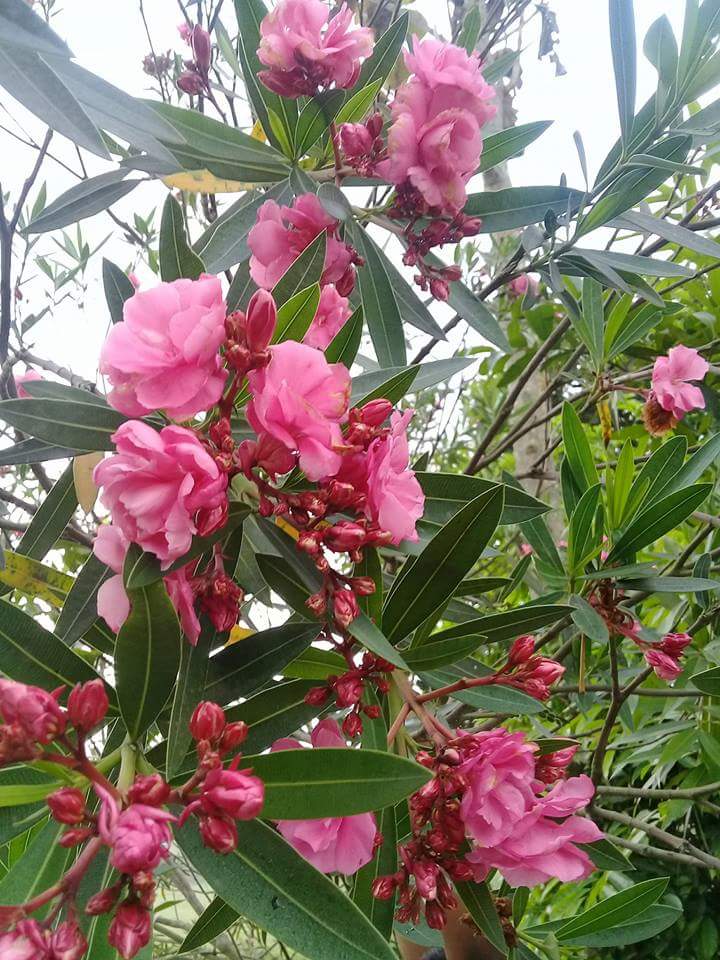
>I will trying to describe about Oleanders & plants. I hope you read my comment & suggest me.
[IMAGE: https://steemitimages.com/DQmXA2enW3QgYYi5P3JigxFsXfshobrQbG1zmmcAgqEcAFL/FB_IMG_1523036125123.jpg]
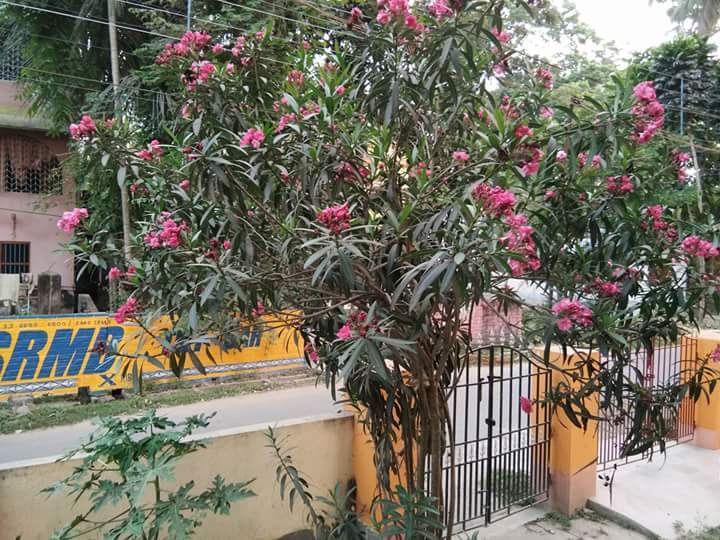
[IMAGE: https://steemitimages.com/DQmWfhxZiK71wKkadgPEVx1degUxm4KRKafBKUuJCQ5Yrbk/FB_IMG_1523036068090.jpg]
There is a bright sunshine on the streets, walking alone on the streets of college. In the Bhati region, the young little girl is less than the shadow, and after shocking shadow, small bush national blood carvari Seeing no way out of the relieved traveler, the blood vessel is resting on the horizontal corridors in the dark sunshine. Besides, goat chana is taking care of duskhaara feeding blood clotting tree bark. About half an hour, the tired traveler is holding this scene in the brain.
At one stage the goat and the leopard slept on the siesta as a tired traveler but the tired traveler still could not understand what was going to happen. A lot of time was spent in the twinkling of the eyelids. The goats and cats were already lying with dull bodies. But the traveler still did not understand what happened! The traveler started to walk again, thinking, but the passenger's mind is not settled in any way. The traveler curiously went to his teacher and explained the details of the incident. The teacher quietly listened to him.
His first explanation was the toxicity of the fungus, and then the eyebrow began to say that the tree was blood clot. Understand that the goat kidney has died in blood poisoning.
Since birth, the tree dedicates their lives to the people of the human life and for human welfare. But the behavior of blood donor is exactly the opposite. Each part of the plant with its leaves, barks, flowers and fruits is poisonous.
If you are using latex emanating from this plant, death is guaranteed. Due to the beauty of blood carbohydrates and white carpets occupy space. According to TESS, in 2002, 846 poisoning cases were recorded in America. Of which 80 percent were blood poisoning. Due to the poisoning of livestock animals by eating dry leaves or branches mixed with grass, they die. Chemical Oleandrin which is found in this plant acts as cardiac glycosides. Cell sodium potassium pump helps in penetrating the potassium ion inside the membrane and sodium ion out. Cardiac glycosides stop this pumps, so sodium can not go out and intracellular (on the thorax) increases the density of sodium and creates deadly poisoning of the animal and dies. Because of the presence of chemicals called Oleandrin, this species is named after Ondaander, Nandini of Rabindranath Tagore's bloodstream drama, but many people have played the role of a villain for blood carcinogenic animals.
Although these plants are harmful, their blossom and inflorescence will call you through the hand. Whatever the threat to the latex and letter extract animal, it does not provide the least oxygen but it does not have the slightest miserliness. So in the nineteenth century, after the devastating hurricane on Glaveston Island in Texas, there was plenty of bloody plants planted, and now they have so much influence in the area that they have been eating pure pink lipstick all year long. Not only this, the blood plant is the favorite plant for the residents of the city. At present, the island of Glaveston has been named the Oleander City, which is the annual Orlander festival there every spring.
Just like some invertebrates
Syntomeida epilais can not touch blood poisoning, these animals live on the leaves of the leaves and buds. However, most insect pests do not shade the shade of this plant, but only toxicity. If we put it in the garden, its insect does not get the slightest velocity for suppressing the spider. Only the children and pets are kept in care. But the presence of insects as a visitor is absolutely indispensable for pollination. In that case, they used cheating techniques.
Using live colorful petals and charlages, the live advertisement shows that the polinators are attracted to the distance from one flower to the other in the flower of the flower. But after being jammed, it is cheated because the little ant can not be found in the blood circulating swelling, the poor insect returns to despair, but its pollination is done by now. For this reason, the blood taxpayer does not get the polyline. If the scientists had their toxic Oleander nectar, if there were a lot of bees, then many bees would have killed them, or This poisonous honey was contaminated in honey, which would be a threat to the human body. What a wonderful natural protection (!) Blood taxi (Oleander) is planted as a plantation plant in the garden garden garden of the warm subtropical region. There is also a slight smell of floral blossom in flowering and rose petal-shaped flowers throughout the year when warm weather results.
The deceiver, the villain, does not give a lot of abuse or slander, so there must be some degree of it.
At first we mentioned that poison for us, but there is no shortage of poison in making oxygen. Scientists are working tirelessly to make cancer medicines from N. oleander species, research has reached such a stage that it is now just waiting for application to the human body. But that day is not too far away, everyone will be able to erase all the negative words, along with the deceit, using the name of the blood card, before its name.
Note:
(1) TESS-Toxic Exposure Surveillance System
(2) Syntomeida epilais - a type of insect that can fly.
>Image content:
Blood oleanders flowers are collected from my garden.
The story of oleander flowers, the symbol of romance and charm, is described in Greek mythology: The young man named Leander swims every night to face the young girl sitting on the opposite bank of the Greek Sea (Marmara) and see him. Again in a stormy september, Leander, who is burning with the love of his lover, leaves herself in horny waters. Leander, unable to withstand the violence of the storm, is about to arrive on the opposite shore and is dead from exhaustion in the dark waters. The horny waves leave the inanimate body of the flock to the white sands, struggling to see once again their love. Seeing this, the young girl puts the oleander flowers he collects for his lover into Leander's lifeless body.
[IMAGE: https://steemitimages.com/DQmYmigAjAZPdWrGQs8WoZiahbPaLP2kgJDt7PfRGWms7yf/zakkum-cicek1.JPG]
Since that day, oleander flowers have embellished as the symbol of Leander's endless love.
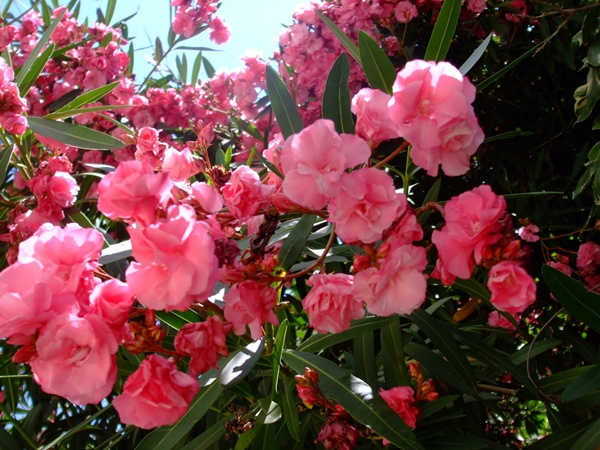
The common name of the oleander, called "oleander" on many foreign languages, comes from Leander, who is strangled to see his love. In our country, it is also known as the tree-tree, the tree-tree and the tree of the struggle. You know the phrase "the roots of my stomach." (For example, the expression "eat the roots of my fortune", which is often used by mourning mothers for meals!) The "wreck" here is actually the zakkumun itself. Oleander, a very poisonous plant, was also used as a potent poison in ancient times. Because of this feature, in some regions it is still known as "killing donkey".
[IMAGE: https://steemitimages.com/DQmdgsELuxjkmUw7vKzoqEdDj7PFP3mh4QRoixJk2nqNF75/zakkum-cicek2.JPG]
[IMAGE: https://steemitimages.com/DQmdMBwUvf5PjwPLYa8BkiyuP7i29ptYshFxsDcS4bBhPcz/zakkum-cicek3.JPG]
[IMAGE: https://steemitimages.com/DQmNxXzJSGVQfrWLGPs55MXzr4LL6WRL11RtGFrAHby38P6/beyaz-zakkum-cicegi-1024x683.jpg]
[IMAGE: https://steemitimages.com/DQmbvjo3m3jjdh463yh2AArH41bhgWM9tTfMWQvrPytJjrP/zakkum-cicek4.JPG]
Picture source
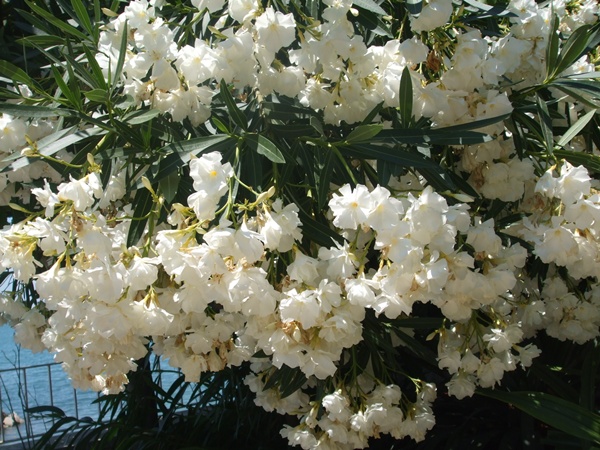
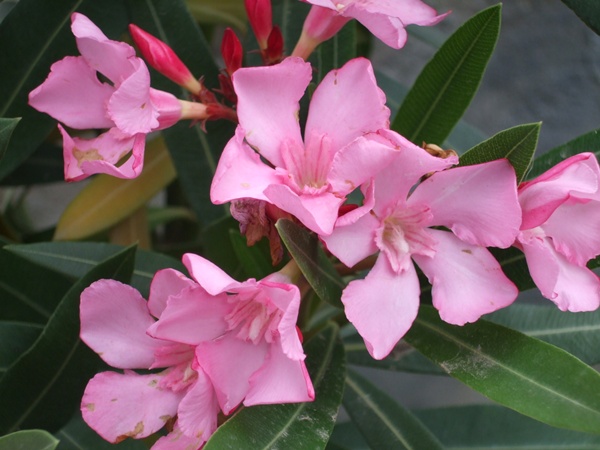
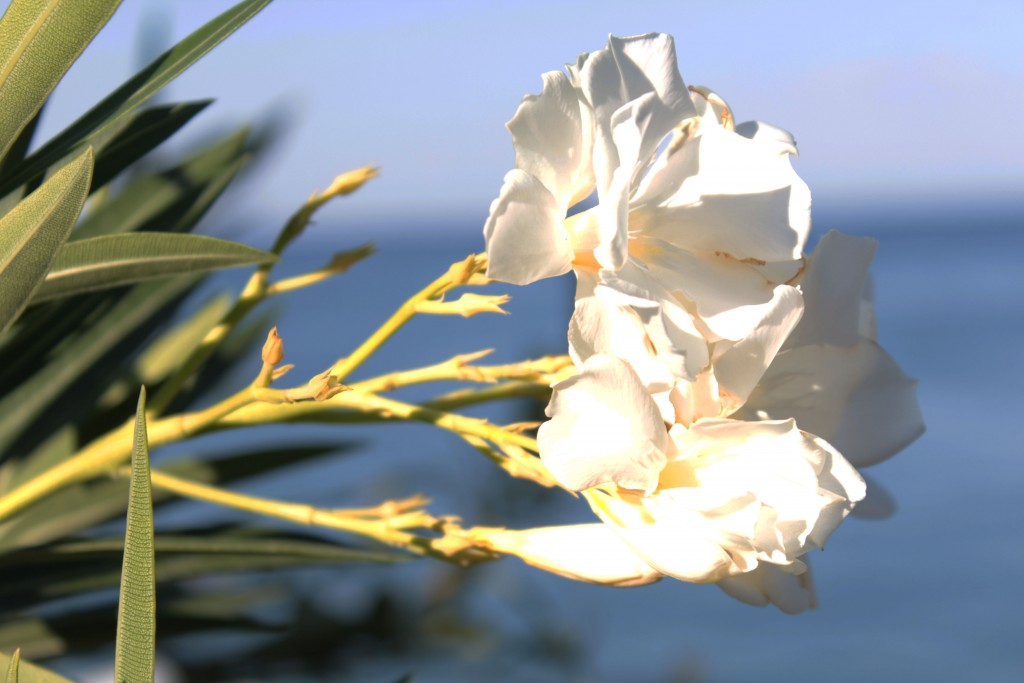
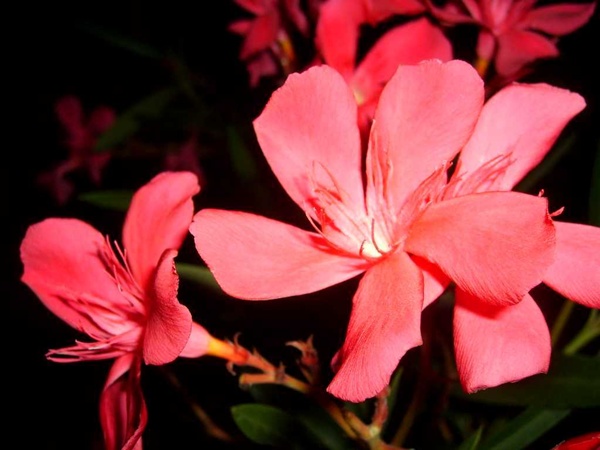
Some very interesting info here, and great pics! You won the Silly Sausage Award, well done !
thank you.. :)
Beauty comes in deadly flowers I guess. Nice article.
>>I walked through soft green grass looking for my flower. As I lifted my head, I found myself looking directly into a cloud of pink and blue. I smiled, wondered: “where is My Oleander?”. I was searching for a very special beauty. But the day was already coming to an-end. I was getting very anxious, as there was not much time left for me to find this flower of Oleander. I ran and saw that the sun was already glowing in the evening sky. The combination of orange, bright and dark red was breathtaking; an explosion of color in endless calm. I simply had to find the flower I was searching for.
>>In the shadow of the last bit of light, in the last second, I finally found my flower. Relieved, I felt my happiness turn into joy. But the flower immediately turned black in my hand. Odd, I thought, before I awoke from my dream. It has been a long time since I experienced this dream, but it still remains alive. The next day I immediately went to our garden and brought this beautiful flower, this time it didn’t turn black in my hand.
[IMAGE: https://steemitimages.com/DQmfJYsGEjk1pjc5gCdGMRPxGcoVdNCA8iitZJXnXSsQjEc/C8339BE3-0235-4AEA-A27F-E3078D7E0F6E.jpeg]
Source
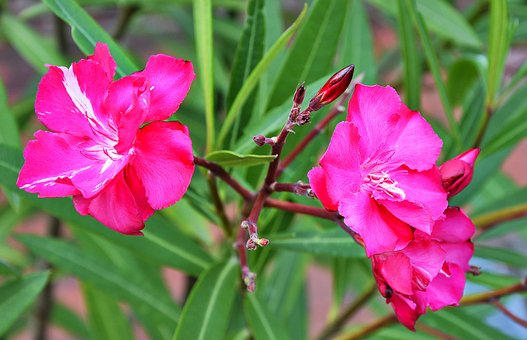
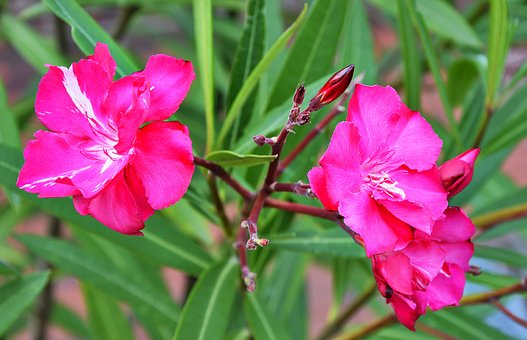
Oleander seeds introduce us to the mysteries of Nature. I would like to tell you about the beauty of oleanders, but also about some of their secrets which are perhaps not so well-known. Let us journey into the distant as well as the more recent past, to get a sense of just how long the oleander has been and is with us on this earth.
In our garden we used often pesticides to rid off mice, flies, caterpillars...The beauty of the oleander in our garden is undoubtably a fact, including the toxicity of this plant. Our oleander plants, which kept multiplying (as seeds were sown every year) served at first to hide the chain-link fences. Later, I kept them in pots. All of the sudden no more mice, hardly any more flies, and caterpillars hadn’t been seen for a long time. Did the toxicity of oleanders have something to do with it? Whatever it was, living with Nature had become much more pleasant.
[IMAGE: https://steemitimages.com/DQmXnzt8dttgbtCoNaR8xb7eYuUR4xvnzJcuh2zczihEJKT/59FC7A59-DFD6-4B4E-BD69-59D139D3E334.jpeg]
Source
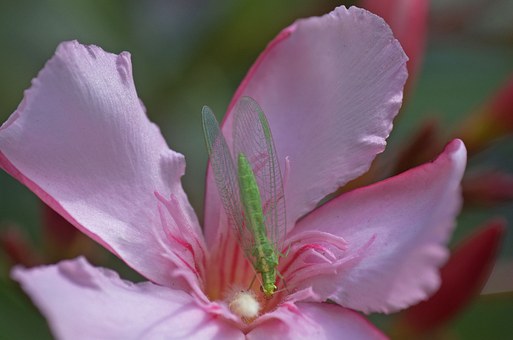

Although poisonous, this plant family is broadly distributed in cultivation as it contains many especially colorful members. These are sometimes even considered the most beautiful in the plant kingdom. The best-known genera are: Plumeria, Allamanda, Mandevilla, and Nerium.
Animals do not eat the oleander, as all parts taste very bitter and if swallowed will trigger the vomiting reflex. Thus they avoid the plant in the future. In humans, ingesting even a few oleander leaves will cause the following symptoms successively: dizziness, nausea, vomiting, cardiac arhythmia, paralysis, and in the worst-case scenario death through heart failure. Swallowing even one leaf or drinking the flower’s nectar can cause death in children. Oleander extracts were used in the past as arrow poisons, and the bark as rodent poison.
[IMAGE: https://steemitimages.com/DQmcekx3DRLyB6b13ZicShfzRyNWi8nB7rmzKgEiUipQnBY/23DABE9C-1BEB-43AF-B3E9-CFB76730E2B2.jpeg]
Source
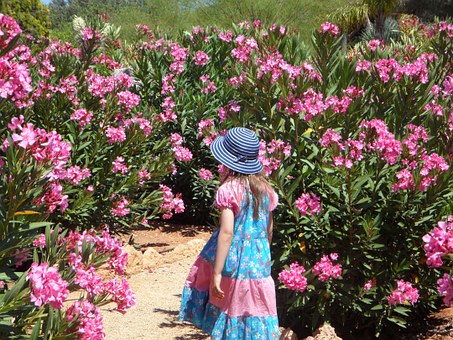
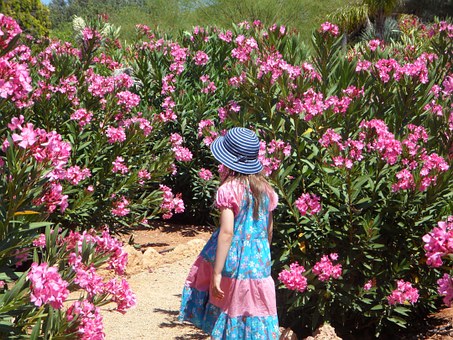
When pruning oleanders, wear gloves; don’t eat or smoke. The poisonous milky sap should not enter open wounds. Oleander wood should not be used as firewood; the smoke can cause painful irritation. Do not rub your eyes. Wash hands with soap after the work is finished.
[IMAGE: https://steemitimages.com/DQmYCHcxixUJutZejv4ChKsA4MvJZYojTMXN3nDZMNWAkn5/ECFAB15F-B8F2-44DA-BB40-25BB2EAEA414.jpeg]
Source
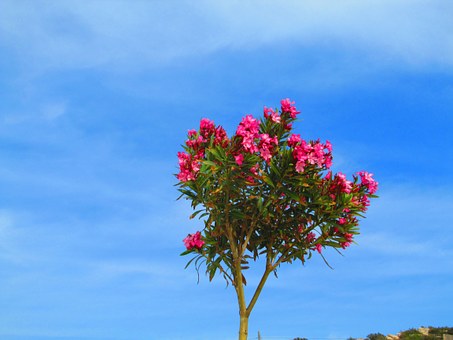
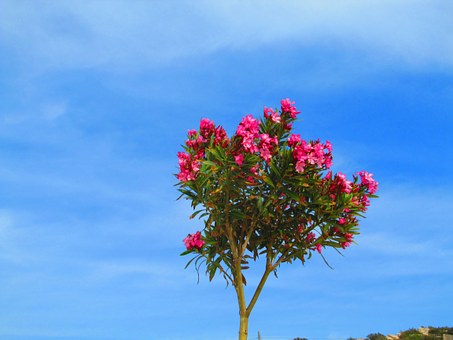
Along with the blue sky and the sea, the hot sun, the scent of wild herbs, and the shrill song of the cicada, the bright pink clouds of oleander flowers also belong to the Mediterranean. An image of its landscape without the oleander would be unthinkable. But in other southern latitudes as well, all around the globe, people decorate the places they live with oleander blossoms, whether it be along the highways under the rising sun, on promenades along the beaches of the Caribbean, or in the mountainous heights of Mexico.
[IMAGE: https://steemitimages.com/DQmX5xoNuAWy28aWkM3aoQLFftsA2MsbEG53fs7XkCFStJ4/B7FE89C9-50AA-40CF-B684-34872C4B8D0A.jpeg]
Picture Source
In the north, where winters bring ice and snow, indeed the oleander grows only in flowerpots or in large tubs; however, in solariums and greenhouses, it blooms even during the cold seasons. The great enthusiasm for oleanders today came from Central Europe. It began in the 60’s when people from the north started traveling to Southern Europe in massive waves. The oleander became the embodiment of “sun and vacation”. People wanted to bring something of this feeling back home, and thus many, many oleander cuttings traveled over the Alps in suitcases. There, the blossoms of the oleander kept the yearning for the South alive.
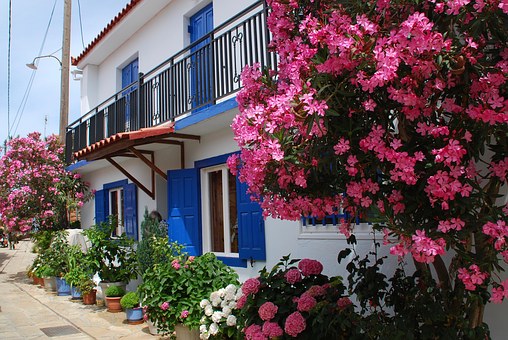
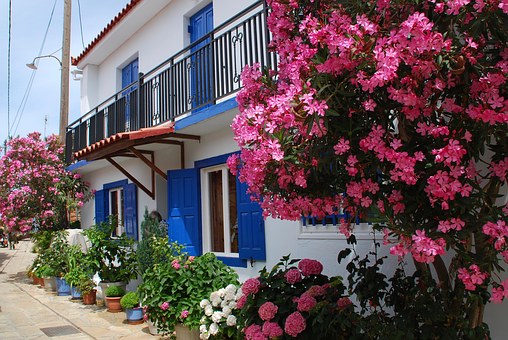
[IMAGE: https://steemitimages.com/DQme9ViuBCkrgoi956AgsWbLKXXpAJTthMT2id2hwwn9bcr/593C7264-2E04-493D-819E-16C9AC7C33C3.jpeg]
Picture Source
In northern and central Europe, the oleander as a container plant climbed its way to first place on the popularity list. That has not changed today. No patio or balcony can be without its “Symbol of the South”. Today, the oleander is sold in every supermarket there. However, the variety of cultivars and colors can only be obtained from specialist nurseries. The oleander is not a “carefree” plant in cold climate zones. Apart from sunny summers, which are a matter of luck, the oleander enthusiast needs to know something about its care.
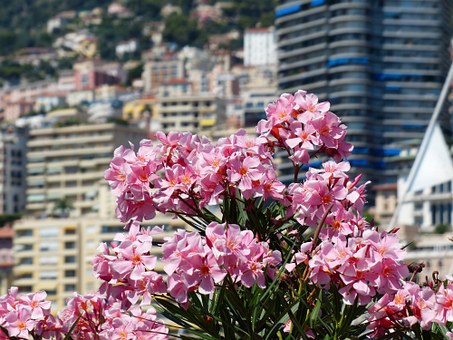
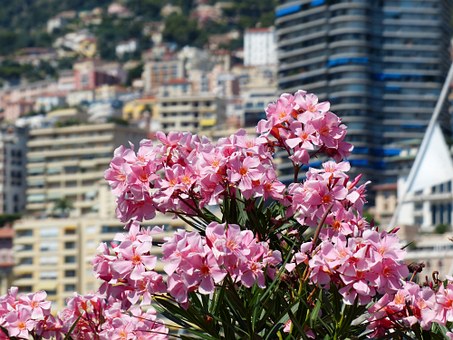
[IMAGE: https://steemitimages.com/DQmdZzWdWF9A8zNfLjwG1gNgJsMxvaxFaKa9LGjXBnnNTpi/357108E8-B23D-4A63-A39C-93F3AD4B1627.jpeg]
Picture Source
It is possible that the oleander’s journey through time began in the darkness of prehistory, and that it led through changing climates caused by catastrophes, or alternating periods of cold and warmth which defined its development and range. The fact is that a type of oleander with a single, non-fragrant pink blossom occurs all around the Mediterranean. It is assumed that the plant with the pink clouds of blossoms came from Asia Minor, the eastern Mediterranean region, and the coasts of the Black Sea.
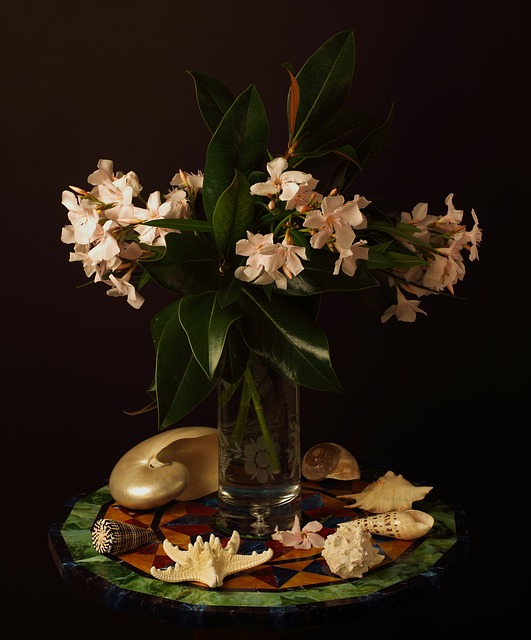
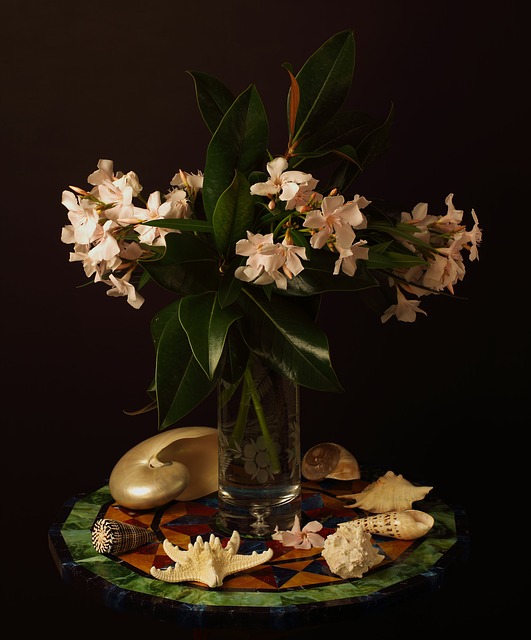
With this beautiful flower there comes also a drawback with it. Be aware of its toxicity!
[IMAGE: https://steemitimages.com/DQmQRYv4r3LRHXGNx5F8G38y8mfrgTrGtUpC9RiUEQjxznE/C50AC55D-0181-432E-BFBF-D1739CAA6A05.jpeg]
Picture Source
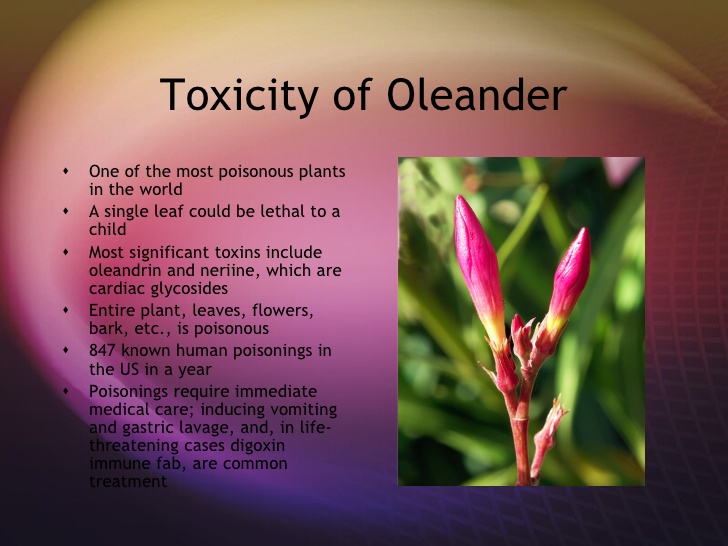
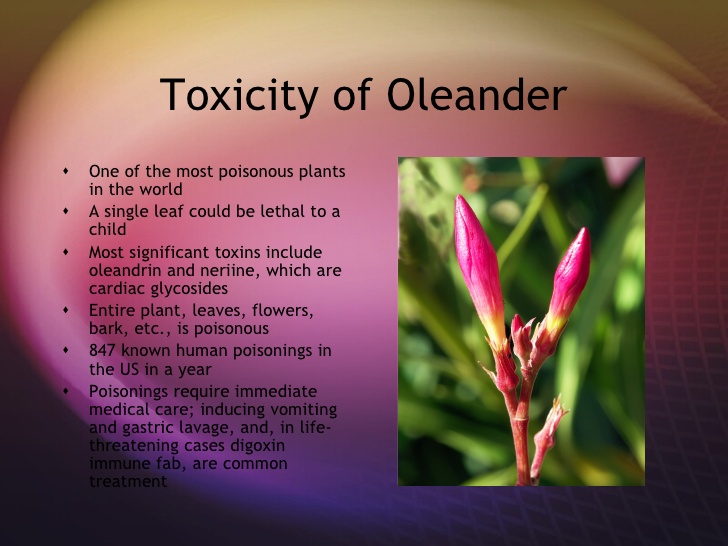
Kaner (Nerium oleander/indicum) is an ornamental shrub or small, densely branched tree, 1 to 10 m tall in the Dogbane family Apocynaceae. Leaves are in pairs of three or whorled, very green, leathery, narrowly elliptic to linear entire. Flowers grow in clusters in terminal branches, each 2.5 to 5 cm, funnel-shaped with five lobes, fragrant, various colors from pink to red, white, peach, and yellow.
The common oleander is one of most poisonous plants that have been shown to contain nondigitalis cardiac glycosides. Oleander is an idiom for plants of the N. oleander L, N. indicum, and, Nerium odorum, species. Common names include soland, lorier bol, rosebay, and rose laurel and kaner.
The oleander is most prevalent, and alluring flowers make it a particular hazard for accidental ingestion. The plant also has shown toxicologic importance for accidents when used in folk medicines, when adults unknowingly eat parts of the plant, or food that has come into contact with the plant, such as hot-dog sticks, and in homicides or suicides. Also, as our case illustrates, toxicities are not limited to temperate climates.
All parts of the oleander plant contain cardiac glycosides, including the roots and the smoke produced from burning, as heat does not inactivate the glycosides. The toxic component are the two potent cardiac glycosides, oleanderin and neriine, which can be isolated from all parts of the plant, Both are very similar to the toxin of Foxglove.[4] Both have positive inotropic, negative chronotropic, and cross reactivity. This includes direct glycoside poisoning of the sodium-potassium pump of the heart and increased vagotonia. Most symptoms from oleander poisoning are cardiac and gastrointestinal in nature and appear four hours after the ingestion.
http://48qbc13dv397vzass1iql2a1.wpengine.netdna-cdn.com/wp-content/uploads/2011/10/Oleander2-300x199.jpg
[IMAGE: https://steemitimages.com/DQmV3F6NJxzFDDPigzYS7FLkMX3SyU2F48CZzDzE7Etv5SA/image.png]
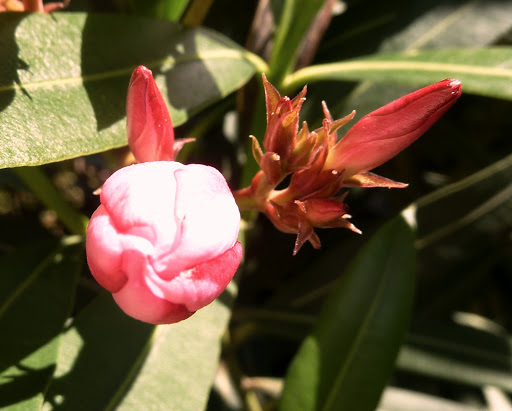
[IMAGE: https://steemitimages.com/DQmRskW5ukvEsQKJ7mKX1ETRPr47gTWrQ11xX1MiKUJuosa/image.png]
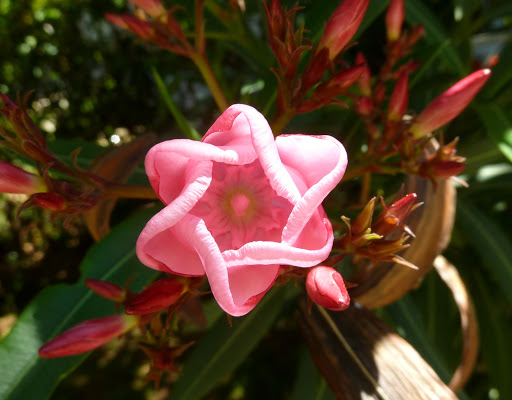
[IMAGE: https://steemitimages.com/DQmdHg7jpURaVG2NuiUSAdyYFKFeVeetUq3yadrwpCbp6YA/image.png]
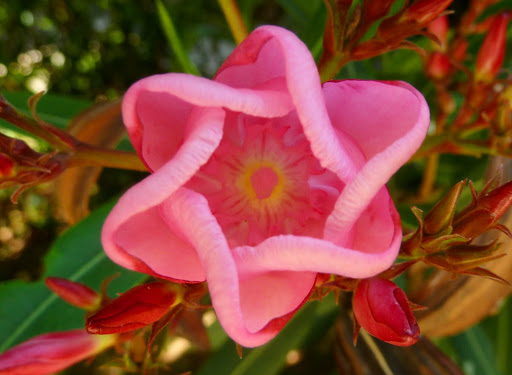
[IMAGE: https://steemitimages.com/DQmdwBFrnY4JEdN151H5G9GKKYsdJv8YiSY7FJnwPKxXiwZ/image.png]
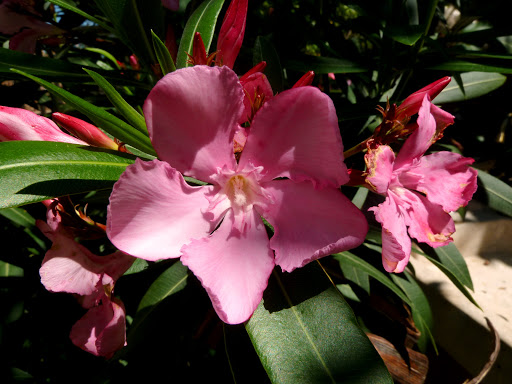
Oleander is an outdoor shrub, popular for its evergreen qualities and delicate flowers. Found commonly in warm locations (e.g., along highways in Hawaii, California, Texas, etc.), all parts of this plant are poisonous to multiple species (e.g., dogs, cats, humans, horses, cattle, etc.). Oleander contains naturally-occurring poisons that affect the heart, specifically cardenolides or bufadienolides. These poisons are called cardiac glycoside toxins, and they interfere directly with electrolyte balance within the heart muscle. The following plants are known to contain glycosides (please see specific plant for more information):
Dogbane
Giant milkweed
Foxglove
Kalanchoe
Lily of the valley
Milkweed
Star of Bethlehem
The toxins within these plants are similar to digitalis or digoxin, a common heart medication used in both human and veterinary medicine. The level of poisoning varies with the particular plant, part of the plant, and amount consumed. All parts of the plant are generally considered toxic – even the water in the vase has been reported to cause toxicosis. Clinical signs from ingestion include cardiovascular signs (e.g., abnormal heart rhythm and rate), electrolyte abnormalities (e.g., a life-threatening high potassium level), gastrointestinal signs (e.g., nausea, drooling, vomiting, etc.), or central nervous system signs (e.g., tremors, seizures). In severe cases, an expensive antidote, digoxin-specific Fab fragments, can be used for severe, life-threatening cases.
Poison type: Plants
Scientific name: Nerium oleander
Alternate names: Nerium oleander, white oleander, cardiac glycosides
[IMAGE: https://steemitimages.com/DQmYgBouRiepqXXwUerqZ9izsbo2YW8E34wAVWnw4b486Vb/image.png]
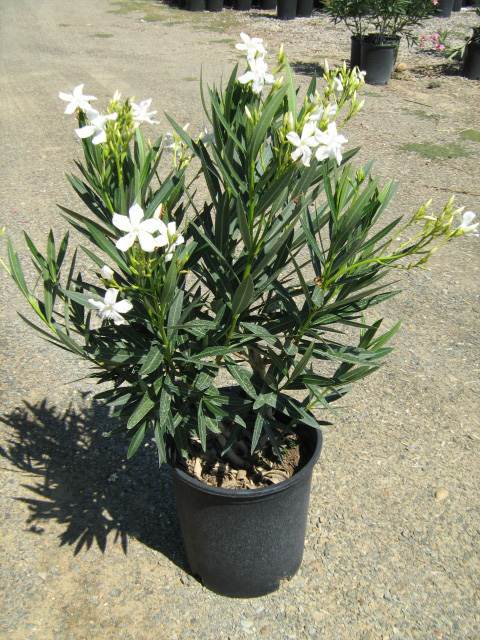
[IMAGE: https://steemitimages.com/DQmfPbjg2pRPn1gPp2AN8vfPmBGUVUWp22UzDaBBeTUEWZN/image.png]
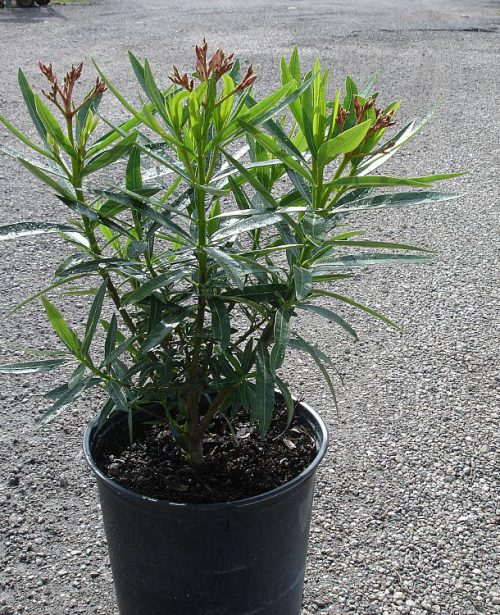
http://storage.googleapis.com/powop-assets/kew_profiles/Nerium_oleander_crop_main_web_fullsize.jpg
http://plants.thgc.net/Content/Images/Photos/F854-20.jpg
Wow amazing & beautiful tomatoes garden.
For your post propagation.
Upvote/Resteem
https://steemitimages.com/0x0/https://steemitimages.com/DQmcHu78WHfiRRuc7QMgyPgxFAstebSg7bYKhisppjJyaSM/NEW%203%20031.JPG
So beautiful garden, thanks for sharing
Resteem
https://steemitimages.com/0x0/https://steemitimages.com/DQmXPLif5dQoc816hSsPmZJcC7X86MGHXoePs686nqDBdAz/NEW%203%20073.JPG
Nerium oleander © Giuseppe Mazza
The Nerium oleander L. (1753) is native to Europe (Portugal, Spain, Balearic Islands, France, Italy, Sardinia, Sicily, Malta, Albania, Slovenia, Croatia, Bosnia, Serbia, Macedonia, Montenegro, Greece, European Turkey) ; Africa (Morocco, Algeria, Tunisia, Libya, Niger, Ethiopia) ; Asia (Israel, Jordan, Lebanon, Syria, Cyprus, Turkey, United Arab Emirates, Oman, Iraq, Iran, Afghanistan, Pakistan India, Nepal, Southern China, Myanmar).
Derivation of the name: The name of the genus comes from the Greek “neron” = water, with possible reference to the shingles and the banks of the rivers where it more frequently grows up; the name of the species should come from the Late Latin “lorandrum”, corruption of the Greek word ‘rhododendron” = pink tree, with possible reference to the most frequent colour of its flowers.
Common names: “oleandro”, “mazza di San Giuseppe” (Italian); “oleander”, “rose bay”, “rose-laurel” (English); “laurier rose”, “oleander” (French); “Oleander” (German); “adelfa”, “balandre”, “laurel rosa”, “pascua” (Spanish); “espirradeira”, “loendro”, “oleandro” (Portuguese); “kyochiku-to” (Japanese).
Evergreen shrub tall up to 5-6 metres, with green stems tending to become greyish while ageing; the leaves are lanceolate-linear, long up to 18 cm and 2-3 cm broad, coriaceous, of dark green colour, opposite or in verticils of three. Terminal inflorescences carrying five-lobed flowers of about 5 cm of diameter with a “fringe” at the centre of the corolla, most frequently pink coloured, but also white, yellow and red, more or less perfumed. The fruits are spindle-shaped follicles long up to 20 cm containing several seeds long up to about 7 mm, provided with a tuft of hair in order to favour their dispersal. It multiplies by seed, semi-woody cutting in summer and air layering.
Plant amply diffused as ornamental due to its abundant blooming in spring and summer, its adaptability to whatever type of soil, even poor, the resistance to long period of drought, to low temperatures (up to about -10°C, even if damage to the aerial part) and to however hostile habitats, such as roads and motorways, where it is frequently employed as traffic island.
JPEG - 53.1 kb
Flowers of Nerium oleander © Giuseppe Mazza
The oleander is considered as one of the most poisonous plants due to the presence in all its parts of several highly toxic substances, between which the oleandrin, a cardiac glycoside which is also, at very low dosage, employed in medicine. Its toxicity is maintained also when dried up.
Synonyms: Nerium indicum Mill. (1768); Nerium latifolium Mill. (1768); Nerium lauriforme Lam. (1779); Nerium odorum Sol. in W.Aiton (1789); Oleander indica (Mill.) Medik. (1790); Oleander vulgaris Medik. (1790); Nerium odoratum Lam. (1792); Nerium floridum Salisb. (1796); Nerium verecundum Salisb. (1796); Nerium carneum Dum.Cours. (1811); Nerium flavescens Spin (1812); Nerium grandiflorum Desf. (1815); Nerium luteum Nois. ex Steud. (1821); Nerium odoratissimum Wender. (1831); Nerium splendens Paxton (1837); Nerium thyrsiflorum Paxton (1837); Nerium mascatense A.DC. in A.P.de Candolle (1844); Nerium kotschyi Boiss. (1846); Nerion oleandrum St.-Lag. (1880); Nerium japonicum Gentil, (1907); Nerium indicum var. leucanthum Makino (1940); Nerium indicum var. lutescens Makino (1940); Nerium indicum var. plenum Makino (1940); Nerium oleander var. indicum (Mill.) O.Deg. & Greenwell in O.Degener (1952); Nerium indicum f. leucanthum (Makino) Okuyama (1955); Nerium indicum f. lutescens (Makino) (1955); Nerium indicum subsp. kotschyi (Boiss.) Rech.f. (1974); Nerium oleander subsp. kurdicum Rech.f. (1974).
[IMAGE: https://steemitimages.com/DQmeHCH56dKcmFeQuYPumWs7ubwRmmjeEyh34HgEUgt6WBH/image.png]
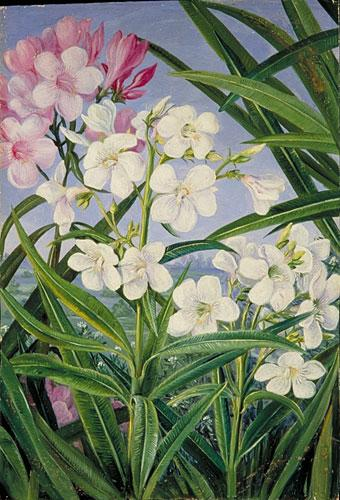
https://toptropicals.com/pics/garden/m1/Raznozwet3/nerium_oleander3470.jpg
https://toptropicals.com/pics/garden/m1/Raznozwet3/nerium_oleander3466.jpg
https://toptropicals.com/pics/garden/m1/Raznozwet3/nerium_oleander3471.jpg
https://toptropicals.com/pics/garden/m2/2012/canon/IMG_0066Nerium_oleander_MrsRoeding_TA.jpg
Source : https://toptropicals.com/catalog/uid/nerium_oleander.htm
Oleander is an evergreen plant that belongs to the family Apocynaceae. This plant is native to Morocco, Portugal, China and Mediterranean areas, but it has been naturalized to almost all continents in the world. Oleander is one of the most poisonous plants on the planet. Despite that fact, people cultivate and create new varieties of oleanders due to ornamental morphology of these plants. Oleander grows on the well-drained soil in areas that provide enough sunlight. It lives mostly in warm, tropical climates. Oleander can tolerate drought and temperatures near zero during short periods of time. Besides being popular in horticulture, oleander can be used in the pharmaceutical industry for the production of various remedies.
Interesting Oleander Facts:
* Size of oleander depends on the variety. It grows in the form of shrub that can reach from 3 to 20 feet in height. Most species are 8 to 12 feet tall.
-
Oleander grows quickly, usually 1 to 2 feet per year. Stem is thick and covered with grey bark.
Leaves are thick and leathery. They are narrow and usually 4 to 6 inches long. -
Oleander develops yellow, white, pink, light orange and red flowers that are often gathered in clusters, located at the end of the branches. Most species of oleanders produce fragrant flowers.
-
Fruit of oleander is called capsule. Each capsule contains large number of fluffy seeds.
-
Oleander is best known by its toxicity. Each part of the plant contains toxins.
-
Poisoning will be induced even after consumption of minimal amounts of this plant. Whistles made of oleander’s stem can induce poisoning of children. Toxic effects are visible both in humans and animals.
-
Typical symptoms of oleander poisoning include vomiting, diarrhea, irregular heartbeats, dizziness and seizures.
-
Besides via ingestion, poisoning can be induced by touching the plant and tree sap with bare hands. Also, inhalation of smoke of burning oleander induces toxic effects in humans.
-
Leaves and seeds of oleander are used in the manufacture of medicines for asthma, epilepsy, painful menstrual cycles, warts and other skin conditions.
-
Polka-Dot Wasp Moth is a type of insects which consumes oleander without visible side effects. It eats all parts of the leaves except veins.
Common Crow Butterfly consumes oleander during the larval stage. By storing toxins in the body, this animal increases its chances for survival (large predators, such as birds, do not consume these larvae). -
Despite their toxicity, there are over 300 varieties of oleander that are grown because of their ornamental morphology. The most popular types of oleanders are Algiers, Calypso, Hardy Red, Petite Salmon and Sister Agnes.
-
Oleander is official flower of Hiroshima. It was the first plant that managed to blossom after devastating effects produced by atomic bomb in the 1945.
-
Oleander can be easily cultivated and it can survive couple of decades.
[IMAGE: https://steemitimages.com/DQmSGQTc4zDVKKiHTtsh9pXvv3bzt3CsHziQWch5ifXWgXo/image.png]
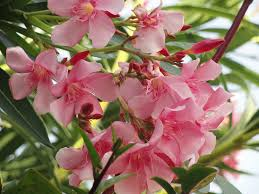
[IMAGE: https://steemitimages.com/DQmSRSeLfLWh3QiC2bLK5bsuxrDJjVRr2fSYKydaWF3nFkp/image.png]
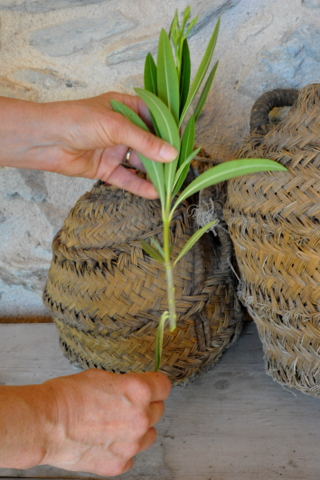
[IMAGE: https://steemitimages.com/DQmZCXG1LU5AnYzvEuJPGuf1M8X75oKd9Db11WFpzrz2AZm/image.png]
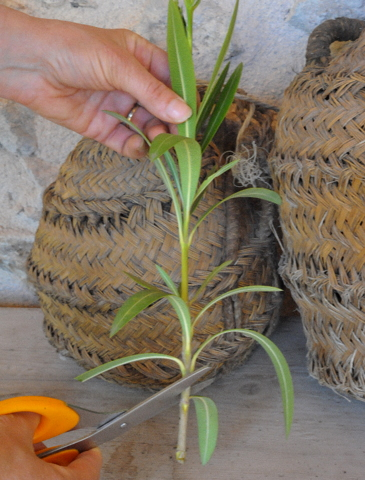
[IMAGE: https://steemitimages.com/DQmfRNqZmqAjyPmRGXGrk8PHfo69omszMXT48QD7nGrGXGK/image.png]
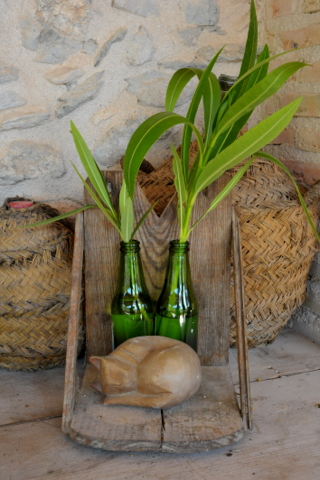
[IMAGE: https://steemitimages.com/DQmWUoCV5sfSzCSXy6MejwzdCatjjoBdNxc6y7qRzHphSkB/image.png]
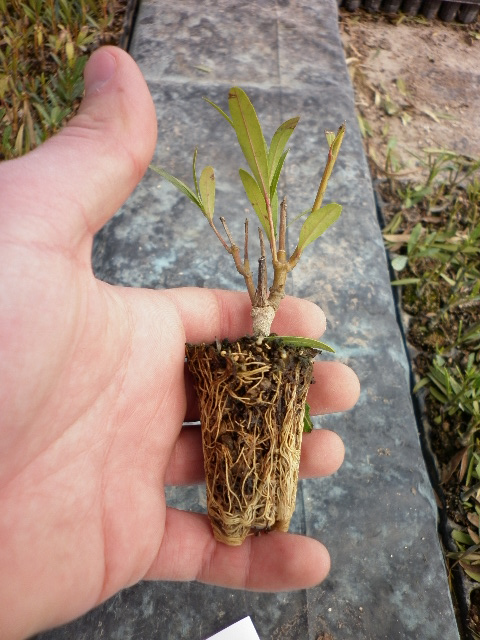
[IMAGE: https://steemitimages.com/DQmaxQyZnViJWUiNGLBDfJME7SghEH69wLRHnbYWxGg1q4h/image.png]
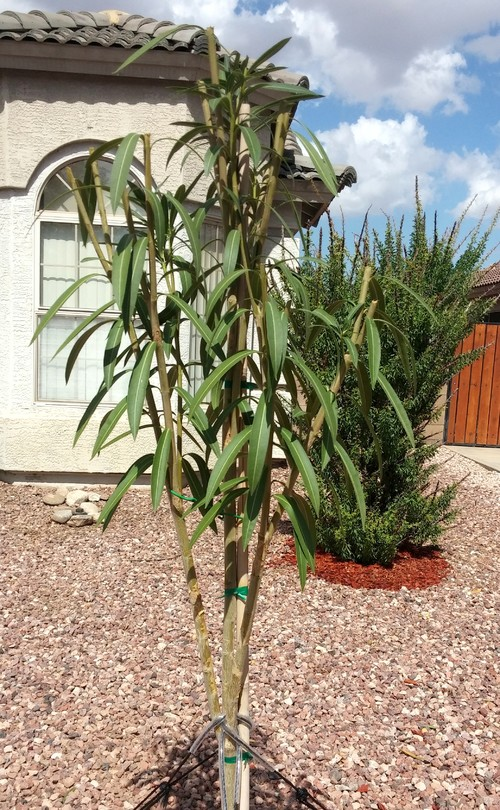
During the Peninsular Wars some of Wellington's soldiers are alleged to have died after eating meat cooked on skewers made from the wood. This same claim is made about other groups of soldiers during other wars so is impossible to verify. This alleged ability of oleander skewers continues to be ascribed to various groups, often boy scouts out camping, to this day. This in spite of the fact that oleander does not produce woody stems of the size or strength to be used as skewers. And, there has been one piece of research that found insufficient transfer of oleandrin from the skewer to the meat to produce a fatal barbecue.
Soldiers sleeping on oleander branches were reported to have died according to the Gardener's Chronicle in 1880 though this may have been a sort of 'Chinese whispers' corruption of the skewer story.
In 1989, the Western Journal of Medicine reported the case of an 83 year old woman who attempted suicide by drinking a tea made of an infusion of Oleander leaves. She suffered severe bradycardia with a pulse rate of 40 and was treated with atropine to counteract this. There are other reports in the literature of failed suicide attempts.
There are numerous reports of animal poisoning featuring a wide range of animals including sheep, cattle, horses, canaries, budgerigars, donkeys, a sloth and a bear. The following are two of the more recent examples.
In 2005, the Los Angeles Daily News reported the case of Fudgie, a dwarf cow beloved of the primary school students in its area. Fudgie ate some oleander branches and suffered cardiac arrest. It was fortunate that the vet called in knew a senior toxicologist because between them they restarted Fudgie's heart twelve times over the week that it took for the cow to recover. The vet apparently kicked Fudgie in the chest to restart his heart.
In August 2009, 23 horses at Rockridge Farm in Rancho Santa Fe near San Diego were reported to have been poisoned after an intruder broke into the stables during the night and fed them oleander leaves. When staff opened the barn at 6 am they found one horse already seriously ill and the others showing the first signs of poisoning.
The workers say they found oleander leaves in the stalls as well as remains of carrots and apples thought to have been used to disguise the bitter taste of the plant.
Three horses were transferred to a veterinary hospital, though two were well enough to be released the next day, and the rest were treated at the ranch.
In July 2011, a giraffe died at a zoo in Tucson, Arizona, after being accidentally fed oleander leaves by an apprentice keeper. Another animal was taken ill but survived with careful medical attention. The zoo had a long-standing policy of feeding clippings from its extensive grounds to its browsing animals but, it seems, the apprentice went against the policy that only material identified by the head grounds' keeper should be collected.
[IMAGE: https://steemitimages.com/DQmf8KZ3DBLWXGHxF4tyaG8vvkBBUMgWdoWfhwCwyyveyVD/image.png]
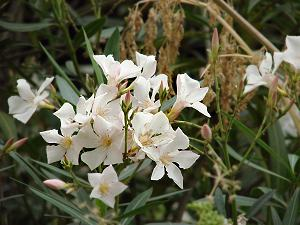
[IMAGE: https://steemitimages.com/DQmXfsqc3r2ersdzanjvGruQJALGFKdCujj3LV3eWwEEYfG/image.png]
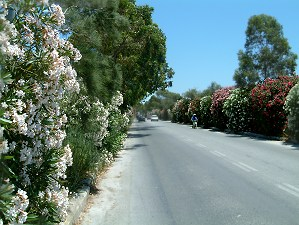
[IMAGE: https://steemitimages.com/DQmWftJXJoS8VT8CEaa6ZetVaytUAMwmBbPUMBvh8q64Gkz/image.png]
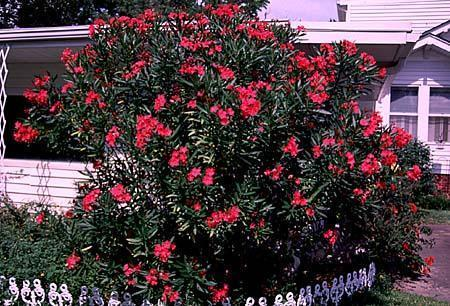
[IMAGE: https://steemitimages.com/DQmSBRyyVLDCMCDWhb4iKpmyJbdx3bW2EPhds4GcbtvQtaY/image.png]
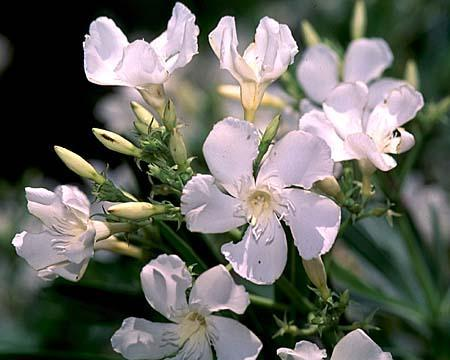
[IMAGE: https://steemitimages.com/DQmdCfRjN4dpFoE7Z3QV17BZiGwFSLyGtQj49Qgfxp11V7Q/image.png]
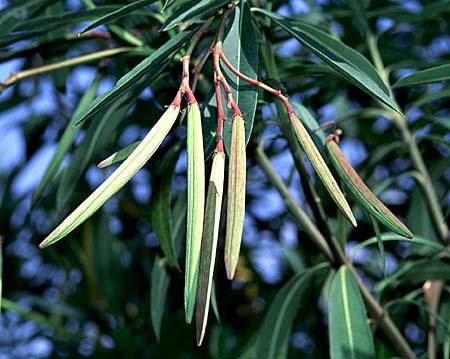
link = http://www.thepoisongarden.co.uk/atoz/nerium_oleander.htm
link = https://plants.ces.ncsu.edu/plants/all/nerium-oleander/
Very interesting stories of poisoning by Oleander !
Ya it's good plant for environment. It has long green leafs and nice flowers too .
Thanks
It's environment friendly plant . Mixture of colors .
What Is Nerium Oleander - the Key Ingredient in Nerium AD?
[IMAGE: https://steemitimages.com/DQmcxPaMBdhNXLXQCfqiRFX8yhXHMSN8aAnLPKBf1dVsrCN/39553.jpg]
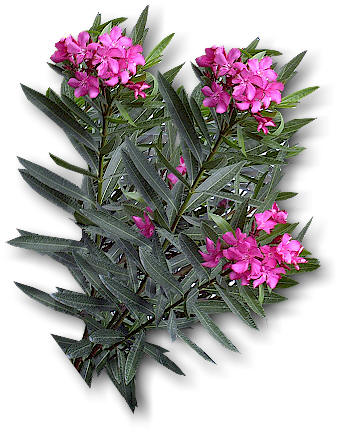
Nerium AD’s key ingredient is a beautiful, but also deadly plant, the Nerium Oleander. This flowering shrub, evocative of New Orleans and Billy Holiday, is commonly used for roadside landscaping due to its forgiving nature towards poor soil. It is also extremely toxic and one leaf can kill a child (source).
Is Nerium Oleander Toxic?
The American Cancer Society unequivocally describes the oleander plant as “poisonous,” and adds “many people have died of heart failure or respiratory paralysis after eating parts of the plant or drinking tea made from it.” Although I found one published report of a death as a result of oral oleander extract, very few toxic events in humans have been reported. According to the Toxic Exposure Surveillance System (TESS) in 2002, there were 847 human exposures to oleander reported to poison centers in the United States. Despite this exposure level, from 1985 through 2005, only three deaths were reported, according to Wikipedia.
[IMAGE: https://steemitimages.com/DQmWuaehRHKaVp2kQJ8eWDQVqNb8eqUiXTc6QUbwBhFVRpX/1375277823_nerium-oleander-main.jpg]
1

Still, toxic it is. So what’s it doing in my face cream? Well, it has been used in folk medicine for centuries to treat a variety of ailments. Researchers have established that the key components are cardiac glycosides, one of which is called oleandrin. And then Anvirzel burst on the scene, claiming to be a breakthrough cancer-curing drug based on nerium oleander extract. The company behind Anvirzel is Nerium Biotechnology – the same company that makes Nerium AD.
In test tube studies, Anvirzel appeared to slow the growth of human bladder cancer cells. But “carefully dosed” people with cancer did not demonstrate that Anvirzel helped them. In the end, it was not approved by the FDA. Oleander leaf is on Germany’s regulatory agency list of unapproved herbs as it has not been proven to be safe or effective. However, all hope for oleander’s curative powers are not lost as the National Cancer Institute instigated a new trial of Anvirzel earlier this year.
[IMAGE: https://steemitimages.com/DQmQtCJf1VVwSSFsN8SfFMdJUbVTg3Vn86cwhTebqGWuhnH/29831451_m.jpg]
1
Does Nerium AD Work As an Anti-Ager?
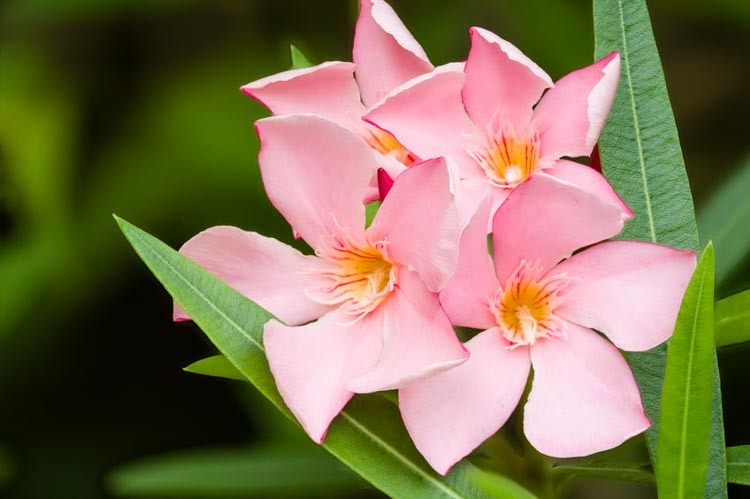
Since, so far, Nerium Biotechnology hasn’t made it big on the anti-cancer front, it seems to be trying its hand at anti-aging cosmetics. Fair enough, but I wasn’t able to find any evidence that nerium oleander extract works as a wrinkle-repair ingredient or any other form of anti-aging for the skin.
[IMAGE: https://steemitimages.com/DQmVxLx8fPmKg1utkBEzsWWc6wijnksNPmzfMww7MaT1kXY/images.jpg]
1
Furthermore, Wikipedia cites studies in which “a nerium oleander extract was applied to the skin of people with different dermal conditions, sensitive mass spectrometry based blood analyses were not able to detect the presence of cardiac glycosides such as oleandrin, indicating that these compounds are not readily absorbed through the skin.”

So, I am facing a poisonous, failed (so far) cancer drug that doesn’t penetrate the skin and is a potential irritant – apparently skin irritation from contact with oleander has occurred and allergies are possible (source). As well as being unproven as an anti-ager (I haven’t even found a single other instance of nerium oleander being used in a cosmetic product), this doesn’t inspire a whole lot of confidence.
[IMAGE: https://steemitimages.com/DQmRachFoshwe1nUqudNJdzARwzGJ9GqMugShNrYSS8XbgK/zakkum.jpg]
1
A doctor who suggests this plant in time is good for cancer on TV has led to the death of many people.anvirzel, one of the components of nerium, is a substance that kills only the tumor cells in the body, does not harm normal cells, and also applies the treatment method for each cancer.however, boiling and drinking the plant does not work in this regard, only kills.
[IMAGE: https://steemitimages.com/DQmchDQd415gAPaE23yL89DEz18L4ZFjobfnLLV9jq23zPv/nerium_oleander_1.jpg]
1
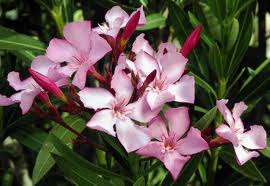

They are looking very beautiful and especially the flowers !
its looking just awesome flower,,Oleander is just a great looking,,thanks for sharing
Magoo-2 found a series of multi accounts of a same owner is following your articles to cheat your generous rewards.
Magoo-2 found these accounts are suspicious & can be multi accounts of a single owner. Conclusion is based on last 30 days transactions:
@rahmanmdriad
@mdriadrahman26
magoo-2
Check our latest multi comment spam update report
hi dear,,
Oleander which looking so amazing,,thanks for sharing
wow,,its really great flower,,i love this very much,,thanks a lot sir for your sharing special Oleander post,,
Magoo-2 found a series of multi accounts of a same owner is following your articles to cheat your generous rewards.
Magoo-2 found these accounts are suspicious & can be multi accounts of a single owner. Conclusion is based on last 30 days transactions:
@rahmanmdriad
@mdriadrahman26
magoo-2
Check our latest multi comment spam update report
Hello dear Sir @ctrl-alt-now thanks for coming with another useful and interesting plant OLEANDER. I did a deep research on it and here are my findings, hope you will like it and if I'm wrong somewhere you can indicate:
Nerium oleander
Oleander, Nerium oleander, is a super drought tolerant evergreen hedge or tree that can add vibrant color as well as privacy to your landscape. From the Mediterranean, this floriferous, fast-growing beauty is a staple in landscapes across the Western United States. It’s a small to medium sized plant that makes an excellent “Living Fence.” Colorful and fragrant white, red and pink flowers appear in late spring and into fall, to create a dazzling display of color. This versatile plant tolerates a wide range of soils and can be used as a hedge or tree,
An Oleander will thrive in full sun with little to no water required once established. It’s a versatile plant that can grow just fine in partial shade, too. Larger Oleanders can be easily trained into single or multi-trunked trees with dark green, leathery, and semi-glossy narrow leaves providing year round interest:
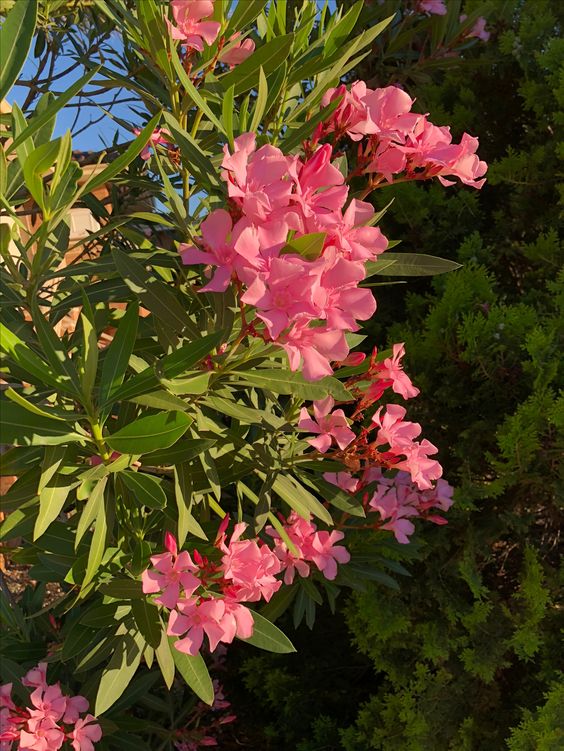
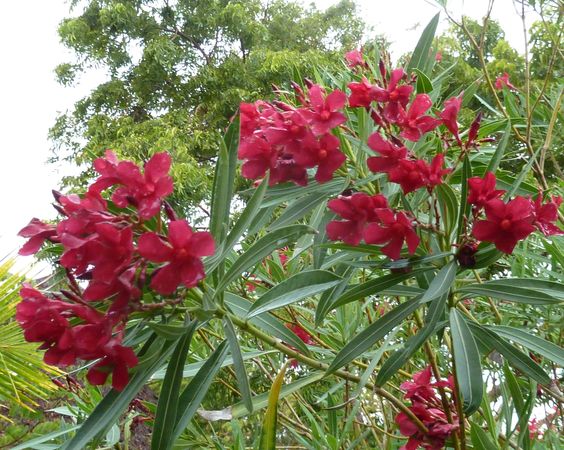
[IMAGE: https://steemitimages.com/DQmVX6tmb6NjqNMYRNwSWq6KYXzF4e17CQxYA3krKexmMdZ/thumb%20(1).jpg]
.jpg)
[IMAGE: https://steemitimages.com/DQmPnX4qnDhudj9JGpoEa7id6Tk7r3sGqHCYavCvH93nrJ5/oleander2.jpg]
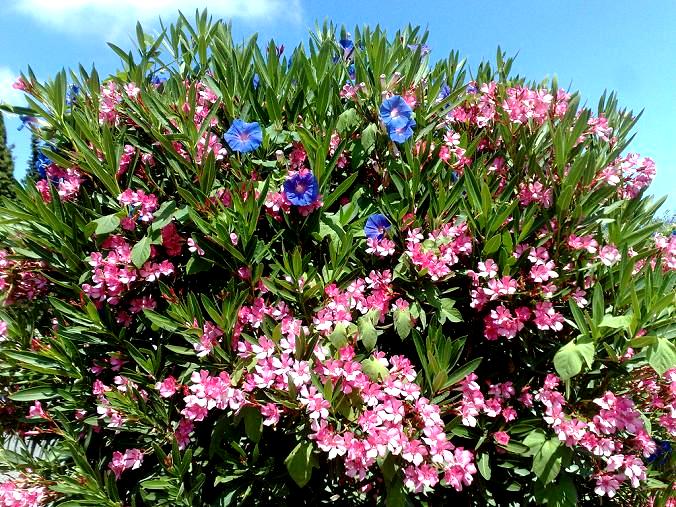
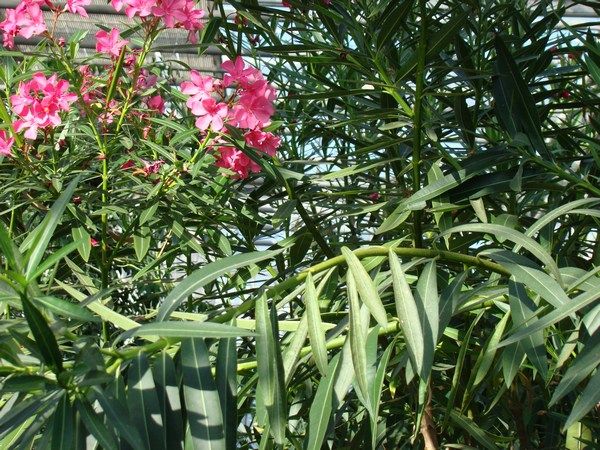
[IMAGE: https://steemitimages.com/DQmXa63gpycUdYnpoWS7zYgqSEYvT66Jh4BKnq13jn9zsLo/DSC05018.JPG]
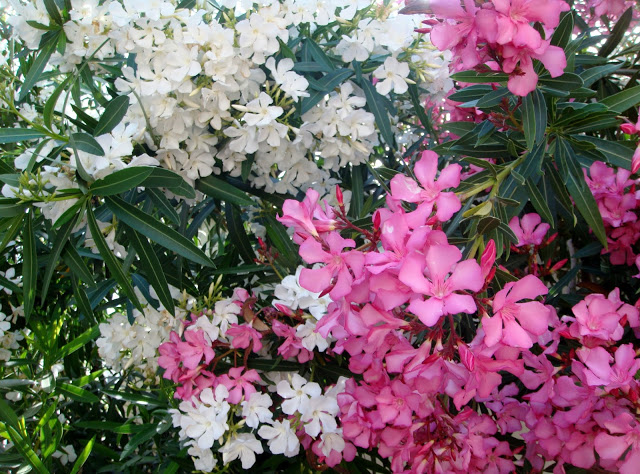
[IMAGE: https://steemitimages.com/DQmR4tMrPBHtiyDHWzo6qm3ymGgbdu73c8z5D9xHLPJgXhz/099.jpg]
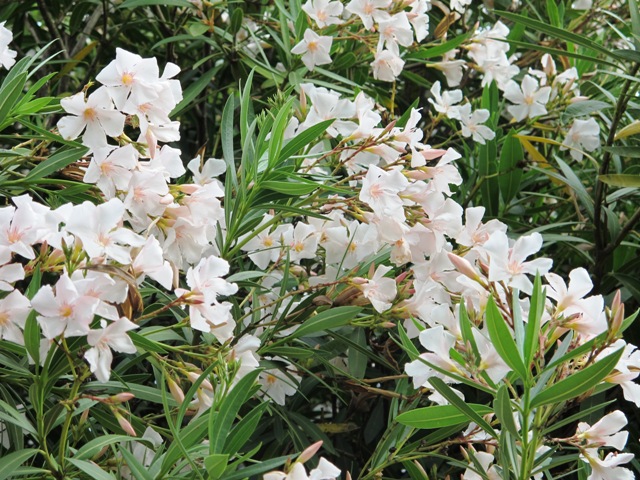
===========*==========*==========
[IMAGE: https://steemitimages.com/DQmYoRhQVGHSVeGdaXaSCpGb61we7LLhDfgw7NVZehDLR3N/nerium-oleander-n6.jpg]
[IMAGE: https://steemitimages.com/DQmTGvHW221bNjPDs1e2m56WLBcLRDWkx51ssxqvVXUDNra/920x920.jpg]
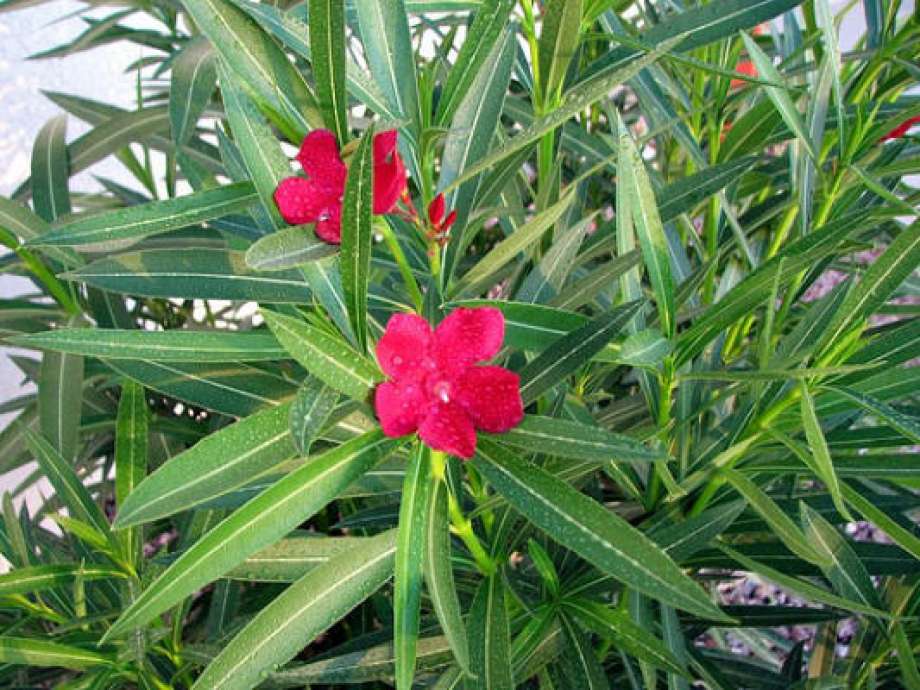
[IMAGE: https://steemitimages.com/DQmZUxh6v8fHgMoWrHtDCUAe85Yuvk7bC6gdfLnWUJQBMwu/nerium-oleander-n1.jpg]
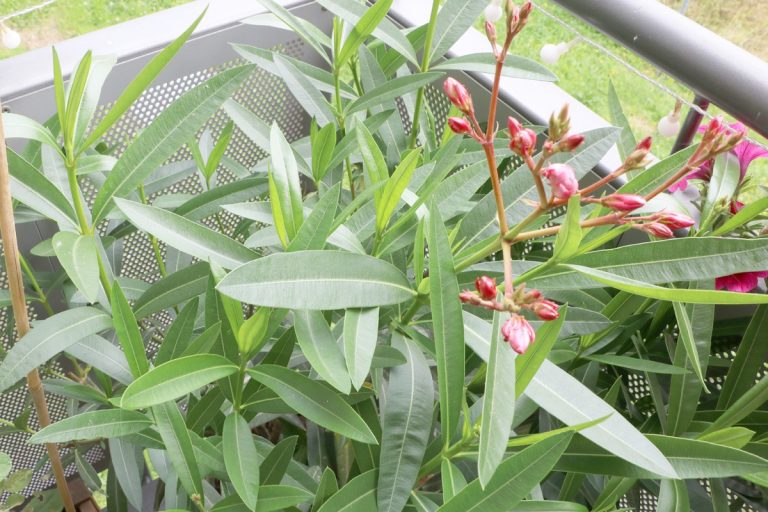
[IMAGE: https://steemitimages.com/DQmV4SvpASScCAryTAo3SUJPRghrSt5coeaxEaMkuFYAYFT/nerium-oleander-n5.jpg]
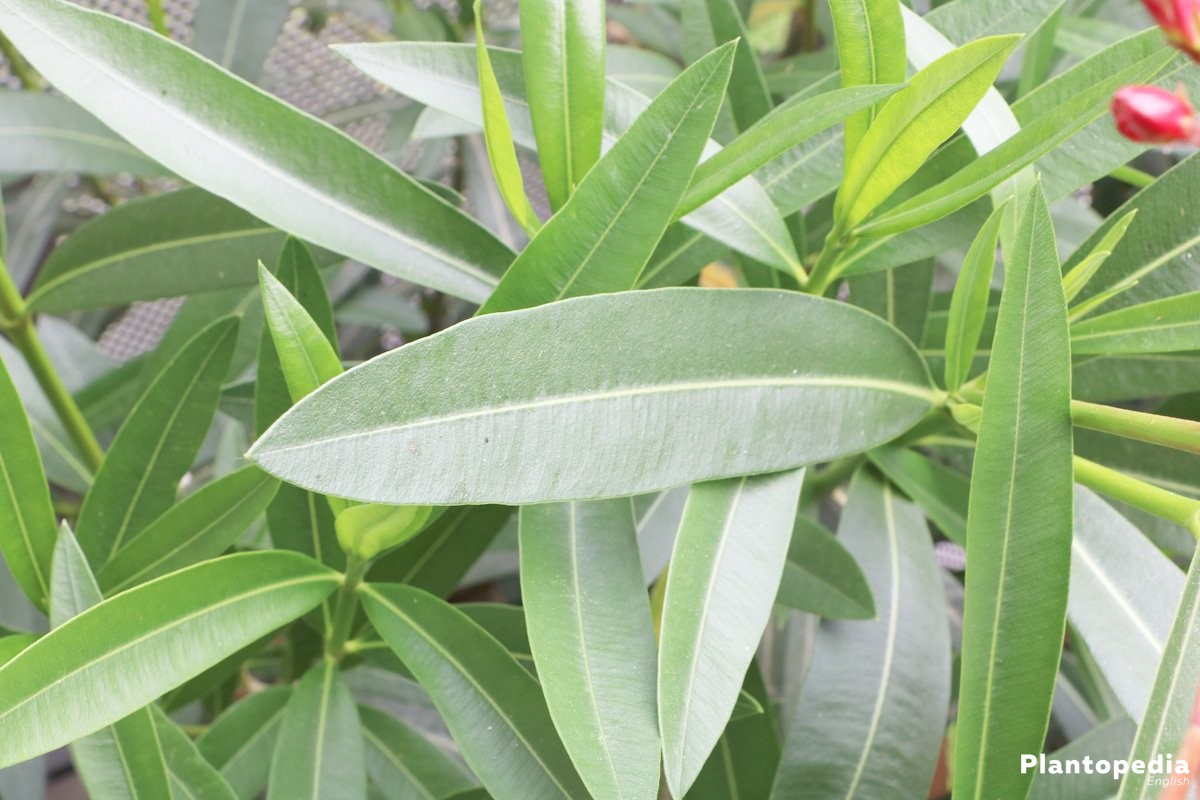
[IMAGE: https://steemitimages.com/DQmQvB7wtHSTtEjBKj2e6E4bAV9EKasK43pAR33vBrpDXrv/nerium-oleander-n8.jpg]
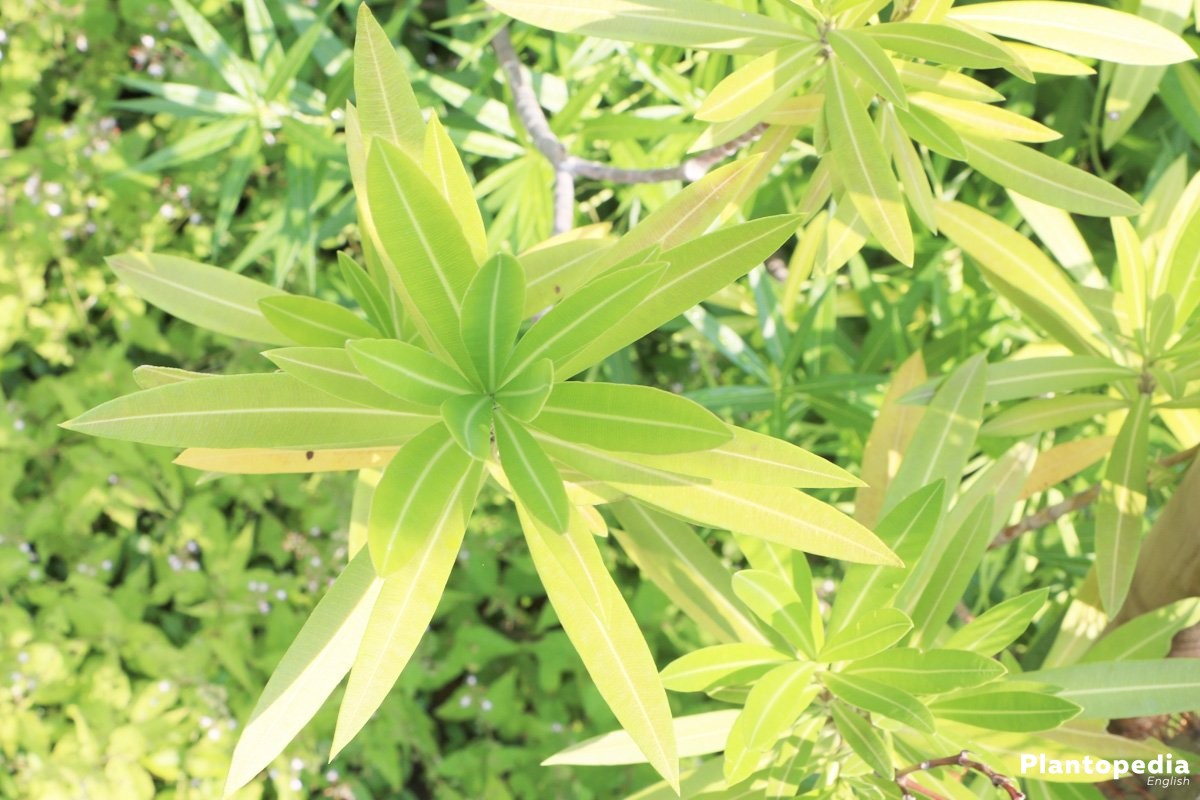
[IMAGE: https://steemitimages.com/DQmdg3ZDAofsWpNp8QPV7vic9sNR6wKWHn8y1guM31mYLsp/nerium-oleander-n11.jpg]
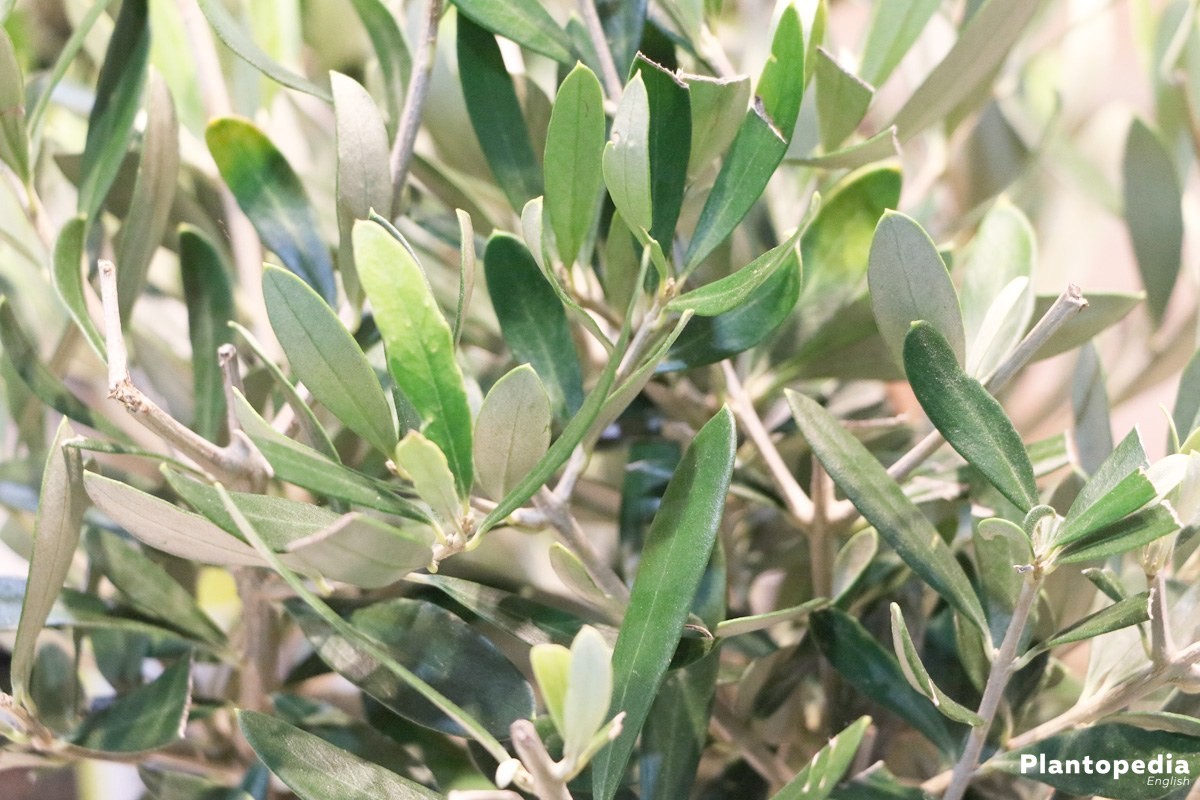
==============================================
Disclaimers: All the data (Pictures, Text) are taken from Google and some other sources. Here are links of that sources:
Text
source 1
source 2
source 3
source 4
===============================================
That's all from my side Sir @ctrl-alt-nwo. Thanks again for your Support towards Minnows like me. Always keep smiling!
I am so blessed that you're the part of this awesome platform dear @ctrl-alt-nwo. You are doing a tremendous job by spreading The Beauty Of NATURE. You have given a motto to the common user of steemit, this is appreciable.
Here is my efforts regarding the topic oleander:
Oleander Plant (Nerium)
Somewhat like an olive tree with clusters of large whorled flowers, the oleander has a Mediterranean mystique. It grows into a large open shrub that forms an attractive screen. Colder-climate gardeners can grow this subtropical in containers and overwinter it indoors. Use caution around children and pets, as all parts of the plant are highly poisonous.
Oleander prefers moist, well-drained soil and a sunny location outdoors. In the Southwest, oleander is susceptible to a bacterial disease carried by the glassy-winged sharpshooter, an imported pest. Affected parts of the plant can be pruned out with clippers disinfected between each cut.
[IMAGE: https://steemitimages.com/DQmWjo6Qts9YNyosGgRvecxiJkbtbStsmb18urChqP6ufst/white-oleander-flowers.jpg]
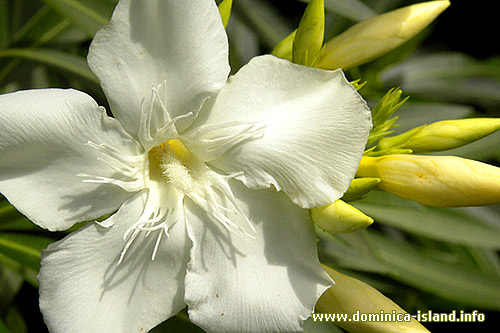
[IMAGE: https://steemitimages.com/DQmSsDCFGNcwG1SqBmAWDsRaoeJY2Utw3ZvWiszKdzd13KH/NeriumOleander14.jpg]
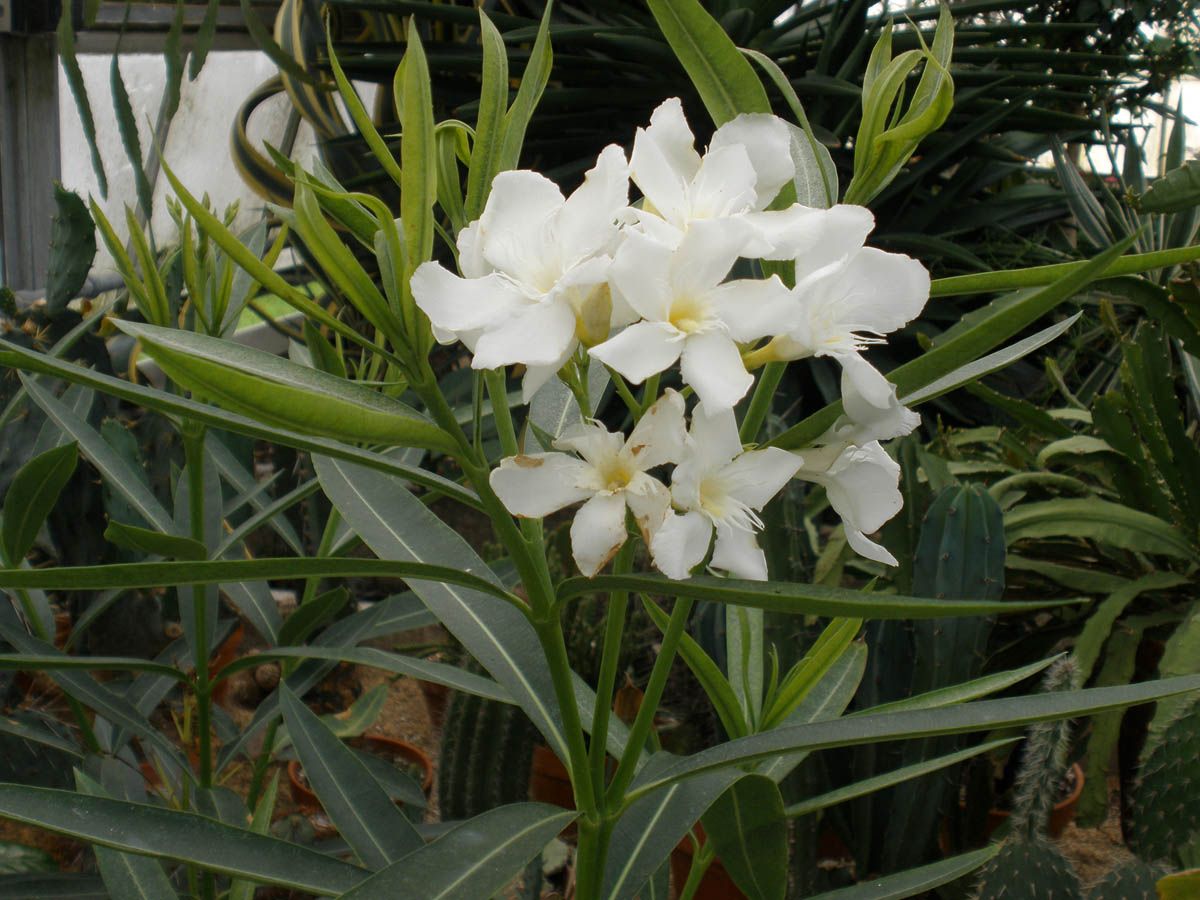
[IMAGE: https://steemitimages.com/DQmTbtkYJW5Ro835SjgZrTe1df7aeK9M647dvUDGyAmH6bn/00.jpg]
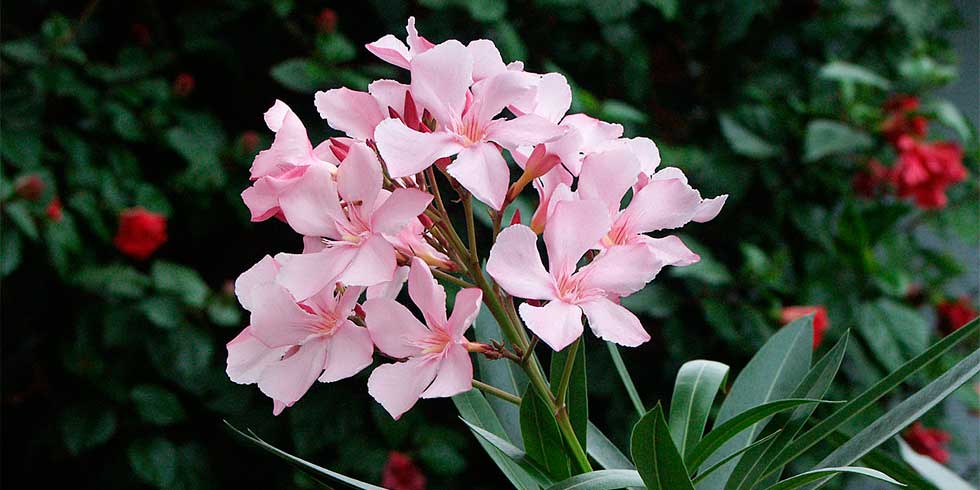
[IMAGE: https://steemitimages.com/DQmdNYgorwQKa6E4pWCcmKe4913CFJSjMxzuqrrYimJCNDm/nerium-oleander.jpg]
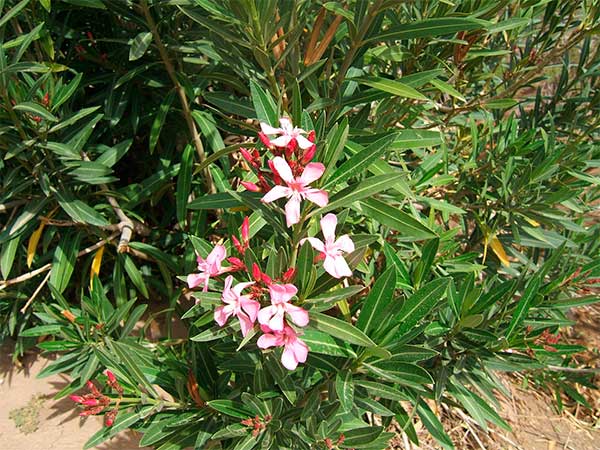
[IMAGE: https://steemitimages.com/DQmWnRtxdwa5sdAw1ZFjfzMGSUkkfp5JvciHee7UeAw9Msc/Nerium_oleander_HRM3.jpg]
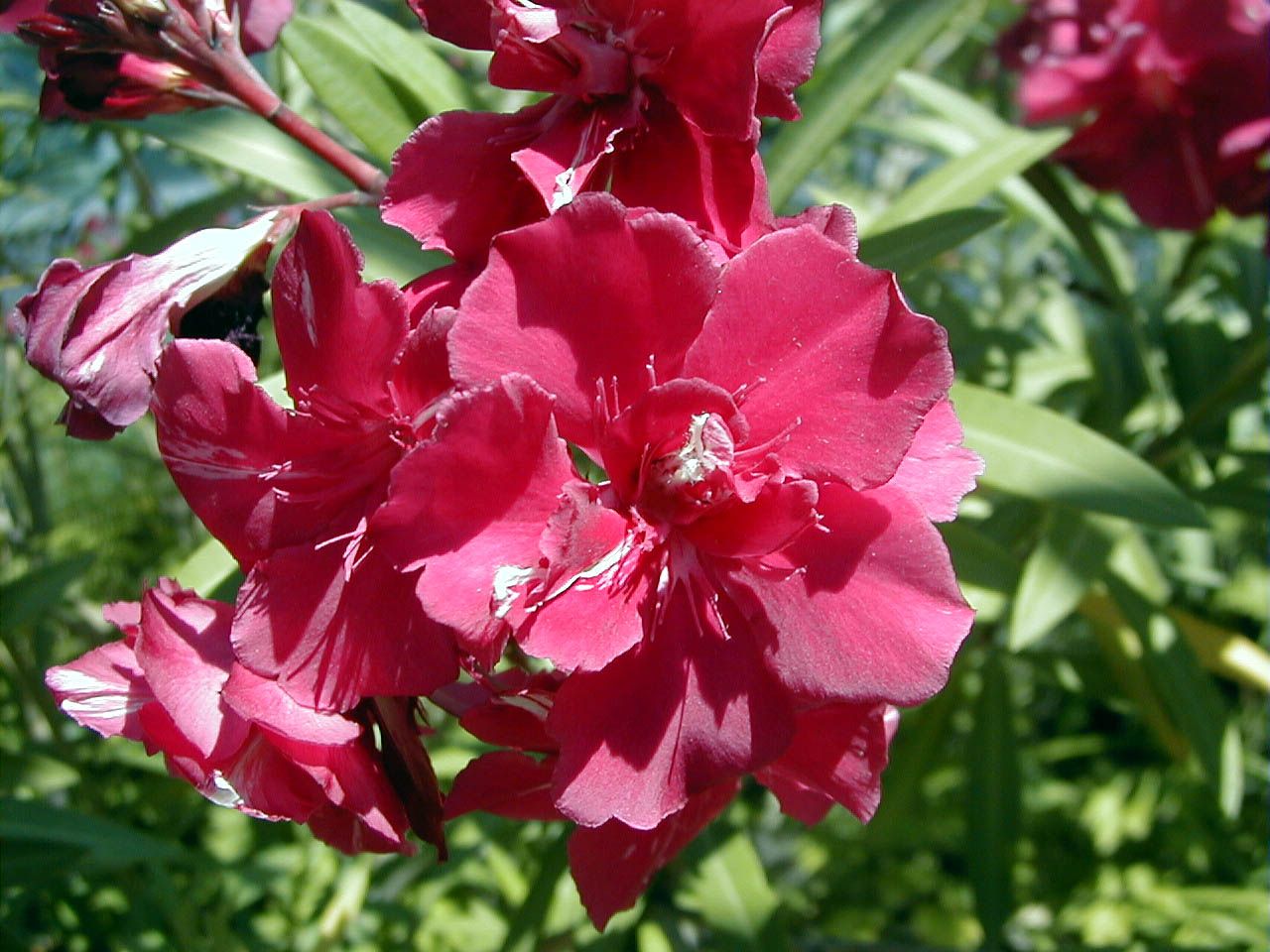
[IMAGE: https://steemitimages.com/DQmVqVUwB7LWuE4w5xdjhrWFoVPj8M1syNhTMKs5P7RRALe/877c9f.jpg]
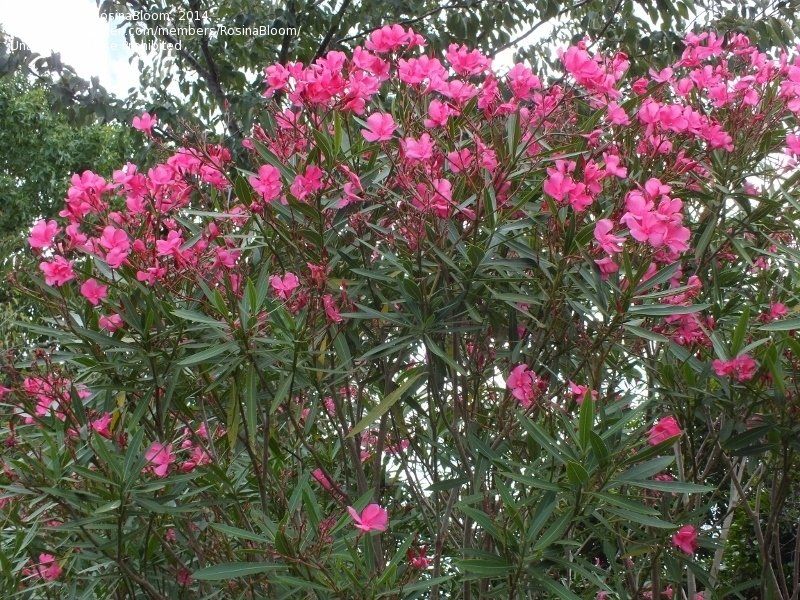
[IMAGE: https://steemitimages.com/DQmXPbrFUsoHUhj38M1mH4fWiZbamcop3jR18XMQ43VTjLu/Untitled-1.jpg]
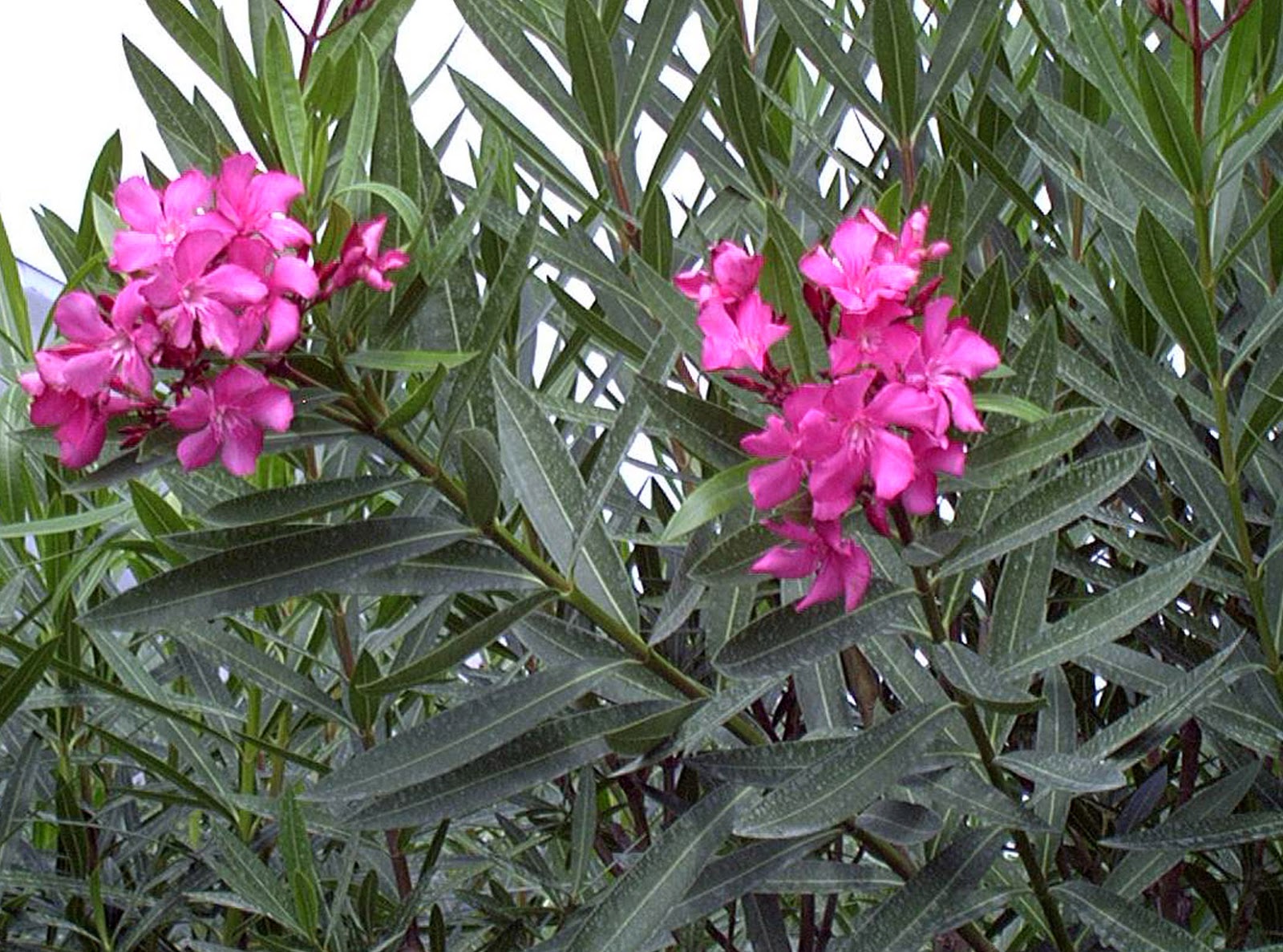
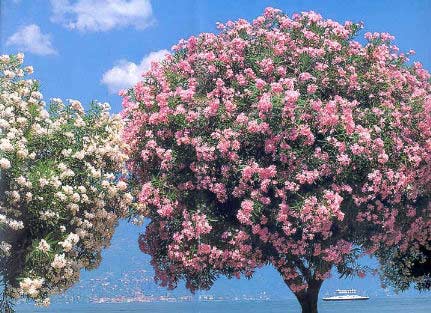
[IMAGE: https://steemitimages.com/DQmdNtVZHqniMziyEkd9GuSMeqPgq4L3Z56M8D1tP1wbJi6/images.jpg]
REFERENCES:

Thanks and all the best @ctrl-alt-nwo!
https://i.pinimg.com/564x/15/3b/17/153b17cdfb9effa92a4558ca1a188a3b.jpg
https://i.pinimg.com/564x/d2/b0/a8/d2b0a8ad7b327756da81191c1d002f53.jpg
How can some of the most beautiful plants be so toxic? Take oleander—that wonderfully large shrub that, despite high winds and salt spray along our coastlines, somehow manages to produce clusters of gorgeous blooms in summer in white, yellow, peach, salmon, pink or red. And yet oleander is considered one of the most poisonous plants in the world. All parts of this gracefully mounded shrub contain poison; a single leaf ingested by a child is known to be deadly.
But, as with thorny roses, prickly cacti, and toxic holiday plants, knowledge is key in preventing hazardous encounters with these landscape beauties. Native to the Far East and the Mediterranean, oleanders, Nerium oleander, grow easily—and rapidly—in the United States, especially southern coastal climes, where they’re often planted along highways as a noise and pollution barrier. These evergreens thrive with little care and are very tolerant of heat and drought. Most will survive temperatures as low as 15 to 20 degrees, though their foliage may get damaged. Yet even then, the shrubs recover quickly in spring so long as their roots are not harmed.
Oleanders grow best in full sun, and most reach 8 to 15 feet tall and as wide, so make sure you give these big guys plenty of space in the landscape. They flower from early summer until mid-autumn with large clusters of 2-inch single or double blossoms. Their long, narrow leaves are smooth but leathery.
A few cultivars to consider include:
'Algiers' features single, dark red flowers.
‘Calypso’ is cold hardy with cherry red single flowers.
‘Hardy Red' is extremely cold hardy with deep red single blooms.
‘Petite Salmon’ is a dwarf plant but less cold hardy than most oleanders.
‘Sister Agnes’ is hardy, grows to 12 feet and has large single white flowers.
https://i.pinimg.com/564x/62/d1/d9/62d1d98b9e27241595506d0689fcb218.jpg.
thanks for this post. for sharing
100% like and resteem