An ocean current can be defined as a horizontal movement of seawater at the ocean's surface. Ocean currents are driven by the circulation of wind above surface waters. Frictional stress at the interface between the ocean and the wind causes the water to move in the direction of the wind. Large ocean currents are a response of the atmosphere and ocean to the flow of energy from the tropics to polar regions. In some cases, currents are transient features and affect only a small area. Other ocean currents are essentially permanent and extend over large horizontal distances.
When ocean waters flow horizontally in streams over long distances from one region of the ocean to another, they form what we call ocean currents. There are two types of ocean currents, that is the warm and cold currents. Warm currents bring warmth and rainfall to the adjacent coastlands they wash, while cold currents bring chilly and dry condition to the coastlands they wash.
[IMAGE: https://steemitimages.com/DQmVSxU6CunbuS7gjHmximhdvh3ScLurk6MU9DDfpkHQCfD/Ocean_surface_currents.jpg]
Wikimedia
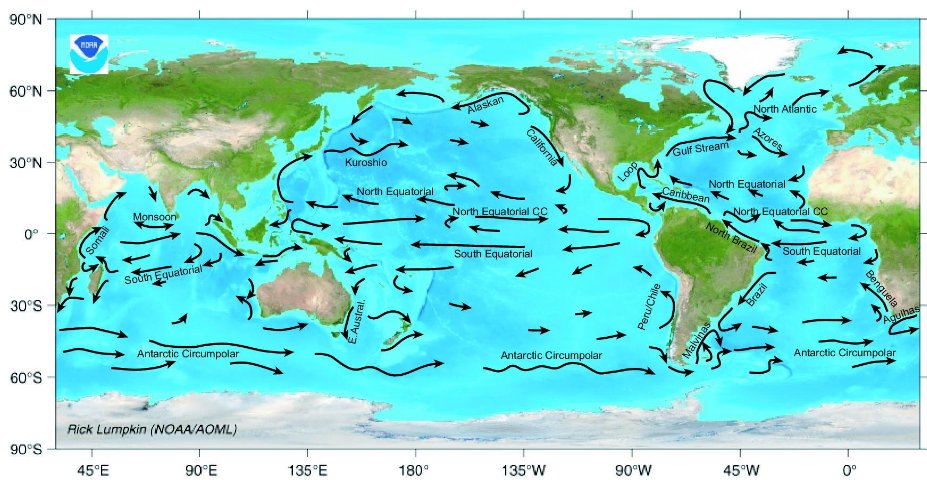

The temperature of the air over a warm current is high, and the evaporation of the waters of the current increases the vapour content in the air. Onshore winds then blows this warmth and moisture to the land to increase both the temperature and precipitation there.
On the other hand, the air over a cold current is dry and chilly. Not only do the onshore winds which blow over this current have no moisture, which such winds may have previously picked elsewhere, condenses on coming in contact with the chilly air over the cold current, and gives rise to mist or fog there. The winds then continue inland as dry winds deprived of their moisture.
This explains why deserts are located close to the coasts washed by cold currents and why there are fogs off such coast. An ocean current warm when it flows from warm waters (near the equator) to cold waters (nearer the poles) and cold when it flows in the reverse direction. The warm equatorial counter currents, however, flow east-west or west-east about the equator while the West Wind Drift flows west to east in the southern oceans.
What causes ocean currents?
Many factors cause and direct the flow of ocean currents.
* The rotation of the earth gives rise to ocean currents and deflects them, the same way as it does to winds. They thus determine their general direction of flow.
-
The winds that blow over the surface of the ocean generate ocean currents too. The currents flow in the direction of the winds, just like what happens to the surface of water in a basin when you blow over it.
-
Differences in the density, salinity and temperature of the ocean water cause the waters to move in a tendency to mix up and equalize these properties. Currents tend to flow an area of low salinity to that of high salinity.
-
The shape of the coastline directs the flow to currents as they either get deflected or split into two when they strike a coastline.
Worldwide influence of ocean currents
I will now discuss the influence of ocean currents on the climate of adjacent lands worldwide.
- In the North Atlantic Ocean, the most famous and longest current in the North Equatorial current which becomes the Gulf Stream in the Caribbean Sea and continues in a northeasterly direction where it is called the North Atlantic Drift. This is a warm current and it carries its warmth from the equatorial region to the southeastern coast of the USA and western Europe, keeping these coasts warm and wet.
On the other hand, the cold Labrador current flowing southwards from the polar region keeps the eastern coast of Canada relatively cold and dry. We can see this when we compare the temperature of New York and Nain, and on the one hand with those of Porto and Glassgow on the same latitude on the other.
Where the North Atlantic Drift and Labrador current meets off the coast of Newfoundland, the moisture over the former condenses when it comes in contact with the cold air above the latter. This gives rise to fog.
In a similar way manner, the cold Canary current which washes the west coast of northern Africa, keeps this coast cool and causes dense fog in the Canary Islands. This current thus deprives the onshore winds of their moisture and thus brings about the extension of the Sahara desert in northern Africa to this coast.
Off the coast of Accra (Ghana), there is an upwelling cold current coming from beneath the ocean. The cold air over this cold current causes fog here as the tropical maritime airmass comes in contact with it, thus deprive this airmass of its moisture. This fact, the orientation of the coast parallel to the wind direction, the low coastal relief and the rainshadow effect of Cape Three Points, give rise to comparative dryness of the Accra coastal plains.
-
In the South Atlantic Ocean, whereas the warm Brazilian current raises the temperature and rainfall of the east coast of Brazil to over 30 degree Celsius and 80cm per annum respectively, the cold Benguela current, practically on the same latitudes , keeps down the temperatures and rainfall of the western coast of South Africa, to about 22 degree Celsius and 50cm per annum respectively. It also accounts for fogs off the Benguela coast and the coastal location of the Kalahari and Namib deserts.
-
The North Pacific Ocean shows a similar pattern. The cold Californian current like its counterpart, the cold Canary current, causes the proximity of the Arizona desert to the ocean. The warm Kuro siwo current, which is a continuation of the North Equatorial current of the Pacific, keeps Japan and the east coast of China warm and wet , while its convergence with the cold kamchatka or Oya Siwo current off the east coast of Japan causes fog s there the same way as the North Atlantic Drift and Labrador current do off the coast of Newfoundland.
-
Also the currents of the South Pacific Ocean. Even though Australia is farther away from the equator than Peru, the east coast of Australia , washed by the warm East Australia current, is warmer and wetter than the arid Peruvian and Chilean coasts washed by the cold Peruvian current. It is along these coasts that we find the Atacama desert.
-
In the Indian Ocean there is the warm Monsoon current which ensures a steady supply of water vapour for the heavy monsoon rains to India and adjacent lands. This current changes direction at two different times of the year. This change in direction is caused by the changing direction of the monsoon winds.
-
In the South Indian Ocean, the South Equatorial current continues to the east coast of southern Africa as the warm Mozambique and Agulhas currents, making this coast register high mean annual temperatures in the region of 22 degrees Celsius and total annual rainfall of 100cm and over. The cold Western Australian current to the east, on the other hand, gives rise to the extension of the Australian desert to the west coast of this continent where precipitation is as low as 5cm per annum.
Conclusion
This account of how currents influence weather and climate should be well mastered, as it offers us an interesting explanation of why the weather and climate of the coastlands vary widely all over the globe.
Reference
Ocean Motion and Surface Currents
Roemmich, D. (2007). "Physical oceanography: Super spin in the southern seas". Nature. 449 (7158): 34–35.