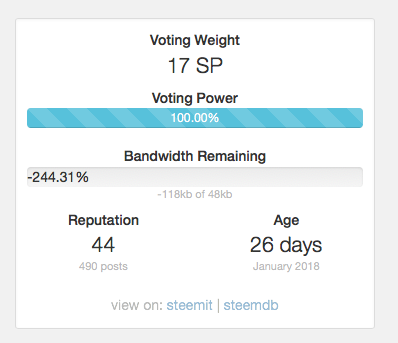
> Basically, you suck up half of the bandwidth all on your own. :P
A man has to have dreams.
> We're not talking about the bandwidth issues people were having a while ago who were adding a ton of users, or posting useless comments even. They can't even do normal social interaction because the site has 50k active users.
I'm aware of the effects. One couldn't spend any time looking through new user postings or paying attention to Steemit.chat and not see that there is a significant problem going on in the mechanics of block resolution on this blockchain.
Which I think is both hilarious and horrific because one of the big selling points of the steem blockchain is that "it can handle so many transactions." You can find crypto cultists going on at disturbing length about how super robust the steem blockchain is, about how it is barely breathing hard at hitting 2 million transactions a day – while simultaneously we have users who are getting regular out of bandwidth messages during US daylight time, to the point that both of us notice.
We don't experience them, but we notice them when enough people talk about them.
> I'm advocating for a better betting system. It's bare basic right now, and it's not working. It needs to be tweaked. Standard use should be possible, even for tiny accounts. They should be able to make one or two posts, even during peak hours, and make a few comments. Likewise, when they can't even post, bots should not be allowed to make hundreds of comments, just because they have high SP. It needs to be adjusted.
I'm not sure that such a betting system using a priori knowledge, that is the information that we have at any given moment, is possible.
After all, we know that people with high SP have done one of two things:
-
Been significantly active on the blockchain, either as a creator or a curator, or earned reputation with someone who was long enough and consistently enough to gather that SP, or…
-
Dropped a big fat wad of some kind of cash for the privilege of being privileged on the steem blockchain. Or been the inheritor of someone who did.
Now, personally I find the latter to be a little oppositional to the desire to have a good, quality social network. To me, it smacks more of being able to buy my advertising eyeballs rather than a way to promote "good content." But that's the mechanic in place.
I would certainly suggest that the current curve of pricing on the bets is wrong. Like you, I think that even a new user should be able to make one or two posts during peak hours and a few comments (which amount to the same thing, given the underlying architecture of data storage). I think we could agree that somewhere on the order of 10 text-content updates to the blockchain for the six-hour peak times in the US should be the bare minimum of available bandwidth to an account.
Except for one little nagging problem: a real person will use that to make at least plausibly structured, potentially useful content additions. But a bot will use those 10 interactions to do bot things. Most of the time, those bot things are things that we don't want.
And we cannot know before they do these things – that is, before they do whatever things that they're going to do – whether or not the account is a bot or a user. It is impossible to know. If we could know, then we would be happy to change the betting weights to favor the actual user.
But we can't. It is informaticly impossible to distinguish the two.
So, given that it is impossible to know upfront, and we know that a spammer will bring a lot more damage to the platform (in the long run) than a new user who insists on posting during prime time (who can be taught to do differently), the bet as it stands may not be what we want, but it may be what we need.
> > It's not only spammers wasting bandwidth. It's everyone. If we know there is a problem, if we actually all just consider our actions a little more carefully, maybe a few more users can post. Maybe even someone who owns a bot will reduce their number of comments if they consider the bandwidth.
The problem with that is that it's silly.
I can't know at any given time what the bandwidth starvation situation is. I can't know at any given time if my interaction is going to keep someone else from being able to post. I can't know if the interaction that I theoretically keep from happening is a legitimate bandwidth operation or the activity of a spambot or the activity of someone transferring a pile of SP to a spambot. Maybe my posting during the day is helping protect the exact same people that you are saying that it is disenfranchising!
You don't know. I don't know. But my made up stuff is just as plausible as your made up stuff. In fact, statistically, my made up stuff is more likely to be the case that your made up stuff.
> I'm not advocating not talking, or not posting, or not interacting. I'm advocating doing so slightly more responsibly.
It has been a never ending source of amusement for me to notice how often "act responsibly" is really just a cipher for "don't do things I don't like." In almost every case, in fact.
Why don't we just say what we mean, or is that too much unmasking the authoritarian to be popular?
Let's be clear, you are very much saying "not talking, not posting, and not interacting" are good things at the right time because you are supposed to "be responsible" and think of people who could use the bandwidth who are not you. That is very deliberately and very clearly saying don't do these things. Implicitly, it's saying "it's okay to do these things if I would like them."
That's a very good way to get more things that you like on the blockchain, but it's going about it in a way that I find a little duplicitous.
> An easy way would be usage. Find the outliers. Who is using more than 90%?
None of them. We're talking about new users and new accounts here, remember? There are no outliers because there are no liers. Differentiation at that level is impossible. There is no data.
Again, I point out, you want to be able to differentiate between new users who should have enough bandwidth to interact with other people and new spammers who will immediately use that bandwidth to go about with the spamming.
Unless you want to immediately differentiate between "how the account was created," privileging those which Steemit.com has created themselves and diminishing those accounts created by purchase and investment, you don't have a winning move here.
It would be interesting to generate a statistical list of accounts at any given time which are at less than 10% of their bandwidth allocation remaining. That might not actually turn up bots because I'm not sure that bots really consume that much of their personal, individual account bandwidth in regular operation, but it would be interesting information.
Pity I don't see anybody else finding this to be a problem.
> Would they?
>
> It's not exactly an easy way, as you point out. You could judge based on the number of posts in relation to upvotes. I still think the most post happy should be curtailed during these times of troubles.
They would. They'd be wrong, in terms of ultimate ability, but they would be reasonable to say that from the accounts first post we ought to be able to make some sort of judgment about them.
But since I then go on in the very same paragraph to point out all the problems with that, you can't possibly think that would be my suggestion. Or, rather, a reasonable person would not think that that was my suggestion. No?
> Every new user should be able to post at least a few times. Though how quickly is a matter for debate. If you did factor in posts and upvotes, you should be able to allow for those with zero posts to post.
And you're back to having the original problem of having no information to go on until bandwidth is already burned. Which solves no problem. You can't factor anything before those things happen, and the things in question are exactly the problems that we're trying to keep from happening.
You have a problem of differentiation which is based on trying to stop the very information that would tell you how to differentiate things.
In such situations, you really only have one choice: limit everybody in proportion to how likely they are to be engaging in useful exchanges. That seems to be exactly what's happening.
But until I see some actual numbers about what is consuming the bandwidth on the blockchain, all of this is bullshit. It doesn't matter. It's randomly made up shit which serves no useful purpose. It's theorycrafting of the worst kind.
> Using bandwidth with the current system doesn't necessarily have a direct impact on spammers, so much as new users.
See, there you go again. Making up random shit.
We literally cannot know the answer to what you just asserted. It is unfalsifiable. Which makes it effectively meaningless.
There are a lot of spammers who effectively use throwaway accounts on a regular basis who have no history to inject content and of the blockchain. We've observed that. It's empirical. We know that those accounts exist and they continue to be made, the churn keeps turning, and their use is definitely not going to be curtailed by hardfork 20, which will make it possible to mine for new accounts to be created in the first place (albeit without any inherent SP).
Given the amount of bandwidth that the crypto cultists keep bragging about the steem blockchain possessing, no amount of reasoned, rational decisions about what not to do at any given time are going to make any difference. If we are hitting bandwidth limits based on new account SP, then the problem is how much overall bandwidth is allocated – not the usage.
You would be foolish to think that the spammers are ever going to cut back on their feeds. If we accept that the bandwidth pool is finite (which seems a reasonable abstraction for this purpose) and that our individual actions on whether to engage with it or not can make a notable difference, and we know that spammers want to inject as much content as they possibly can – then at the margin, when bandwidth is at its limit, that's when we should be most aggressive about posting good content. Because if we don't the trade-off is not between new users and spammers because there is no trade-off at all. The spammers will always have more SP, even if only just, then most brand-new users who are likely to be hit with limited bandwidth. Which means that, by your argument, taking your premises is true, every post that you decide not to make during high bandwidth consumption hours is at least one and probably several posts from spammers, rather than making room for legitimate users.
Nice job breaking it, hero.
Honestly, a better solution would be to find out exactly what is clogging up the tubes in what proportion and from what sources, and then act directly against those. Don't tell legitimate, reasonable users not to use the platform on the off chance, minimal, that they could be helping a new user post without simultaneously at least mentioning that they are also helping spammers spam.
Given the way that the blockchain is architected, I have no idea why Steemit doesn't have a "congestion alert" as part of its interface. If nothing else, "estimated time at your bandwidth until this commit can be processed." The current error messages terrible and that it happens only after a commit of some sort without any way for the user to predictor expect that it might is just bad feedback design.
If we set the expectations of the new users with some sort of feedback display which says, "you are low on bandwidth and traffic is high, expect waits "the pressure of the problem all but goes away.
But we can't do that. That would be solving the problem or at least approaching it. Far better to tell people how they should live their lives. Far better to tell people how they should interact in a social space. Far better to leave room for all the spammers. It's just all around better.
Or not.