First of all, I'd like to express my gratitude to all you who manifested support for the Hive-Science initiative! Special thanks to @gtg for his very important support!
Since my introductory post, I learned (thanks to @gtg, what a fine lad!) about the PEvO project, initiated by @pharesim in 2016. I was very pleased to be in contact with him and learn that we share the idea (dream?) of using blockchain technology to try to make scientific communication more efficient, democratic and censorship-resistant. I invite you all to read the PEvo [Publish and Evaluate Onchain] whitepaper:
https://pharesim.me/pevo_whitepaper.pdf
[IMAGE: https://files.peakd.com/file/peakd-hive/hassemer/Eou6o1t3zSkGdARbugGDaVCfHSCBGQerWzM3uphGXKGEfbbKAWXLBsDjy2PrbJsFuuh.png]
It is with great pleasure I announce that @pharesim and I will join forces to try to make this goal a reality! It won't be easy, that's clear, but I'm hopeful that with resilience and force of will, slowly and steadily, we'll eventually succeed in offering a viable alternative to the highly detrimental, perhaps even parasitic, scientific communication model currently being enforced in academia.
For more info on PEvO, there's also this nice talk given at the 2016 SteemFest in Amsterdam:
https://www.youtube.com/watch?v=qdwRolxemTQ
WHAT ARE THE NEXT STEPS?
As I see it, we should now focus on two aspects:
-
Conscientise more scientists about the disadvantages and problems of the scientific communication model in current use (see my introductory post for a succinct listing) and how a blockchain like Hive can address these issues. To this end, we will:
a} introduce Hive to university students [more details about this in my next post, coming in a week or two];
b} offer a series of talks and workshops, to students, professors and the general community, about blockchain, Web3, Hive, and the vices of the established scientific publishing model;
c} publish (both on Hive as a pre-print, and in some regular scientific journal) a formal article revising the issues, problems and pains associated with the established scientific publishing model, and discuss how blockchain could be used to improve this situation.
-
Build a frontend to allow for the efficient publication of scientific pre-prints and conduction of peer-review on Hive, everything done on-chain. As I see it, the main features such infrastructure will need, that current Hive frontends lack, are:
a} a very explicit and convenient way to track all versions of a given post, so that each version of a post is treated as a distinct publication (this is absolutely needed, to ensure immutability of the scientific record and to allow for efficient peer-review on Hive);
b} an efficient way to link posts, specifically thinking of structuring a peer-review process, so that all reviews conducted for a given publication can be easily listed (chronologically) and accessed by the readership.
In the future, we can imagine that specifically-tailored algorithms could be developed and applied to filter thrash / spam, and keep track of something like a "scientific reputation" in some way, which would be linked to a specific Hive account. There's a lot of other exciting and useful things that could be developed / added, please have a look at @pharesim's whitepaper; though I'd argue that the above discussed topics are the most urgent in order to allow for the publication of scientific pre-prints on Hive.
CAN WE EXPECT TO REPLACE IMPACT FACTOR ANYTIME SOON?
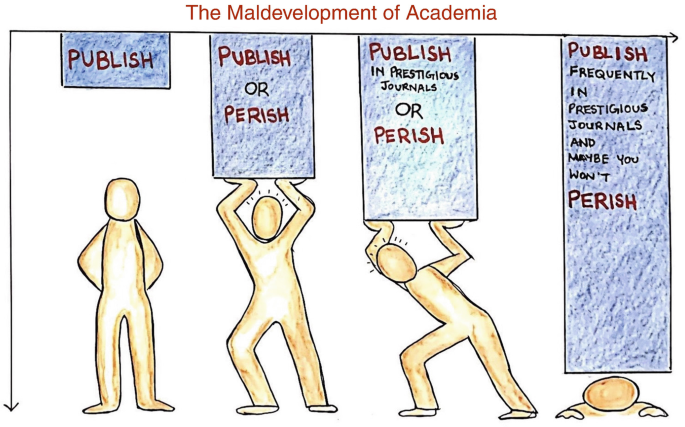
Realistically, no. Not for now, at least. This might be unknown to most people, but scientists are currently trapped in a very brutal type of rat race, where the motto "publish or perish" is truer than ever. It will take time before such corrupting system is weakened, and, in order for it to be replaced one day, we must have a viable, efficient alternative publication and evaluation platform / venue. Hence why I argue that we should focus on building an efficient and attractive platform (i.e., Hive frontend) for pre-print publication.
Pre-prints are already widely used by scientists, and their adoption is on the rise, especially because of the enormous delay an article typically suffers before final publication in a formal journal. In fact, there are many websites / platforms offering support for the publication of pre-prints (e.g., ResearchGate), but they are centralised and plagued with censorship (I known this from personal experience!), so they lack all the advantages that the use a blockchain like Hive can offer. Actually I think this is a niche Hive is extremely well poised to compete and win!
Publishing pre-prints on Hive would also make the peer-review more dynamic, meaningful and rewarding. High-quality, meritous articles and reviews would further benefit from Hive's rewarding system, which is an added plus. Finally, it should be highlighted, pre-prints published on Hive (or any other online platform, for the matter) absolutely don't impede the "formal" publication of the same work in a scientific journal. This is important so scientists are able to satisfy the scientometric requirements they are currently subject to.
[IMAGE: https://files.peakd.com/file/peakd-hive/hassemer/23wXLkwPZ771h6DFH9ZMtJXHBQYr89ocxdPeb4DDJ3gSkhpvUyAXYyAijgHYaJMj2wmk9.png]
And that's all for now, thanks for reading! If you are a scientist and would like to contribute to Hive-Science and PEvO, please let us hear from you! Let us know what features a Hive frontend tailored for scientific communication would need. And please help spreading the word!
Stay tuned for more, coming soon!
>"...I envisage that the "scientific front-end" we want on Hive won't auto-conceal (i.e. censor) content merely because of downvotes."
Science publishing is all about money. Grants flow to those that publish, and the ability to censor facts dispositive of ideologies, and interpose fake news, is perhaps the signal feature of the extant totalitarian technocratic tyranny being imposed globally. Any front end only rides on the base layer, and Hive is a pure plutocracy. You can prevent the greying out of posts in a front end, but you cannot eliminate flags that require nothing more than stake to fly.
Hive has capabilities latent within it that enable it to become a governance mechanism for voluntarist communities, both geographically localized and dispersed. However, the financialization of it's features have produced #trending and the previously mentioned user retention failure, perhaps the worst in the industry. No one supports eliminating the burgeoning censorship of published research that increasingly eliminates factual scientific information, even as history itself is being purged by scouring the internet of historical facts, and discouraging the publication of scientific fraud that today comprises the bulk of peer reviewed papers in even the most respected journals, just as Goolag's Gemini has been so deranged by it's training that it all but refuses to produce an image of a white man, and replaces historical actors with various flavors of racially preferred peoples, more than I, but the facility with which promotion and discouragement of content, including peer reviewed research, by nothing more than money will be a hazard you will need to navigate.
I hope to encourage you to succeed in this endeavor, and not misapprehend the real impediments to success as have so many marketing efforts before that have caused them to crash and burn without achieving anything they set out to do. Political ideologues control immense pools of capital, not only on Hive, but globally, and you will be sadly mistaken if you just assume they won't deploy it to suppress information on Hive. They have been since 2016, and aren't about to stop now.
Edit: hiding content behind a click is indeed censorship, but it is not the only form of censorship on Hive. The Canadian Truckers that protested Canada's tyrannical government suffered the seizure of the bank accounts. Financial encomiums encourage content authors, and financial deprivation discourages them. Censorship is any suppression of speech, and flags certainly constitute censorship. It is flags that have driven off ~1m Hive users since 2016, silencing all those voices that were once here posting content.
>"Why do you assume that votes (up- or down-, doesn't matter) by random internet users would even be shown on the front-end?"
I don't. I point out that front ends can display some or all votes, or not, can take action reflecting some or all votes, or not. But, they cannot shield content from votes up and down.
>"Science publishing is all about money."
Censorship operates by any mechanism that affects creators. Whether double tapping to the back of the head, or sneering at them during company trust building exercises, and financial stimuli is a critically sensitive value to creators. I point out that Canada censored truckers honking in Canada to protest tyranny by seizing bank accounts of supporters of that protest that sent them money for maple syrup for their pancakes.
Whether or not the votes are displayed on the front end isn't material to whether research is censored when published to Hive. What matters is what creators, in this case scientific researchers, gain financially from publishing their research. Research that is contraindicated by specific ideologies will be flagged by ideologues on Hive, which is shown by >1M former users badmouthing Hive across the cryptosphere today.
>"Any front end only rides on the base layer, and Hive is a pure plutocracy. You can prevent the greying out of posts in a front end, but you cannot eliminate flags that require nothing more than stake to fly."
That's what I said, and that is not regarding whether up or down votes are shown on front ends, but whether those votes incentivize or discourage publishing content financially.
To render research publishing subject to the influence of opinion flags will further compromise the integrity of researchers, not reduce the noxious influence of stake on scientific research. My point is that to benefit scientific research by securing researchers from censorship will require insulating them from the influence of ideologues that fly opinion flags on Hive, and front ends can't do that.
Edit: I neglected your second question.
>"Is there anything else but post-rewards on your mind when you think about hive?"
I do not use Hive tokens as money, to insulate myself from censorship on Hive. The vast majority of users that came to the platform have abandoned it because they sought to use Hive tokens as money which they expected to receive as author rewards for content they published on Hive. When those rewards were flagged away by ideologues with large stakes on Hive, >1M of them left the platform angry that censorship afflicted them through that vector.
There are 3-4k users on Hive today, and they are resistant to that censorship. That is less than .5% of all users that came to Hive to publish content and receive author rewards. I do keep that in mind when I consider Hive as a platform and society of creators, as I am only here because I have resisted that censorship, and most people do not.
>"There is no censorship on hive."
How are spam, scams, and plagiarism prevented on Hive?
>"Censorship is the suppression of speech, public communication, or other information."
https://en.wikipedia.org/wiki/Censorship
>"The term censorship refers to the suppression, banning, or deletion of speech, writing, or images that are considered to be indecent, obscene, or otherwise objectionable."
https://legaldictionary.net/censorship/
I could go on. However, I have repeatedly posted proof that censorship is not only possible on Hive, it is critical to Hive's existence, because without censorship scams, spam, and plagiarism would make Hive unusable and pointless. It is completely nonsensical to aver that censorship does not exist on Hive.
Censorship, as I have pointed out repeatedly without any acknowledgement from you, ranges from tactical application of nuclear weapons to mild dispproval at social gatherings, and comprises any mechanism that suppresses the dissemination of information. It is one of the most venerable and time-tested means of censorship to disrupt or seize financial resources, because economic matters are critical to the felicity of humanity, and creators of content usually go to the trouble to create it in order to gain financial resources.
Downvotes are censorship by the standard and accepted definition of censorship by every authoritative source, and have met that definition that has existed since the dawn of history. Reducing the economic viability of creators of content intended to be suppressed was within the definition of censorship practiced in ancient Sumer, and is within the definition of censorship today. Denying this is factually correct is delusional.
>"We are not planning to incentivize scientists with hive rewards."
Then what is the point of publishing scientific researchers papers on Hive? Is the blockchain more durable than clay tablets? Do you aver that scientific researchers do not respond to economic incentives like all other content creators, and will be drawn to publish on Hive for some other, inarticulated, encomium? The whole point of the platform that has become Hive is that the financial rewards of creating content was not nominally shared with creators, but was monopolized by centralized platforms, and the author rewards upvotes provided directly financially incentivized creators, while the blockchain prevented deletion of their content.
Doesn't paper, being a physical medium, prevent deletion just as effectively? Don't stacks of cash handed to creators at drug-fueled orgies by professional drug dealers provide economic incentive to publish content praising the benefit of illegal drugs as well, or better, than upvotes? In order to improve the integrity of scientific research publishing, Hive will need to offer nominal incentives to researchers to overcome the economic incentives to bias their reports. Since Hive doesn't have the reputation venerated science journals have to grantors, whom are the sources of income of scientific researchers, how will Hive create incentives for researchers to publish their research on Hive?
>"You sound like a broken record."
Why do broken records repeat themselves? Because the information they are conveying does not change when the needle repeatedly responds to the recorded information they are confined to by the scratch that breaks them. The definition of censorship hasn't changed in millennia, and simply denying it applies to Hive is fake news. The proof that news is fake necessarily refers to facts, which remain the same each time they are referred to.
It is the scratch in the record that requires repeating the same information that is factually embedded in the groove. It is not the fault of the information being repeated, but of the scratch that requires repeating that information. You get the same factual information every time you derange the mechanism by asserting censorship doesn't exist on Hive because fake news leads back to the actual facts that refute it.