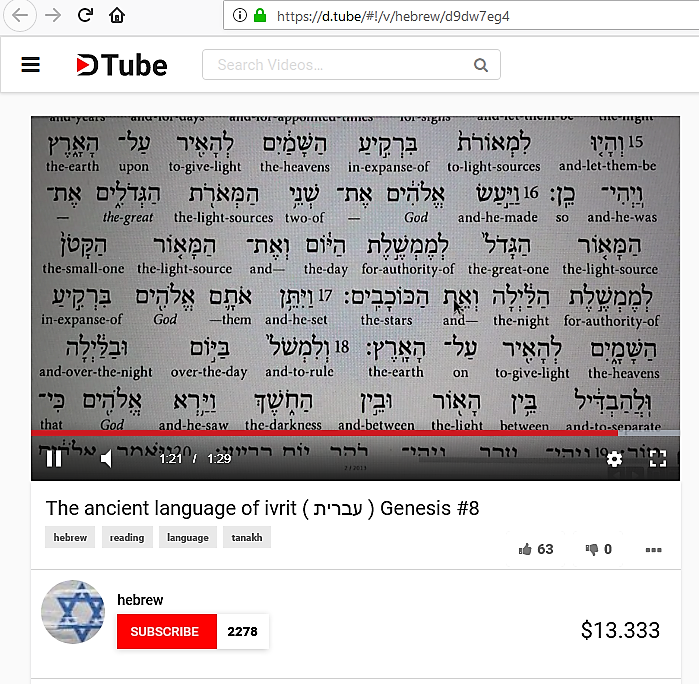
Welcome back to my DTube Hebrew reading & language series.
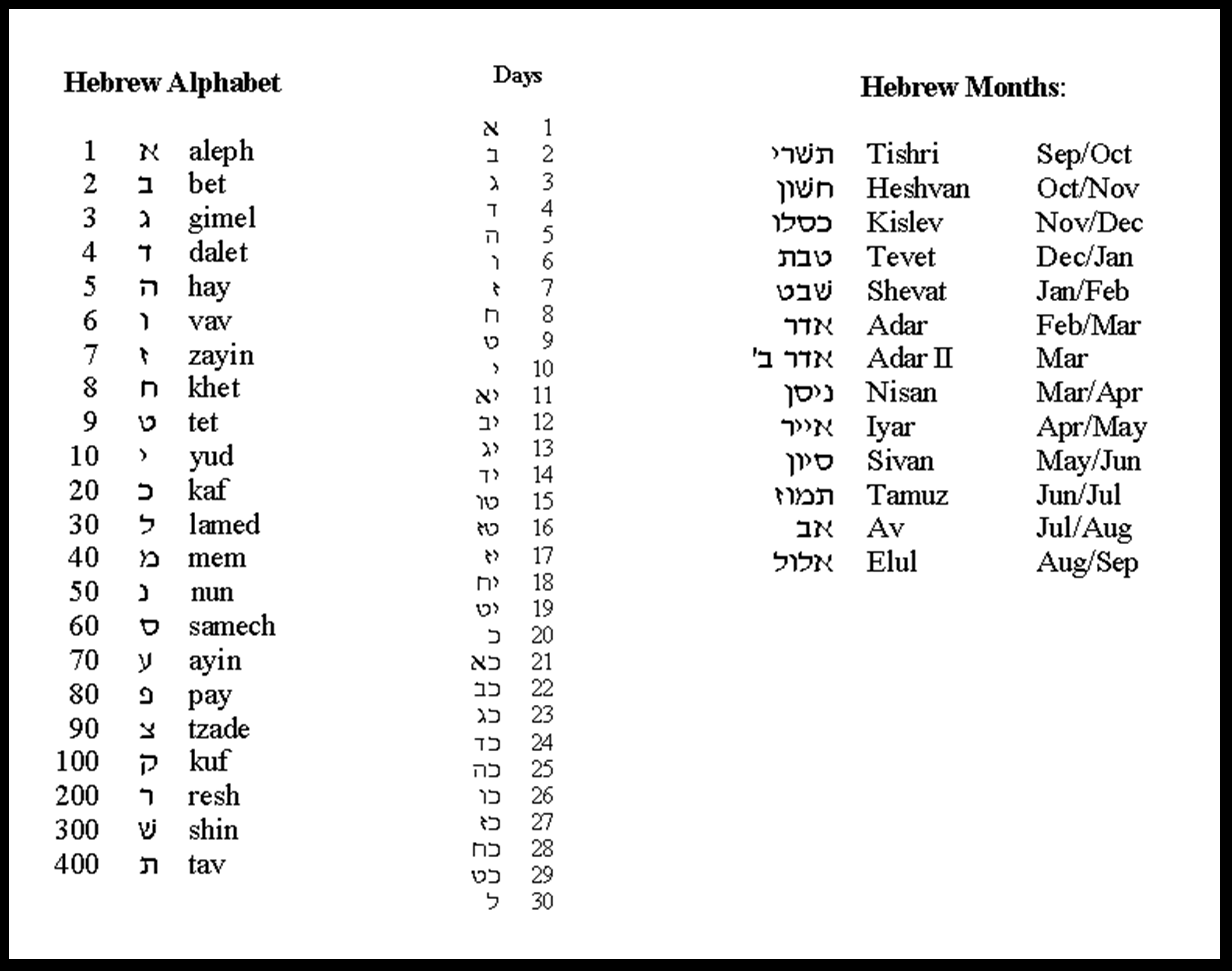
The full study is now on line covering the Alef-Beyt here in my blog. This is a beginners program to teach letters, vowels, and reading. The vowels are marked in this bible and are designed to help avoid confusion on what a word is and how it is pronounced. The confusion is obvious in the hundreds of interpretations globally. In modern Hebrew, only children need a niqqud or vowel marking for each letter. Old manuscripts also usually have vowels marked.
This week's reading is from Genesis 1:15 onward.
We are talking about the naming of the day, the night, and the setting of the stars in the expanse. I really try to keep the lessons short so we can learn a few new things each time we read.
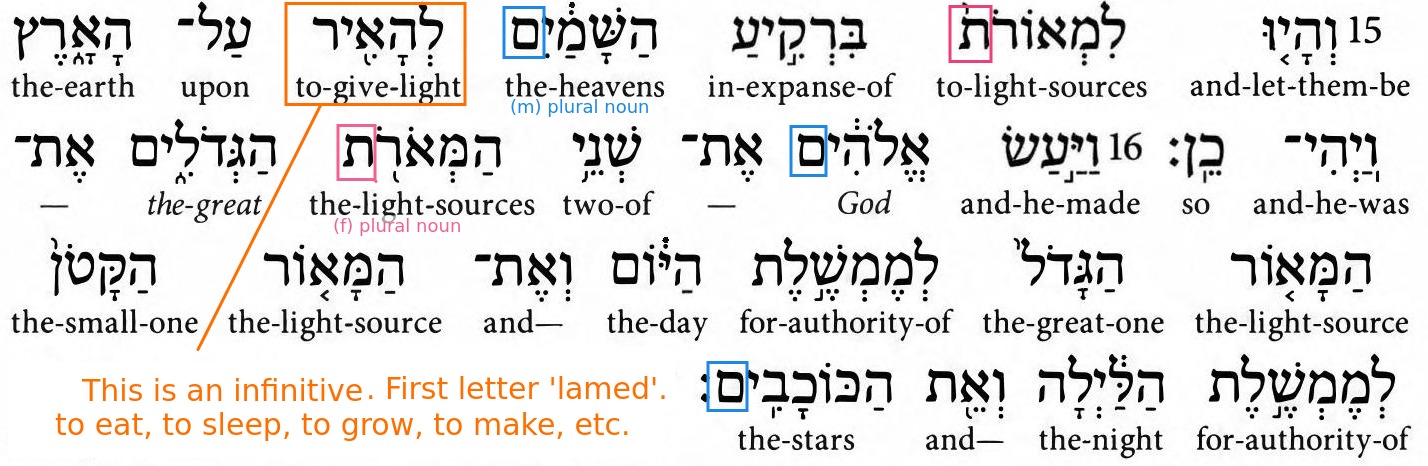
Today we are identifying masculine (m) and feminine (f) nouns by their plural forms. This is important because the the way we say/write verbs, adjectives and numbers is different depending on the gender of who or what we are talking about. We will also be learning how to identify an infinitive verb. For example "be" which is never used without the word "to" before it. In Hebrew, the letter 'lamed' precedes and is together with the infinitive verb.
[IMAGE: https://steemitimages.com/DQmduA8kafqsy1e9KBCXrv3H3hXDMHF7J87RPmTr2VR1e48/wholepassate5518.jpg]
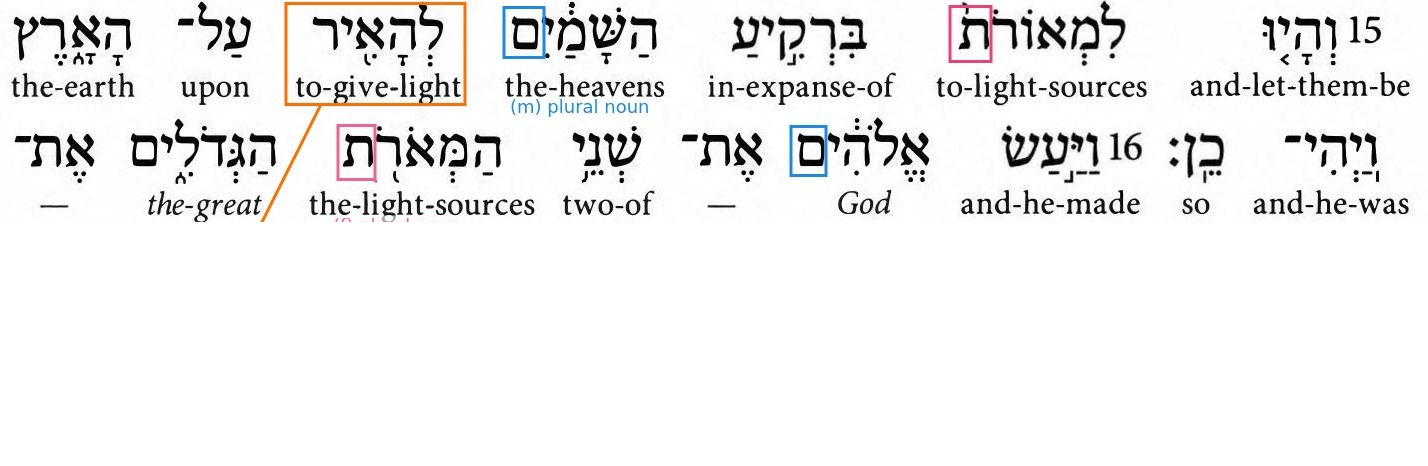
Here you have today's lesson in a nutshell. Several examples of (m) and (f) nouns in their plural forms and an example of an infinitive verb. Infinitives always start with a lamed with the vowel shvah (:) under them.
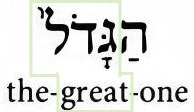
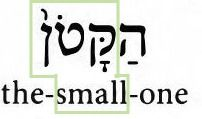
Great and Small
or big and little if you like.
These are the adjectives used for feminine nouns. We can tell this by looking at the ending of the plural noun "lights". It ends with tav which is one way to tell that this noun is feminine.
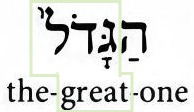
You can see that the hey at the beginning of each is the word "the" and it also refers the the only big light and the only small light by context. In this case, English works the same way, my interpretation reads, "God made two light sources larger than the rest, the bigger one rules the day and the smaller one rules the night, and stars..." You can see that removing the word "one" would sound bad in English. It would not sound bad in Spanish without the word 'uno' and it would be left out - not necessary.
There is no such thing as a "translation" because everything needs to be interpreted and has the translator's bias or twist incorporated. A a trilingual person, I make translation decisions all day every day. Should I use phrase-A which works, or phrase-B which also works? I have to choose which one works as I speak or write in daily life.
Here are the links
Please click over to DTube and read the above passage with me in Hebrew.
▶️ DTube ▶️ IPFS
Get your Hebrew Bible now!
Click here to obtain the book we are using. It is a free download - or browser usable.
Thanks for taking the time to watch and read.
Shabbat Shalom
I give no opinion, but yours are welcome below
@hebrew.
To we humans without light we can't do anything. God has already established the light in heaven, so the heavens were filled with light. God so cared for us that He don't want to leave us in darkness, then He said: "let this light in the sky shine down on the earth, and it was so".
This light became the day that we enjoy today. God understood that we are all children of light hence He established the light in other for us His children to shine in the light of His glory.
God made two greats lights, the greater light to rule the day and the lesser light to rule the night. These are two great lights that God established, but one is greater than one. The one that is greater is called day. In the day time the sun gives light and heat.
The lesser one is the moon. Without the moon at night everywhere would have been dark. The sun comes with full voltage and at evening hour, it withdrew back. Then the moon emerges to give us the evening light
The light of the moon is not as bright as the sun. But if not for the light of the moon, we would not have been able to see in the night hour.
Genesis 1
> The earth was without formed and darkness covered the face of the deep.
It is the sun that brought about day while the moon brought night.
Wonderful post @hebrew. God continue to bless you for your support on my blog.
Shalom
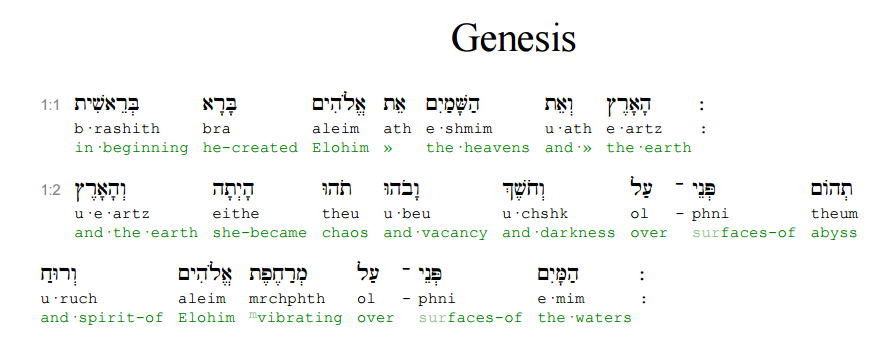
The language is still new to me, but I'm starting to pick up on things. The interlinear format helps to get a better understanding of the text. It's strange to see how some of the words are translated in different places. Sometimes a word is translated as one thing, another time it's something else. I think you hit the nail on the head here:
> There is no such thing as a "translation" because everything needs to be interpreted and has the translator's bias or twist incorporated.
The more I learn about different languages, specifically the ones that are character-based, I have a lot of respect for the people who translate them. Not only do you have to figure out what it says, but you have to determine what it means so you can use the appropriate words in the translation (interpretation to use your wording).
I'm thankful that many people have taken the time and used their skills to give us copies of the Bible that we can read in our own language. I appreciate that even a different translation or interpretation of the scriptures can give new meaning and insight based on the connotations one translated word might have over another.
When I can see a little different perspective of the passage, it helps me get a better understanding of God. Not that He changed, but that my perception of Him changes as I learn more about how big and loving He is.
I was reading a post earlier about how some people believe we're all in a simulation and how it's just as believable as some guy with a white beard telling us to be good. It makes me sad that they aren't able to see God as loving, so much so that the passage discussed here is part of how He shows us He loves us. He wanted relationship with us so much that He didn't move heaven and Earth to get to us, He made the heavens and the Earth. That's pretty cool!







.gif)