+-+-+ +-+ +-+-+-+-+
|G|O| |4| |H|I|V|E|
+-+-+ +-+ +-+-+-+-+

 --- A GOPHER-LIKE INTERFACE FOR HIVE BLOCKCHAIN ---

Neat Python Feature - Pickle!

BY: @makerhacks | CREATED: March 2, 2018, 2:18 a.m. | VOTES: 47 | PAYOUT: $13.83 | [ VOTE ]

[IMAGE: https://steemitimages.com/DQmVQnH8f1Wi9eBXJUhs6bJHFFpHGLdfng8nN6Kps1qsjV8/persist.png]
Back when I was learning C and C++, I often reused a piece of code that would write data from memory to a file and read it back again to persist state.

Just dump my struct to a file.

Any time the software needed to restart - say after a system crash - it could just keep on trugging along as if not much had happened :)

It is a very long time since I coded in C++ (outside of Arduino and C#) but that concept stuck with me.

I had no idea there was a similar functionality in Python until today (yes, I am late to the party!)

Introducing Pickle

Now if this is not news to you I do not blame you for rolling your eyes, but if you haven't seen Pickle then you are in for a treat.

Start with, as you would expect, importing pickle.

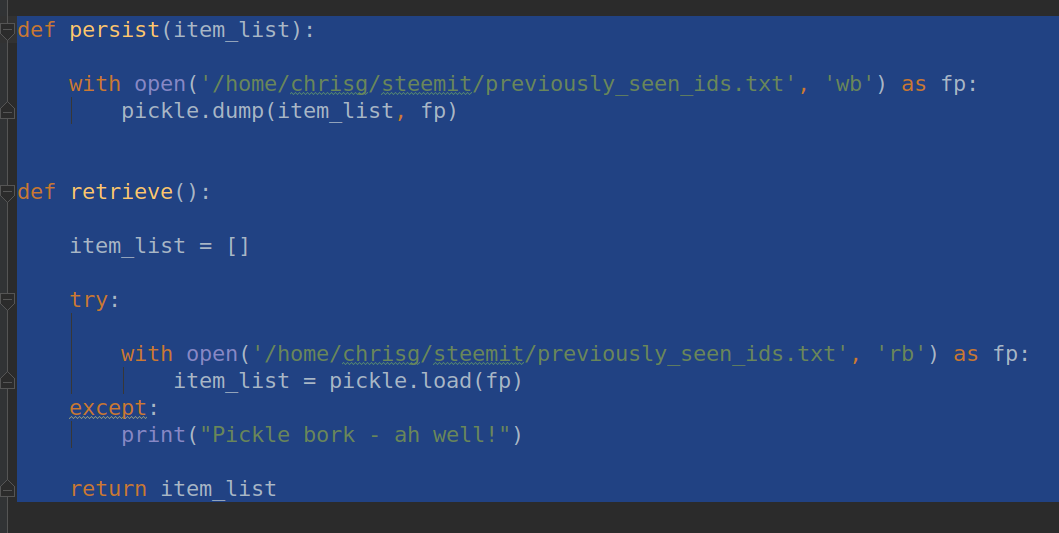
Then use the following code to persist and recall your data:

def persist(item_list):

    with open('my_list.txt', 'wb') as fp:
        pickle.dump(item_list, fp)

Supply this function with your array/list.

And then to get it back ...

def retrieve():

    item_list = []

    try:

        with open('my_list.txt', 'rb') as fp:
            item_list = pickle.load(fp)
    except:
        print("Pickle bork - ah well!")

    return item_list

So what happens is your array or list goes from memory to a file on your file system, and then you can reverse the process :)

Obviously the file needs to exist, so just use the shell command as follows:

touch my_list.txt

(this will create a placeholder file ready for your script to run)

Neat, eh?

TAGS: [ #python ] [ #coding ] [ #programming ] [ #technology ] [ #steemit ]

Replies

@geekpowered | March 2, 2018, 2:23 a.m. | Votes: 1 | [ VOTE ]

Pickle is highly useful! I'm not sure if I've used it to restore a whole state though. I only really remember using it with big data.

@makerhacks | March 2, 2018, 2:26 a.m. | Votes: 0 | [ VOTE ]

I am using it to check for IDs of records to see if I have seen them before, doesn't sound like a big deal but it saved me some migraines ;)

@stelwok | March 2, 2018, 2:29 a.m. | Votes: 0 | [ VOTE ]

What this configuration, from your coding?

@joseangelperez | March 2, 2018, 3:10 a.m. | Votes: 1 | [ VOTE ]

Friend had not noticed that Pickle option, which is efficient. Thanks for the input, Greetings ;))

@lemony-cricket | March 2, 2018, 4:51 a.m. | Votes: 1 | [ VOTE ]

Pickle is great. I find it most useful when I am dealing with a lot of manually-entered data and an unstable script I wrote off-the-cuff. If I'm an idiot and break something, as long as I keep pickling it to disk as I go, I can just sort of pick it up where I left off.

@themarkymark | March 2, 2018, 5:11 a.m. | Votes: 1 | [ VOTE ]

It’s a really good feature when you are in a pickle and need to get your data back.

Thanks I will be here all week.

@makerhacks | March 2, 2018, 5:37 a.m. | Votes: 0 | [ VOTE ]
@crokkon | March 2, 2018, 9 a.m. | Votes: 1 | [ VOTE ]

.

@makerhacks | March 2, 2018, 5:36 p.m. | Votes: 0 | [ VOTE ]

Ooh, nice! Thank you :)

@veleje | March 2, 2018, 5:19 p.m. | Votes: 1 | [ VOTE ]

Beginner question:

> with open('my_list.txt', 'wb') as fp:

Shouldn't this command create a file if it is not existing already?

@makerhacks | March 2, 2018, 5:35 p.m. | Votes: 1 | [ VOTE ]

Yes but in most cases your scripts will attempt to read first so touching the file is just a precaution, obviously you can check for file existence in your code too and even prepare it with an empty array :)

@cynthialee | March 3, 2018, 2:51 a.m. | Votes: 1 | [ VOTE ]

Thank you for introducing this very useful tool. I may use this to save some unstructured data or model.

[ BACK TO TRENDING ] [ BACK TO MENU ]
CMD>