____  ___    _  _     _   _ _____     _______
 / ___|/ _ \  | || |   | | | |_ _\ \   / / ____|
| |  _| | | | | || |_  | |_| || | \ \ / /|  _|
| |_| | |_| | |__   _| |  _  || |  \ V / | |___
 \____|\___/     |_|   |_| |_|___|  \_/  |_____|

 --- A GOPHER-LIKE INTERFACE FOR HIVE BLOCKCHAIN ---

Higher Order Thinking: An Introduction

BY: @rortian | CREATED: April 24, 2018, 8:19 p.m. | VOTES: 403 | PAYOUT: $88.45 | [ VOTE ]

[IMAGE: https://steemitimages.com/DQmRaxTLs1t1WdDSLtiwnAAV88FNMVfh346edHyor8dseyB/Einstein%20quote.jpg]
Source
Higher Order Thinking: An Introduction

I define higher order thinking (HOT) as the production of highly coherent linguistic discourses (conversations and texts) about complex subjects.

Describing HOT is an interdisciplinary project, comprising elements of psychology and philosophy. My objective is to support learners and curriculum developers who believe that it’s important for people to develop deep thinking as a habit.

The project stands on two presumptions. Its main premise is the claim that learning about the processes which underlie thinking and learning helps people to think better and learn more.

That is, the process of learning to develop deeper and more coherent thinking is facilitated by understanding some basic principles of psychology and philosophy.

The second premise is that those principles, taken from academic texts and journals, can be translated into language which can be understood by inquiring learners who have never studied them. This essay is an attempt to demonstrate that.

Deep Thinking and Deep Learning: An Overview

HOT comprises a set of theories about processes which are associated with deep thinking and deep learning. Those elements are described in the following sections.

Here’s a simplified two-dimensional overview of the global concept. The processes are specified in the rectangles at the bottom level of the diagram.

[IMAGE: https://steemitimages.com/DQmNUTj24Py9yWUD5GcsrNBat78q1bgbTc6gT3PnMJiz9wX/HOT%20diagram.jpg]
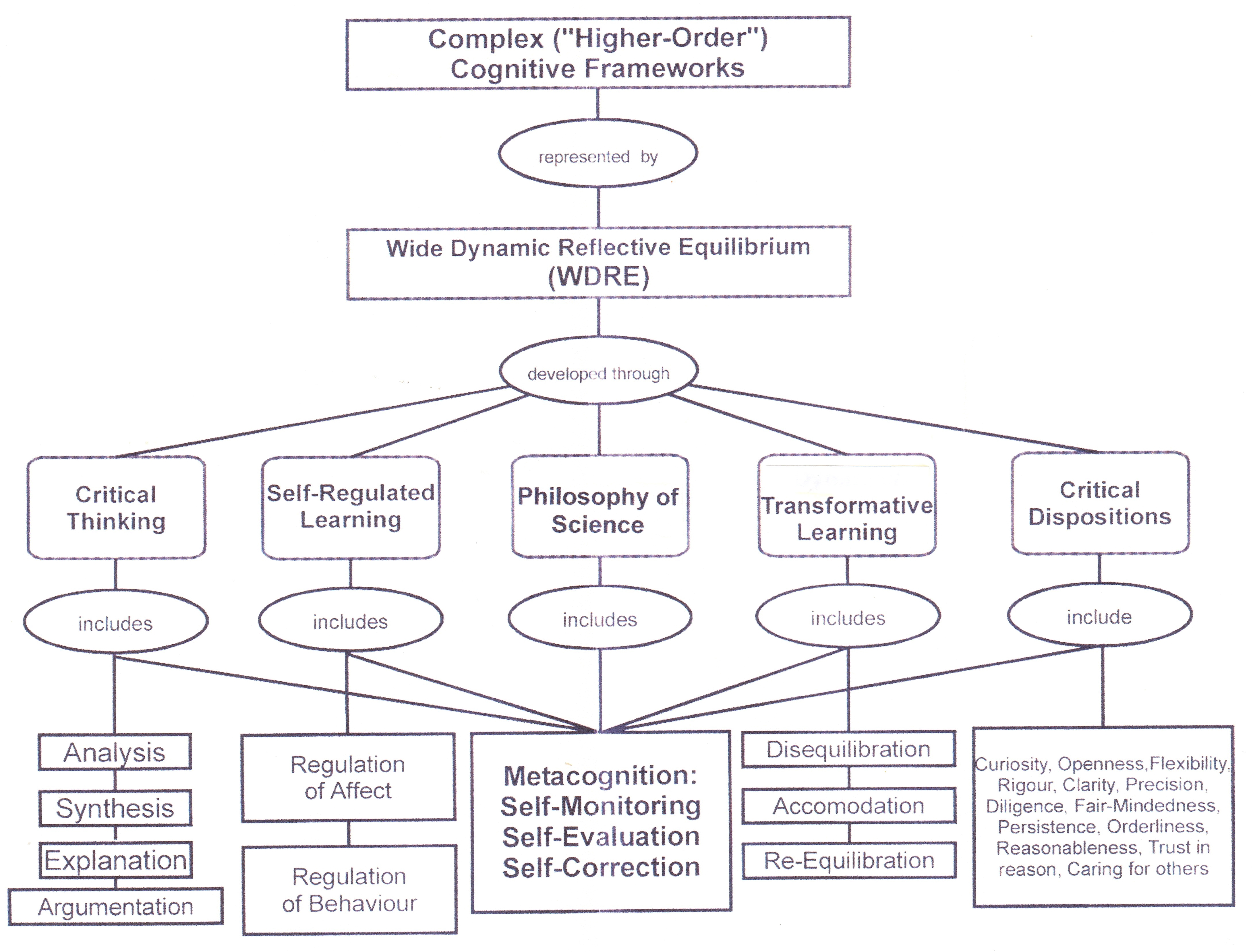
John Rawls [note 1] suggested that an ideal cognitive system would continually change and grow as it takes new ideas and new evidence into account. Wide dynamic reflective equilibrium represents an ideal set of beliefs and opinions that would continually account for the largest possible set of ideas that are consistent with all reliable evidence and all reasonable arguments. Unfortunately, perfect wisdom is unattainable, but some sets of ideas are better (more coherent, useful, beneficial, etc.) than others.

Metacognition

Metacognition is academic shorthand for metacognitive self-regulation, which means: correcting one’s own ideas (beliefs, opinions and theories). This practice is relevant to every aspect of deeply coherent thinking.

It refers to the processes of examining (and re-examining) the justifications for our beliefs and our opinions, evaluating their coherency, and correcting them whenever evidence or reasoning indicates errors.

It’s also called reflective (or reflexive) thinking.

Critical Thinking

Critical thinking (CT) has been defined as “reasonable reflective thinking that is focused on deciding what to believe or do.” [2]

Here’s a more detailed description, which was developed by a committee of forty-two educators (mostly philosophers and psychologists) who participated in a two-year study of CT:

“We understand critical thinking to be purposeful, self-regulatory judgment which results in interpretation, analysis, evaluation, and inference, as well as explanation of the evidential, conceptual, methodological, criteriological, or contextual considerations upon which that judgment is based. CT is essential as a tool of inquiry.”
-Delphi Report, p. 3.

Despite the great number of professors who have claimed that CT is focussed on seeking the truth about things, that is a very popular misconception. CT is based on critical theory, which warns that thinkers and learners should never presume that our ideas or our arguments are absolutely true.

Here’s how the Stanford Encyclopedia of Philosophy describes the postmodern revolution in philosophy which has superseded the previous paradigm (that is, truth-seeking):

“Postmodernist philosophers in general argue that truth is always contingent on historical and social context rather than being absolute and universal and that truth is always partial and ‘at issue’ rather than being complete and certain." [3]

CT is about appreciating the value of reasonable justification, that is, understanding not only what we should believe and do, but also why those things are better than other alternatives. According to contemporary philosophical standards, coherent reasoning, not truth, is the gold standard for human understanding.

CT includes developing and applying the following processes:

Analysis is the breaking down of discourses to examine their meanings; synthesis is its opposite: constructing explanations and arguments. Metacognition is essential to doing those things reasonably (that is, coherently).

Producing deeply coherent reasoning requires learning to apply these cognitive processes effectively from people who have had more practice in doing so.

The intent to apply CT is demonstrated by particular attitudes, or dispositions, which support effective inquiry. Some of the motives (critical dispositions) associated with that purpose are indicated in the above diagram.

Self-Regulated Learning

Immanuel Kant described three guidelines to developing practical wisdom. The Stanford Encyclopedia of Philosophy [4] has translated the following from his work Anthropology from a Pragmatic Point of View:

“…[N]ot even the slightest degree of wisdom can be poured into a man by others; rather he must bring it forth from himself. The precept for reaching it contains three leading maxims: (1) Think for oneself, (2) Think into the place of the other [person] (in communication with human beings), (3) Always think consistently with oneself.” SEP

In introducing this passage, Kant pointed out that perfect wisdom, the idea of a practical use of reason that conforms perfectly with natural law, “is no doubt too much to demand of human beings.” However, it is possible to manage ourselves in more or less effective ways with regard to achieving our learning objectives; that is, if we set any learning objectives, and if we’re intent enough on achieving them.

Self-regulation: The Psychology of Self-Management

When it comes to learning, educational psychologists have described a set of self-regulatory processes, each of which plays a part in managing ourselves to learn more effectively. [5]

Higher order cognitive development is an ongoing purpose; it doesn’t occur by accident. In addition to regulating our thinking (metacognition, described above), it also requires careful attention to managing our motives and our actions.

Managing our motives and our desires is called affective self-regulation or metamotivation. Metamotivation is about deciding which ideals are most valuable to oneself, and then applying them in action. Since this process includes deciding what’s important, it involves dealing with questions of morality and ethics.

A personal value is an idea (an abstract ideal) which someone believes is important, something that one want to experience, such as ‘wisdom’ or ‘justice.’

The processes by which metamotivation is applied in practice are: articulating one’s most important values and purposes (deciding one’s commitments); sharing these decisions with others (declaring them publicly); and engaging in ethical discourses with others to decide what we should or shouldn’t do to manifest our higher values in action.

I’ve described metamotivation in greater detail here.

According to this scheme, one of the most important processes involved in higher order cognitive development is engaging in discourses with others about what we should or shouldn’t do, and why. While making important decisions by ourselves is an option, social flourishing is produced by applying the values of communication, cooperation, and teamwork.

We can also regulate our behavior and our learning environments. For example, it helps to pay close attention when listening or reading, and to spend time thinking, talking and writing about what we’re learning. We can adjust the area around us in various ways, or move from one place to another, in order to focus on our work.

We can apply all of these practices to manage our learning.

Self-directed learning and learner-centred education are pedagogical theories which focus on what learners want to know and which educational methods are suited to their interests. These techniques are being implemented more and more widely (I suppose because they’re more effective than traditional teacher-centered methods). Here are some examples:

Centre for Teaching Excellence, University of Waterloo, Canada
Stephen D. Brookfield
A group at Concordia University, Portland, Oregon, USA
Hoboken Charter School, Hoboken, New Jersey, USA

Philosophy of Science

Science grew out of epistemology, the philosophy of knowledge and understanding. Epistemology was originally considered as truth-seeking, but in the postmodern world it’s seen as the study of justification:

https://en.oxforddictionaries.com/definition/epistemology
https://dictionary.cambridge.org/dictionary/english/epistemology

“Because there is no clear dividing line between what can be accepted as truth, and what is conjecture, most scientists do not stray into this area. They slowly build upon accepted theories that only a major paradigm shift, or the refuting of a fundamental principle, can alter.”
Martyn Shuttleworth

In 1620, Francis Bacon wrote the seminal text on systematic empirical investigation, The New Organon (Novum Organum).

In it he invented objectivity.

Bacon proposed that we could manage to overcome the three barriers that prevent us from attaining true knowledge: human nature, “because the structure of human understanding is like a crooked mirror which causes distorted reflections (of things in the external world); fallacies, or errors of interpretation; and false presumptions, “the deepest fallacies of the human mind: For they do not deceive in particulars, as the others do, by clouding and snaring the judgment; but by a corrupt and ill-ordered predisposition of mind, which as it were perverts and infects all the anticipations of the intellect.” SEP

Since then, philosophers have become reconciled to idea that human perception and human language are inadequate to represent anything in the world with absolute exactitude. [6] While we may be supremely confident that many of our ideas about things are indeed the best interpretations that language can signify, we can at the same time understand that “truth is always partial and "at issue" rather than being complete and certain." [3]

…[T]here can be no criterion of truth; that is, no criterion of correspondence: the question of whether a proposition is true is not in general decidable for the languages for which we may form the concept of truth. Thus the concept of truth plays mainly the role of a regulative idea…It does not give us a means of Finding truth, or of being sure that we have found it even if we have found it. So there is no criterion of truth, and we must not ask for a criterion of truth.Popper

If we agree that an empirical inference is extremely well justified (in that all reliable and relevant evidence supports it), and that no thoughtful person would disagree, is it also important to insist that it must also be absolutely true? What beneficial purpose does that serve?

Believing that one’s beliefs are absolutely true may be a severe obstacle to learning. In 1997, Hofer and Pintrich published an extensive review of five independent educational research studies [7], which analysed the work of separate teams who investigated the correlations between university students’ ideas about knowing and their academic achievements. The reviewers found a consensus in the various studies’ findings. Each team reported that students who maintained that absolutism (absolute truth) was their standard for understanding performed worse academically than those who understood that the best knowledge is contextual, evaluative, constructed or reflective (rather than absolutely true).

It appears that people learn better if we realise that coherency, according to reasonable justification, is more important than truth.

Transformative Learning

Developmental psychologist Jean Piaget distinguished two types of learning, which differ in an important respect. [8] Assimilation is the process of learning something that’s consistent with what someone already understands. Accommodation occurs when we observe something that doesn’t fit with what we already believe, and we alter our previous beliefs in order to understand it.

According to Piaget, the new observation upsets the cognitive equilibrium of the observer; the resulting disequilibration is resolved by cognitive self-correction (re-equilibration).

You can read more about this at: britannica.com

Piaget worked with young children. Jack Mezirow (9) described a similar phenomenon, transformative learning, which may occur when adults face disorienting dilemmas. When evidence invalidates what one has long understood, confusion may produce a sense of inadequacy as one realizes that one’s meaning schemes have been less than completely coherent. This realization presents an opportunity for reflection and self-correction.

Transformative learning represents an alteration of one’s point of view. When a point of view changes, things appear differently; more meanings are revealed. Transforming a point of view isn’t a gradual process of learning to see things differently; it’s a discontinuous process wherein relative large changes occur in a moment.

Critical Dispositions

“In psychology, an attitude refers to a set of emotions, beliefs, and behaviors toward a particular object, person, thing, or event. … While attitudes are enduring, they can also change….Cognitive dissonance is a phenomenon in which a person experiences psychological distress due to conflicting thoughts or beliefs. In order to reduce this tension, people may change their attitudes to reflect their other beliefs or actual behaviors.” Kendra Cherry

Educational psychologists have described a set of critical dispositions, attitudes and tendencies which appear to be relevant to learning deeply and maintaining coherency. According to Facione and his panel of educators:

”The ideal critical thinker is habitually inquisitive, well-informed, trustful of reason, open-minded, flexible, fair-minded in evaluation, honest in facing personal biases, prudent in making judgments, willing to reconsider, clear about issues, orderly in complex matters, diligent in seeking relevant information, reasonable in the selection of criteria, focused in inquiry, and persistent in seeking results which are as precise as the subject and the circumstances of inquiry permit.
-Delphi Report, p. 3.

Of course (as Kant remarked about perfect wisdom), it’s impossible to maintain all of these attitudes perfectly, but if one intends to engage in CT, it’s possible to cultivate them.

Ennis added a social (moral) dimension to the list of critical dispositions; he acknowledged the importance of caring for the interests of other people. [2]

It seems clear that an open-minded, inquiring, diligent and rigorous attitude is important to developing HOT. As we work on developing greater discernment, we can also work on developing our dispositions in order to produce greater satisfaction and social success.

Applying Higher Order Thinking

It’s impossible to predict the limits of what an inquiring self-directed and self-regulated learner might discover. If deep learning (accommodation) is more important to us than maintaining what we already understand, then we’ll be open to new ideas and new ways of thinking. If it’s more important to maintain our historical points of view, then that’s what we’ll do.

People are motivated by our values and our desires.

Values and purposes relate to each other in hierarchies. Some ideals contribute to more general (or higher) purposes; these are called instrumental values.

For example, the value of ‘nutrition’ is instrumental to ‘wellbeing.’ ‘Caring’ is instrumental to ‘morality.’

All beneficent values are instrumental to social flourishing. If social flourishing is important to us, then we can apply moral values to guide our thinking and our actions.

Aristotle described the ideal human lifestyle (eudaimonia, or social flourishing), defined as “an activity of the soul in conformity with excellence or virtue.” [10] In practice, flourishing requires careful consideration of our actions and their consequences. The idea ‘arête’ (moral excellence, or virtue) refers to rational consideration of human actions, with the purpose of deciding what we ought to do (or not do). This, as Ennis suggested, represents the ethical aspect of critical and higher order thinking.

It’s been widely advertised that lifelong learning, the commitment to inquiring into unfamiliar ideas and circumstances, is instrumental to achieving success throughout one’s life.

“Your ability to expand your mind and strive for lifelong learning is critical to your success.”
Brian Tracy

“The more you learn, the more sides you’ll see of the same issue. Reading, watching intelligent television and holding conversations with others will educate you about other points of view. It may or may not change your mind, but it’ll help you to understand that there is more than one side to every issue.”
Whitney Coy

“In order to truly empathize with others, increase social awareness and build relationships, we must intentionally seek out ideas that differ from our own. This is critical not only to the health of individual relationships, but also the health of society.Caroline Vander Ark & Mary Ryerse

There is no canonical curriculum for practical wisdom. Postmodern thinking and critical theory have begun to filter through the academy, but many educational systems are still rooted in the historical regime of received and authoritative truth. While philosophers and the more iconoclastic self-directed learners learn to inquire critically, most teachers, professors and students remain dedicated to the paradigm of absolutism, the idea that only one set of beliefs (the true ones) is to be maintained, and anything that conflicts with one’s knowledge is to be refuted or ignored. This approach leaves little room for criticality, accommodation or novel insights.

Because critical theorists are in the minority among education professionals (and among parents), most people haven’t learned that truth-seeking is not the best approach to education.

I close with my message to those who are working to reform higher education:

Critical coherency could be promoted by implementing curricula for higher order thinking in preservice teaching programs, and in the graduate programs of every university faculty. If student teachers and graduate students would spend their university years learning to apply the processes associated with HOT, then they would be able to demonstrate and explain them for the benefit of future generations of students.

References

[1] Rawls, J. (1999). Collected Papers of John Rawls, S. Freeman (Ed.). Cambridge, MA: Harvard University Press. 

[2] Ennis, R. H. (1987). A taxonomy of CT skills and dispositions. In Baron, J., Sternberg, R. (Eds.), Teaching thinking skills: Theory and practice (pp. 9-26). New York, NY: W. H. Freeman, p. 10.

[3] Aylesworth, Gary, (2015). "Postmodernism", The Stanford Encyclopedia of Philosophy (Spring 2015 Edition), Edward N. Zalta (ed.), https://plato.stanford.edu/entries/postmodernism/

[4] Williams, Garrath, (2017). "Kant's Account of Reason", The Stanford Encyclopedia of Philosophy, Edward N. Zalta (ed.), https://plato.stanford.edu/entries/kant-reason/#MaxComHumUnd

[5] Pintrich, P. R., & Zusho, A. (2002). The development of academic self-regulation: The role of cognitive and motivational factors. In A. Wigfield, J. S. Eccles (Eds.), Development of achievement motivation, (pp. 249-284). San Diego, CA: Academic Press.

[6] Popper, K. (1979).Objective Knowledge: An evolutionary Approach. Oxford University Press.

[7] Hofer, B. K., & Pintrich, P. R. (1997). The development of epistemological theories: Beliefs about knowledge and knowing and their relation to learning. Review of Educational Research 67, 88-140.

[8] Piaget, J. (1971). Biology and knowledge: an essay on the relations between organic regulations and cognitive processes. Chicago: University of Chicago Press.

[9] Mezirow, J. (1991). Transformative dimensions of adult learning. San Francisco: Jossey-Bass.

[10] Aristotle (1962/2000). Nichomachean Ethics. Translated by Martin Ostwald (New York, NY: MacMillan/Library of the Liberal Arts, 1962). In F. E. Baird & W. Kaufmann (Eds.), Ancient philosophy (pp. 364-434). Upper Saddle River, NJ: Prentice Hall. (1098a, 16-17)

TAGS: [ #education ] [ #steemiteducation ] [ #higherorderthinking ] [ #philosophy ] [ #psychology ]

Replies

@a-0-0 | April 24, 2018, 8:19 p.m. | Votes: 0 | [ VOTE ]

👍 a-0-0

@vaughndemont | April 25, 2018, 12:35 a.m. | Votes: 0 | [ VOTE ]

Regarding critical theory and thinking, what we often do in my classes is go into the Allegory of the Cave, do activities like "Two Truths, One Lie", examining things from different angles but also questioning motivations.
For example, in my poetry class, I went off of a list of poems that are commonly assigned to college freshmen, and then after doing the typical analysis, I would open up discussion to have them question why these poems are assigned to college freshmen, if there's possibly an agenda, if there's subtext, or if it's simply to go with what's familiar, theme and such. It takes a little while for them to accept that yes, it's okay to question those things, but once they do they really get into it.

@axiogenesis | April 25, 2018, 5:11 a.m. | Votes: 0 | [ VOTE ]

Can't you preserve absolute truth alongside a coherence theory? In other words, the realization that human understanding is often partial (which is obvious to most people) need not militate against absolute truth, right?

@rortian | April 25, 2018, 11:20 a.m. | Votes: 0 | [ VOTE ]

"the realization that human understanding is often partial (which is obvious to most people) need not militate against absolute truth"

Why not, I wonder? Please explain.

That was Popper's dilemma; that's what his book was about.

All he could manage in defending the concept was that the definition (correspondence) was still coherent in theory. He was obliged to admit that in practice we can't have it both ways.

It seems to me that we have the option of insisting without justification that our best descriptions are absolutely true, or else we recognize that fallibilism is a better (more justified, pragmatic and openminded) approach than absolutism.

Is this right or wrong? How would you or we decide that?

Is it absolutely true? I don't think so, but that's not my concern! My concern is that people need to believe that whatever they believe is absolutely true...why is that, hmmm?

Do we need it to be right or wrong? Well, only if we have standards for how to decide that; otherwise, what's the point of arguing? That's the problem with people's use of philosophy - we don't always consider the practical consequences of our best (or worst!) ideas!

Do we need it to be absolutely true or false? Why would we?

For any such complex issue, perhaps we could settle for understanding that one approach is more coherent with evidence, reasoning and beneficent purposes than another?

Why not?

What would be the consequences of that?

I appreciate the inquiry, @axiogenesis.

all the best (none of the worst)

@axiogenesis | April 25, 2018, 12:05 p.m. | Votes: 0 | [ VOTE ]

Let me use an example from my own field. The example is also well-known among philosophers, so it has the advantage of not seeming obscure.

Gödel proved that the set of mathematical proofs is a proper subset of the set of mathematical truths. In other words, Gödel proved that mathematical truth cannot be identified with axiomatic provability.

This forces a kind of mathematical Platonism, which does establish objective/ absolute truth. To quote Gödel:

"Finally it should be noted that the heuristic principle of my construction of undecidable number-theoretic propositions in the formal system of mathematics is the highly transfinite concept of 'objective mathematical truth,' as opposed to that of 'demonstrability,' with which it was generally confused before my own and Tarksi's work. Again, the use of this transfinite concept eventually leads to finitarily provable results, for example, the general theorems about the existence of undecidable propositions in consistent formal systems."

This is an example of the assumption of absolute truth -- what Gödel described as his heuristic principle -- leading to a profound discovery. It is very likely that the incompleteness results would not have been possible without this heuristic.

@rortian | April 25, 2018, 1:34 p.m. | Votes: 0 | [ VOTE ]

Do you believe that formal languages are comparable to natural languages in this respect?

Formal languages are based on axiomatic truths, and they restrict their functionality to describing the relationships of symbols.

They're not based on empirical observations, and they're not dependent on biophysical sensation or on non-axiomatic presumptions.

I don't see any equivalence in this comparison.

(Nice try, though...)

Thanks again for participating. I appreciate our conversation. May we continue?

My experience is in psych and philosophy; yours is mathematics.

What are the consequences of insisting that anyone who disagrees with my belief is absolutely mistaken?

And what would be the consequences of giving up insisting that our inferential beliefs are absolutely true?

Why do people isn't that their beliefs must be true?

Do you have any interest in our motives, @axiogenesis? Do you examine yours?

[wondering]

@axiogenesis | April 25, 2018, 2:18 p.m. | Votes: 0 | [ VOTE ]

I am interested in motives. I think the search for truth (including moral-aesthetic truth) should be a primary motive.

Can we expect anything beyond internal consistency from philosophy? If not, then the philosophical project seems to reduce to determining when two philosophies are isomorphic. Some philosophers might argue that we cannot expect more than internal consistency in any field, but I think I've given a counterexample to that.

Of course, I think truth is more than a value we assign to a proposition. Again, Gödel's theorems actually prove this. This ties in with your observation on axiomatic systems, so there does seem to be a kind of parallel with natural languages because both axiomatics and natural languages are insufficient to fully capture truth. But this view only makes sense on the assumption that we are approximating some truth.

Rescher developed a coherence theory of truth that is interesting, but I haven't looked at it in ten years.

@rortian | April 25, 2018, 2:47 p.m. | Votes: 0 | [ VOTE ]

"I think I've given a counterexample"

Are you insisting that natural and formal languages are equivalent?

How could that be?

Some natural language statements resemble logic, but not empirical ones.

"both axiomatics and natural languages are insufficient to fully capture truth. But this view only makes sense on the assumption that we are approximating some truth."

Well, I'd say that we're approximating some reality which we can neither define exactly nor describe exactly.

Truth is a function of language, it's an abstract ideal. It's black or white. Isn't that so?

There's nothing there to approximate. It's just another belief. We believe that (some sort of) reality (?) can be exactly reflected in language or we don't.

You seem to be insisting that we can have it both ways. Are you??? How could that make sense?

Correspondence is impossible to establish.

"Rescher developed a coherence theory of truth that is interesting"

Yes, neo-pragmatism is my specialty. Rescher did brilliant work:

IEP on Rescher:

"Rescher’s conception of scientific realism is thus strictly tied to his distinction between reality-as-such and reality-as-we-think-of-it. He argues that there is indeed little justification for believing that our present-day natural science describes the world as it really is, and this fact does not allow us to endorse an absolute and unconditioned scientific realism. In other words, if we claim that the theoretical entities of current science correctly pick up the “furniture of the world,” we run into the inevitable risk of hypostatizing something, that is, our present science, that is only a historically contingent product of humankind, valid in this particular period of its cultural evolution. Rescher’s view is, instead, that “a realistic awareness of scientific fallibilism precludes the claim that the furnishings of the real world are exactly as our science states them to be -- that electrons 'actually are just what the latest Handbook of Physics claims them to be.'"

What's so bad about that, axio? What's the psychological charge on being (that is, feeling) absolutely certain?

Perhaps you might be open to accommodating the possibility that it's incoherent to believe that something is both true and false...

Did you get the section on epistemological sophistication and absolutism's effect on one's ability to think coherently?

[wondering]

@axiogenesis | April 25, 2018, 5:01 p.m. | Votes: 0 | [ VOTE ]

I don't know why my counterexample would imply that natural languages and formal languages are the same? I said some philosophers might argue that consistency is all we can expect from any discipline. Mathematics is a counterexample. The view that truth is always a function of language shatters on Gödel's work.

Both ways? I'm just willing to recognizing Gödel's distinction between demonstration and truth.

Rescher is interesting. Like me, he is a Roman Catholic, so I know he would not (in his personal life) reduce truth to a function of language. I talked with him about seven years ago about some of these issues. Sometimes he describes himself as a pragmatist (and he is widely perceived as one), and often he gives pragmatic arguments, but I think he is really in Leibniz' camp, which takes him well outside pragmatism.

Rescher's work on scientific realism is pretty good. He is right in that, almost by definition, science has no ontology. Mathematics is different, I think.

@rortian | April 25, 2018, 5:52 p.m. | Votes: 0 | [ VOTE ]

"Mathematics is different"

Well, that's my point, isn't it?

"reduce truth to a function of language"

Reduce? Is it an abstract ideal or isn't it? Correspondence is a myth, right?

"consistency is all we can expect from any discipline. Mathematics is a counterexample. The view that truth is always a function of language shatters on Gödel's work."

Isn't this like conflating elephants and quarks?

Truth is either given and preserved, or it's not. In math and logic it is, otherwise it's not.

Derivation and inference are completely different animals.

Is this mistaken? Is it confusing? It's not very complicated, is it?

Where's the absolute truth in any of this?

IMO:
It's just an idea; it applies where it applies and it doesn't apply to science. Math: yes; science: no.

Casual conversation: No

Thanks again for discussing this, axiogenesis.

If you presume and insist that you know the truth, then you must believe that your ideas are superior to mine, because I don't claim to know the truth about the various inferences that I make.

That's how you win, by insisting that you know better, whether what you know makes sense to someone else or not.

So, you've beaten me with your presumption, which (I suppose that) you suppose is superior to mine.

Ouch.

@rortian | April 25, 2018, 6:01 p.m. | Votes: 0 | [ VOTE ]

I read this eighteen years ago.

I understood about a third of it quite clearly...that was enough for me to transform all my perspectives on how we manage to understand things.

http://pages.uoregon.edu/koopman/courses_readings/rorty/rorty_CIS_full.pdf

This guy knew more about philosophy than anybody else, I think.

@shenobie | May 6, 2018, 6:46 a.m. | Votes: 0 | [ VOTE ]

Hey!

I just got through this book. It was a most satisfying read. Thank you for sharing the link....

@shenobie

@rortian | May 6, 2018, 11:45 p.m. | Votes: 0 | [ VOTE ]

Well, @shenobie, I'd like to know how it affected your perspectives and your activities, if you'd be kind enough share your experience of that.

I haven't heard much from people about their insights...it would be nice...

In any case, it's nice to hear that you appreciate that guy's work!

Best wishes

@shenobie | May 7, 2018, 12:05 p.m. | Votes: 0 | [ VOTE ]

Hi @rortian,

Philosophy is one of my favourite subject matter areas, and I am one of those to who people who always say' you think too much' or 'over analyse' :-D

In the book I agreed for example very much about our truths being the general interpretations of language.
Another part I thought rung true was the different nature of interpretation of langue- for example when it came to religion. The nature of groups, for example in religion, classifying themselves as 'us', which means there are a 'you' which leads to conflicts and justifications for horrors that we commit upon on each other.

I also really enjoyed how he used Kant, Freud and Nietzsche to make his points.

Overall I thought it was a fun book! Rorty's style is relaxed, and even though I had trouble with a few sentences or ideas here and there, it was not a big deal. Anyone who likes to engage with a thought on self and society will find a lot to ruminate on in here.

Best Wishes
@Shenobie

PS: I understand how you feel about feedback and gaining other people's insights. I am new to Steemit and try and produce work that is of good quality. I have had very little input and when asked for it, I had pretty bad reactions!
It is quite disheartening when you see memes getting upvoted a ridiculous number of times and honest work by others ignored.
However, I guess I do it for the passion for writing- I never realised Steemit was a platform for $$$'s and upvotes. I came of all social media a few years ago and thought this would be an excellent platform to showcase opinion pieces that free from the restrictions that are required when I submit work to formal publications.

However, I soldier on!

As the quote goes:
“It is better to fail in originality than to succeed in imitation.”
― Herman Melville

@rortian | May 7, 2018, 2:36 p.m. | Votes: 0 | [ VOTE ]

Thanks for sharing, @shenobie. I appreciate it.

All the best,

Mike

@shenobie | May 7, 2018, 8:49 p.m. | Votes: 0 | [ VOTE ]

My pleasure @rortian

Regards
Avinash

@axiogenesis | May 11, 2018, 12:36 p.m. | Votes: 0 | [ VOTE ]

It's interesting that you like both Rescher and Rorty, given Rescher's rather scathing view of Rorty.

While I like Rescher quite a bit, Rorty doesn't interest me.

@rortian | May 12, 2018, 1:56 a.m. | Votes: 0 | [ VOTE ]

Rorty doesn't interest me

Well, axio, my only interest in history is what we can manage to learn about it that will provide a better future and more possibilities for people.

And my main interest in philosophy is pedagogic; if it doesn't apply in action then it's useless by definition. That's why they invented pragmatism.

btw, did you ever figure out that formal languages and natural ones differ with regard to the relevance of truth?? It was obvious to the guys whom I learned from...and it's pretty clear on the face of it... (I think)...Truth is a property of symbolic expressions based on given (true) presumptions and a limited set of operations.

confirmation bias?

Confirmation bias is pronounced in the case of ingrained, ideological, or emotionally charged views.

Do you wonder about human nature? Do you think of it in terms of mathematics, I wonder?

Hmmmm.

@axiogenesis | May 12, 2018, 11:56 a.m. | Votes: 0 | [ VOTE ]

I suppose you could say that I'm interested in philosophy as the handmaid of theology. Since my answers to your questions about truth and human nature are principally theological, they might not interest you.

If you are curious, the view I have of human nature is scattered over a number of papal encyclicals, though it has a rather nice summary in the Catechism of the Catholic Church. As for truth, I do not regard it as a property of language (except perhaps in a secondary sense). Jesus Christ is the life, the truth, and the way. Interestingly, he is the Word too.

A marvelous set of questions orbit around the so-called Mystery of Rationality, which Einstein wrote a bit about. Questions like: How is irrationality possible? How is pure mathematics possible? How is science of the natural world possible? From a theological point of view, the rationality of the world is God's Logos immanent in the world.

@rortian | May 13, 2018, 7:22 p.m. | Votes: 0 | [ VOTE ]

Philosophy and critical thinking are about open (as in openminded!) inquiry into what you don't already know.

As I told you, knowing the truth disqualifies one from a) understanding what philosophy is about, and b) understanding anything that doesn't accord with your already-beliefs.

"how is irrationality possible?"

lol People don't understand the first thing to know about things: How does one know what's what?

E.G. Your question: To what definition of rationality does it refer?

Nobody understands the true or right definition of that!!!

Asking that question demonstrates that you presume that you (or someone) can know what 'rationality' is; to me that's not very rational.

Part of wisdom is understanding the limits of what humans can possibly understand.

Knowing the truth prevents that.

Knowing the truth means being stuck in a narrow frame with no opening for critical (rational) inquiry
into anything different - how rational is that?

@axiogenesis | May 13, 2018, 9:50 p.m. | Votes: 0 | [ VOTE ]

If, as you say, no one understands the true or right definition of "rationality," then it is strange for you to refer to my position as "not very rational."

But there is an important distinction to make here, namely: you can know what truth is even while lacking an exhaustive understanding of that truth; so knowing what the truth is does not necessarily stop open inquiry. Certainly this is true with respect to God, who is (aside from revelation) infinitely beyond anything we can think, say, or write. Your point about the limits of human understanding is thus well taken.

In fact, that is what attracts me to the religious mindset! Sincere religion makes one alive to the mystery of things, keeping in check mankind's tendency to "know it all."

@rortian | May 14, 2018, 3:44 p.m. | Votes: 0 | [ VOTE ]

If, as you say, no one understands the true or right definition of "rationality," then it is strange for you to refer to my position as "not very rational."

lol

You might be starting to get the idea, ax.

Opinions aren't true, no matter how hard we might want them to be.

There are many different ways to describe a concept, many shades of meaning, none of which is absolutely true. We each have general (often quite vague) ideas about what things mean.

Otherwise we couldn't converse.

In formal language there are no vague ideas. In natural tongues practically everything is vague. That's why philosophy and empirical science are useful, because they're our only tools for cutting through the crap.

you can know what truth is even while lacking an exhaustive understanding of that truth; so knowing what the truth is does not necessarily stop open inquiry...Your point about the limits of human understanding is thus well taken.

Knowing what 'truth' is (i.e . correspondence) is easy. Knowing that we don't know the certain truth about things makes open inquiry possible.

In fact, that is what attracts me to the religious mindset! Sincere religion makes one alive to the mystery of things, keeping in check mankind's tendency to "know it all."

To me, the Absolute must remain mysterious; I trust in Being and I live in mystery. To me talking about the unknowable distracts people from things that are more important than discussing the nature of deities. That's why I emphasize the importance of understanding the limits of human understanding.

If you want to cut the crap, learn philosophy!

@axiogenesis | May 14, 2018, 5:23 p.m. | Votes: 0 | [ VOTE ]

We both have a sense for what is rational (and what is not), even if we lack a formal definition of rationality. Mathematics is much larger than formal language, which is what Gödel proved. There are certainly obscurities in mathematics.

I heartily disagree with your campaign against rationality and truth. By the way, what I have proposed as truth (which, as I said, may not be interesting to you) has nothing to do with correspondence or coherence; it is transcendent in the sense that it goes beyond methods used in science or philosophy.

When the Lord told Pilate he was the truth, Pilate responded philosophically, "What is truth?" You are in Pilate's camp, I suppose. But the philosophical denial of truth is just one way of disguising the Tyranny of Relativism, which always results in the use of force over reason (because it denies reason its critical role).

The practice of goodness is accompanied by a spontaneous spiritual joy and moral beauty. Likewise, truth carries with it the joy and splendor of spiritual beauty. Truth is beautiful in itself. Truth in words, the rational expression of the knowledge of created and uncreated reality, is necessary to man, who is endowed with intellect. But truth can also find other complementary forms of human expression, above all when it is a matter of evoking what is beyond words: the depths of the human heart, the exaltation of the soul, the mystery of God. Even before revealing himself to man in words of truth, God reveals himself to him through the universal language of creation, the work of his Word, of his wisdom: the order and harmony of the cosmos -- which both the child and the scientist discover -- 'from the greatness and beauty of created things comes a corresponding perception of their Creator,' 'for the author of beauty created them.' (Catechism of the Catholic Church, 2500)

@rortian | May 14, 2018, 6:28 p.m. | Votes: 0 | [ VOTE ]

I don't campaign against rationality; you're mistaken about that.

I'm not in Pilate's camp.

I campaign against bullshit asserted by people who don't understand what's what.

@shenobie | April 25, 2018, 8:55 a.m. | Votes: 0 | [ VOTE ]

A really well referenced and easy to read piece of work (which is not easy to pull off!).

Kudos! (and I have resteemed it for the benefit of others!)

Cheers,
@Shenobie

@rortian | April 25, 2018, 11:21 a.m. | Votes: 0 | [ VOTE ]

Thank you very much, @shenobie. I'm very glad to hear this.

Mike

@arcange | April 25, 2018, 4:41 p.m. | Votes: 0 | [ VOTE ]

Congratulations @rortian!
Your post was mentioned in the Steemit Hit Parade for newcomers in the following categories:

  • Upvotes - Ranked 7 with 400 upvotes
  • Pending payout - Ranked 9 with $ 68,99

I also upvoted your post to increase its reward
If you like my work to promote newcomers and give them more visibility on Steemit, feel free to vote for my witness! You can do it here or use SteemConnect

@rortian | April 26, 2018, 1:14 a.m. | Votes: 0 | [ VOTE ]

Thank you, #arcange.

@cortexx | April 26, 2018, 12:17 p.m. | Votes: 1 | [ VOTE ]

Why people became so dumb today and incapable of critical thinking is because the way the system was designed intentionally, once they graduated they became an asset to the rich people, that's one of the essence of capitalism, it benefits those who have money to run their own business, but the negative effect to that is people doing repetitive task will lose their creativity that can be a danger to real economy without creativity and talent we cannot progress to where we are today.

@rortian | April 26, 2018, 4:02 p.m. | Votes: 0 | [ VOTE ]

"Why people became so dumb today and incapable of critical thinking is because the way the system was designed "

Agreed. What can we do that might resolve this?

@steemitboard | April 29, 2018, 6:33 a.m. | Votes: 0 | [ VOTE ]

Congratulations @rortian! You have completed some achievement on Steemit and have been rewarded with new badge(s) :

[IMAGE: https://steemitimages.com/70x80/http://steemitboard.com/notifications/firstpayout.png] You got your First payout
[IMAGE: https://steemitimages.com/70x80/http://steemitboard.com/notifications/payout.png] Award for the total payout received

Click on any badge to view your own Board of Honor on SteemitBoard.
For more information about SteemitBoard, click here

If you no longer want to receive notifications, reply to this comment with the word STOP

> Upvote this notification to help all Steemit users. Learn why here!

[ BACK TO TRENDING ] [ BACK TO MENU ]
CMD>