You're probably reading the current version. It might need some further edits.
What I'm saying is that printing or not printing doesn't really help significantly in terms of 'drying up SBD'. Numerically it just doesn't. 2.9% per year is the difference between printing and not priting. Normal volatility overwhelms that.
The 'drying up' process has to involve conversions, and conversions require that SBD be (at least close to) at or below $1. If SBD pumps, in part because the supply has been cut off, then the conversion mechanism fails and the SBD supply can't adjust, even when the STEEM price declines. That's what happened over the past year when the supply pumped and then the print cutoff was reached.
There are other ways of accomplishing the goal of preventing such sustained pumps (to in turn avoid preventing conversions from bringing down the SBD supply in a responsive manner), such as reverse conversions, but they have the same issue of potentially getting blocked by a print limit.
> and produce more STEEM, which in theory would be produced at a higher rate than the price of STEEM going down
That makes no sense. You can't prevent the market cap of an asset from declining by printing more of it (inflation) without adding value in some other way. It is just dilutive (neutral to market cap at best; worse than neutral if the market doesn't absorb the newly-printed STEEM smoothly).
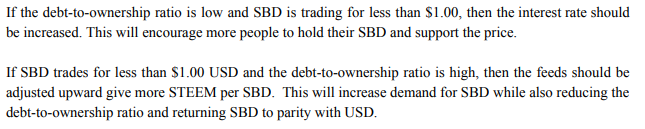
> Unless I am misreading, or not reading the current version of the whitepaper, maintaining the SBD -USD peg (or getting SBD back to the 1USD mark) is still important even above the 10% debt ratio
That literally makes no sense. It would block all conversions (certainly not desired) since the SBD price if kept at $1 would be well above the conversion target. It would also become increasing impossible/impractical if or when the STEEM price continued to decline. There is simply no way to peg to $1 as the STEEM market cap falls. The capacity to do so within a system of declining value just isn't there.
As I noted, the intent is to peg to STEEM rather than USD once beyond the limit. Again the white paper might need some edits.