Hello, Steemians! I Hope everyone is fine. Today, I will be discussing an experiment of calibration of the thermocouple.
Introduction
The accurate measurement of temperature is important in different fields. There are many methods to measure the temperature of various range. These measurement techniques depend upon the effect of temperature. The fluid expands when heated, this effect is used to make glass thermometer. Like this, the temperature difference between two dissimilar electrical conductors produces a voltage difference between the two conductors[1]. This is called Seebeck effect.
[IMAGE: https://upload.wikimedia.org/wikipedia/commons/1/10/Seebeck_effect_circuit.png]
wikimedia commons


The value of this voltage depends upon several factors including temperature. The pair of conductors of this sort is used to measure the temperature are called thermocouple. The produced voltage depends upon the type of thermocouple used. Higher the distance in thermoelectric series, higher is the voltage produced.
[IMAGE: https://www.electronics-cooling.com/wp-content/uploads/2006/11/2006_techdata_table1.jpg]
Source: electronics cooling
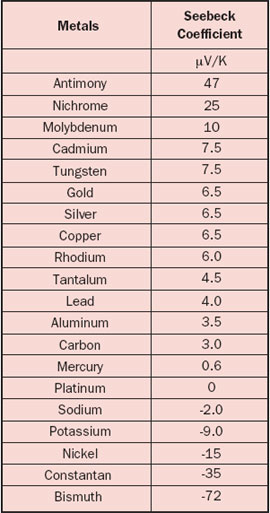
For example, the maximum voltage is produced if the thermocouple is Antimony-Bismuth.
We need to know two more effects to understand this experiment.
Peltier is just the reverse effect of Seebeck effect. It is the presence of heating or cooling at an electrified junction of two different conductors. When a current is made to flow through a junction between two conductors A and B, heat may be generated (or removed) at the junction[2].
The major difference between Thomson effect and other two is that in Thomson effect we deal with only single metallic rod and not with thermo-couple as in Peltier effect and Seebeck effect[3].
According to this effect, if a conductor has placed in varying temperature along its length and current is passed through it then it will absorb or evolve heat. Absorbing or evolving heat will depend on the direction of the current.
Relevent Equation
Peltier effect,
eA-eB = P (ӨA – Ө B) … (1)
Here P is Peltier coefficient.
Thompson’s Effect,
e1 = T1 (ӨA- ӨB) … (i)
e2 = T2 (ӨA – ӨB) … (ii)
From (i) and (ii)
e2 – e1 = (T2-T1)(ӨA – ӨB) … (2)
T1 and T2 are Thompson coefficient.
From (1) and (2)
eA-eB + e2 – e1 = (P+ T2 –T1)(ӨA – ӨB)
or, E = k (ӨA – ӨB)
Here, E = eA- eB + e2 – e1
And, k = (P+ T2 –T1)
eA - eB = potential difference between A and B
ӨA – ӨB = temperature difference between A and B
k = thermocouple constant
e2-e1 = potential difference from thompson effect
The equipment and accessory required to carry out this experiment are as follows:
i) TK294A Instrumentation module
ii) Heat bar
iii) Thermometer
iv) Calibration Tank
v) Transducer thermocouple and flying compensating lead
vi) Power Supply
vii) Multi-meter
Observational Table
Notch Number Tank Temperature(in ℃) Room Temperature (in ℃) Temperature Difference Voltmeter Reading(in V) TC emf (in mV) 2 95 27 68 2.520 0.002520 4 80 27 53 2.512 0.002512 6 71 27 44 2.000 0.002500 8 65 27 38 2.487 0.002487 10 59 27 32 2.481 0.002481 12 54 27 27 2.471 0.002471 14 50 27 23 2.457 0.002457 16 45 27 18 2.449 0.002449 18 42 27 15 2.446 0.002446 20 38 27 11 2.411 0.002411 22 34 27 7 2.400 0.002400Result
[IMAGE: https://i.imgur.com/HTZByz6.png]
thermocouple emf vs temperature difference

The slope of the approximating line = 2e-6 mV/℃
= 2e-3 μV/℃
It is the thermocouple constant.
Discussion
In this experiment, we calibrated the thermocouple. We observed different values of emf produced for different differences between two junctions. The emf so produced was small, so we amplified and observed using a voltmeter. The graph was drawn between produced emf and difference in temperature. In actual, the curve should be linear but in our practice, it has deviated from it. An equivalent line was used to approximate the curve and slope was calculated.
The difference in the ideal condition and practical was due to human error, inaccuracy to measure temperature by thermometer to a required limit, the sensitivity of the instrument etc.
Conclusion
It was concluded that the emf produced is dependent on the difference in the temperature between two junctions. By the above method, we can observe and calculate such phenomenon. Thermocouple constant can be calculated.
